Why Is Structural Health Monitoring Important for Bridges
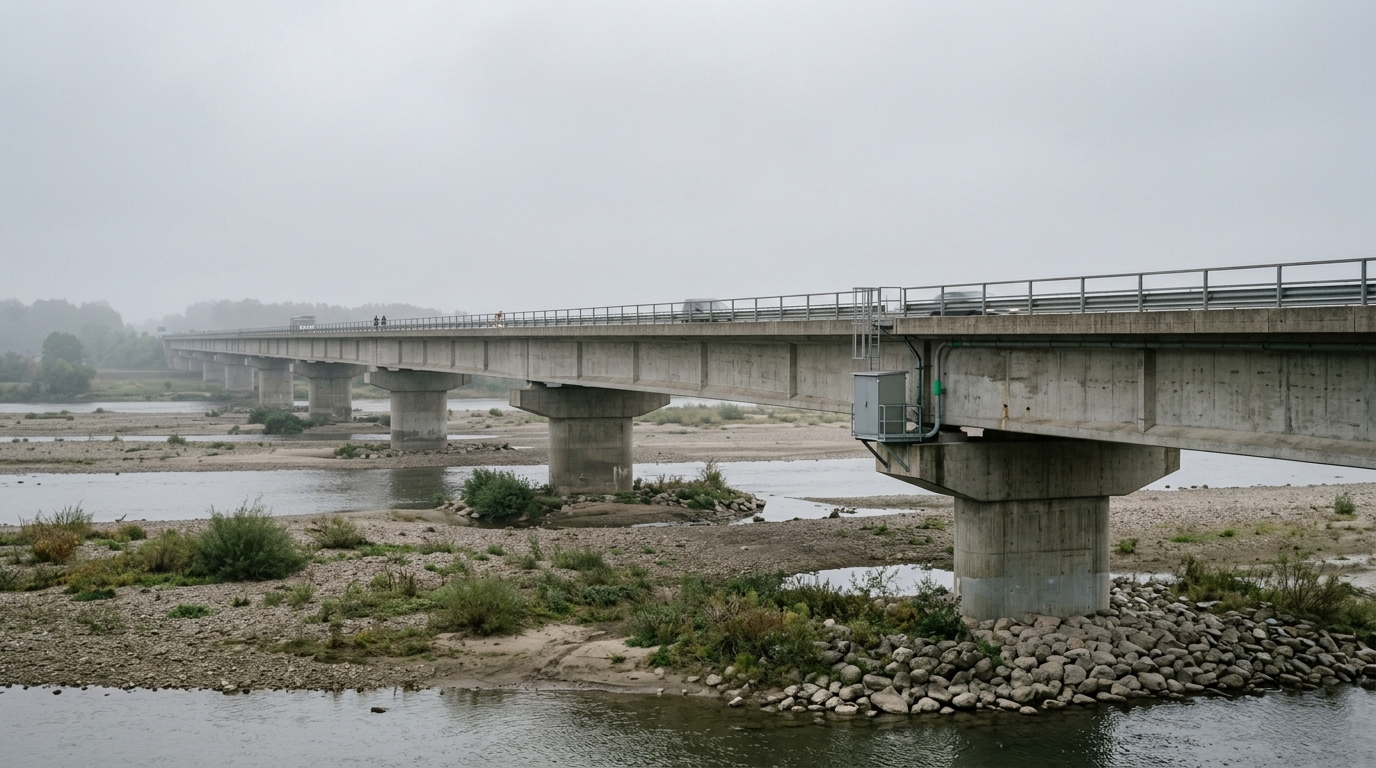
On 30 May 2016, the Majerhat Bridge in Kolkata showed visible distress signs for months before a section collapsed, killing three people and severing a critical arterial route for weeks. Post-incident investigations confirmed that no continuous structural monitoring was in place. Understanding why is structural health monitoring important for bridges is not an academic question — it is a matter of public safety, regulatory compliance, and asset lifecycle management for every bridge owner and engineer in India.
India's National Highways Authority manages over 1,500 bridges on the national highway network alone, while Indian Railways operates more than 1,45,000 bridges, many of them over 100 years old. IRC SP-35 and IRC SP-37 provide the technical framework for bridge inspection and maintenance, yet periodic visual inspection — conducted every one to five years — cannot capture the real-time strain accumulation, dynamic load effects, or sub-surface scour that precede most structural failures. Structural health monitoring (SHM) fills that gap with continuous, sensor-based data acquisition and automated alert thresholds.
This post examines the engineering case for bridge SHM importance, the failure modes it detects, the Indian regulatory context that mandates it, and the measurement parameters that matter most to practicing bridge engineers.
Key Takeaways
- Structural health monitoring for bridges is mandated by IRC SP-35 inspection frameworks and is increasingly specified in NHAI and RVNL project contracts for long-span and critical bridges.
- SHM detects failure precursors — micro-strain accumulation, dynamic deflection, bearing displacement, and scour depth — that visual inspection cannot quantify.
- Wireless DAQ systems and 3D digital twin platforms now enable remote, real-time monitoring of bridge response under live traffic and seismic loading.
- Indian bridge failure cases, including Majerhat (2016) and the Savitri River Bridge (2016), demonstrate that unmonitored deterioration leads to sudden collapse rather than gradual, visible decline.
- Bridge monitoring benefits extend beyond safety: they support evidence-based maintenance scheduling, load rating updates, and insurance and regulatory compliance.
What Structural Health Monitoring Means for a Bridge
Structural health monitoring for bridges is the continuous or periodic measurement, recording, and analysis of physical parameters — strain, deflection, acceleration, temperature, and corrosion potential — to assess the structural condition and remaining service life of a bridge under operational loads.
Unlike a visual inspection, which produces a qualitative rating at a single point in time, an SHM system generates time-series data at resolutions as fine as 1 ms, capturing dynamic events such as impact loads from overloaded vehicles, wind-induced vibration in cable-stayed spans, and seismic ground motion per IS 1893. The data feeds into alert logic that notifies engineers when any parameter crosses a pre-defined threshold — for example, when mid-span deflection under live load exceeds the IRC:112 serviceability limit of span/350, or when a vibrating wire strain gauge records micro-strain values outside the design envelope.
For a deeper look at the sensor technologies that make this possible, see our guide on SHM sensor types and their engineering comparison.
Indian Bridge Failures That Demonstrate the Cost of No Monitoring
The engineering record of Indian bridge failures provides the clearest argument for bridge SHM importance. Consider three cases:
Savitri River Bridge, Maharashtra (2016): A 100-year-old British-era bridge on NH-17 collapsed during the monsoon, killing over 28 people. The primary cause was scour at the pier foundations — a sub-surface process invisible to visual inspection but detectable with sonar-based scour sensors or piezometers monitoring pore-water pressure changes at the riverbed.
Majerhat Bridge, Kolkata (2016): Residents and commuters had reported visible cracks and spalling for months. Without continuous strain or acoustic emission monitoring, there was no quantitative trigger for emergency closure. A vibrating wire strain gauge array on the critical girder sections would have provided measurable evidence of load redistribution before collapse.
Nandigama Bridge, Andhra Pradesh (2009): Overloaded trucks repeatedly crossed a bridge rated for lower axle loads. Weigh-in-motion (WIM) sensors integrated into an SHM system can log each vehicle's gross vehicle weight and axle configuration, generating an automatic alert when loads exceed the IRC:6 design envelope.
These cases share a common thread: the failure mode was progressive, the precursor signals were physically present, and the absence of instrumentation meant no data existed to trigger intervention.
Why Is Structural Health Monitoring Important for Bridges: The Engineering Parameters
The answer to why is structural health monitoring important for bridges lies in the physical parameters that govern structural integrity but cannot be assessed by eye. The following are the primary measurement domains in a bridge SHM system:
Static and dynamic strain: Vibrating wire strain gauges and fibre Bragg grating (FBG) sensors measure strain in micro-strain (με) at critical sections — mid-span, pier tops, and cable anchorages. For a prestressed concrete bridge designed to IRC:112, the allowable tensile strain in the extreme fibre under service loads is tightly bounded; continuous monitoring detects when traffic-induced strain accumulation approaches that boundary.
Deflection and displacement: Linear variable differential transformers (LVDTs) and total-station-based displacement sensors measure vertical deflection in millimetres. For a simply supported span of 30 m, the IRC:112 deflection limit under live load is approximately 85 mm; an SHM system flags exceedances in real time.
Acceleration and modal frequency: MEMS or piezoelectric accelerometers measure vibration in mm/s² or g. A shift in the fundamental natural frequency of a bridge — even 2–3% — can indicate stiffness loss from cracking, bearing deterioration, or section loss due to corrosion. This is the basis of vibration-based damage detection, widely validated in academic literature.
Bearing and expansion joint movement: Displacement transducers on elastomeric or pot bearings measure movement in mm, detecting bearing lock-up or excessive rotation that redistributes load to unintended structural elements.
Scour depth: Sonar sensors or buried magnetic sliding collars monitor riverbed elevation at pier foundations, providing the earliest warning of the most common cause of bridge collapse in India during monsoon season.
Corrosion potential: Half-cell potential sensors embedded in reinforced concrete piers measure electrochemical potential in millivolts (mV), indicating the probability of active rebar corrosion per ASTM C876 thresholds, which are referenced in Indian practice under IS 13311.
Geolook supplied bridge health monitoring accessories to IIT-Mandi for an instrumented bridge study, providing vibrating wire sensors and data acquisition hardware for academic-grade structural response measurement in a seismically active Himalayan corridor — a context where IS 1893 Zone IV seismic demands make continuous dynamic monitoring especially critical.
Bridge Monitoring Benefits: Comparison of Monitored vs. Unmonitored Asset Management
The bridge monitoring benefits become concrete when comparing the asset management outcomes of instrumented versus uninstrumented bridges across key engineering and operational dimensions.
| Dimension | Unmonitored Bridge | SHM-Instrumented Bridge |
|---|---|---|
| Failure detection | Visual inspection every 1–5 years; qualitative rating only | Continuous sensor data; automated alerts within seconds of threshold breach |
| Scour monitoring | Post-monsoon visual survey; scour depth unknown during flood | Real-time sonar or magnetic collar data; pier scour depth in metres, updated continuously |
| Load effect measurement | Design-stage assumptions; no as-operated load history | WIM sensors log actual axle loads in kN; IRC:6 compliance verified continuously |
| Maintenance scheduling | Calendar-based or post-distress; reactive | Condition-based; maintenance triggered by measured deterioration indices |
| Seismic response | Post-earthquake inspection; damage extent unknown until surveyed | Accelerometers record peak ground acceleration (PGA) and structural response; IS 1893 compliance assessed from data |
| Remaining service life | Engineering judgement from visual condition; high uncertainty | Fatigue accumulation models fed by measured strain cycles; quantified remaining life in years |
| Regulatory and contractual compliance | IRC SP-35 inspection records; no real-time data trail | Continuous data archive supports NHAI, RVNL, and MoRTH audit requirements |
For a detailed technical walkthrough of how these parameters are measured on national highway bridges, read our post on how does bridge health monitoring work for national highways in india.
Digital Twin Integration and Remote Monitoring Platforms
Modern bridge SHM importance extends beyond sensor data to the analytical layer that makes data actionable. A 3D digital twin of a bridge — a parametric structural model updated continuously with live sensor readings — allows engineers to visualise stress distribution, deflection profiles, and modal shapes in near real time, without being physically present at the structure.
Geolook developed a 3D Digital Twin and VR Visualization Platform for Bridge Health Monitoring in collaboration with RITES Ltd, a Government of India PSU under the Ministry of Railways. The platform integrates sensor streams from vibrating wire gauges, accelerometers, and displacement transducers into a navigable 3D model, enabling remote condition assessment and anomaly detection by engineers located anywhere in India. This is particularly relevant for bridges in remote or difficult-access locations — Himalayan highway bridges, long-span river crossings, and railway viaducts in tribal and forested corridors.
Separately, Neeladari Buildtech deployed a wireless DAQ system for a bridge health monitoring installation, demonstrating that cable-free sensor networks can achieve the data fidelity required for structural assessment without the civil works cost and maintenance burden of wired installations.
Explore the full range of real time bridge monitoring sensors india to understand the hardware ecosystem behind these platforms.
Cable-Stayed and Long-Span Bridges: Elevated Monitoring Requirements
Cable-stayed and extra-dosed bridges present monitoring challenges that go beyond what standard periodic inspection can address. Cable tension varies with temperature, traffic load, and long-term relaxation; a change of even 5 kN in a stay cable force can indicate anchorage slip or wire fracture. Vibration-based cable force measurement — using the taut-string relationship between natural frequency and tension — allows non-contact force estimation from accelerometer data alone.
Geolook's Strategic Advisor Sandeep Gupta, IRSE, former Chief Administrative Officer of Indian Railways, brings direct domain expertise in cable-stayed and extra-dosed bridge engineering. His advisory input informs Geolook's monitoring specifications for long-span railway bridges, where dynamic amplification factors under moving train loads (as specified in IRS Bridge Rules and IRC:6) demand higher sensor sampling rates — typically 200 Hz or above — than highway bridge applications.
For long-span bridges in seismic zones III and IV per IS 1893, the SHM system must also capture the bridge's response to ground motion, including deck acceleration in mm/s², pier base shear, and bearing displacement. This data is essential for post-earthquake rapid assessment — determining whether a bridge can remain open to emergency traffic within hours of a seismic event, rather than waiting days for a manual inspection team to reach the site.
Regulatory Framework: IRC, MoRTH, and the Dam Safety Act Analogy
India's regulatory environment for bridge monitoring is evolving rapidly. IRC SP-35 (Guidelines for Inspection and Maintenance of Bridges) establishes the inspection frequency and condition rating methodology for highway bridges, but it does not yet mandate continuous SHM for all bridges. However, NHAI project contracts for major bridges — particularly those over 60 m span or crossing navigable waterways — increasingly include SHM as a contractual deliverable, with data submission to the NHAI Regional Office as part of the operations and maintenance obligation.
The Dam Safety Act 2021 provides a useful regulatory analogy: it mandates instrumentation and monitoring for all large dams in India, with penalties for non-compliance. A similar legislative trajectory for critical bridges is anticipated as India's bridge inventory ages and the economic cost of unplanned closures becomes more visible to policymakers.
IRC:114 (Guidelines for Seismic Design of Road Bridges) and IRC:78 (Standard Specifications and Code of Practice for Road Bridges — Foundations and Substructure) together define the design parameters that an SHM system must monitor to verify ongoing compliance. When a bridge's measured response deviates from its IRC:114 design assumptions — for example, when recorded pier base acceleration during a seismic event exceeds the design PGA — the SHM data provides the engineering basis for a load rating review or structural intervention.
Learn more about the full range of transport infrastructure monitoring solutions that address these regulatory requirements across highway and railway bridge portfolios.
Implementing Bridge SHM: Practical Considerations for Asset Owners
For bridge engineers and asset owners evaluating an SHM deployment, the following practical considerations determine system effectiveness:
- Sensor placement strategy: Sensors must be located at sections of maximum stress demand — mid-span for bending, pier tops for shear and moment, cable anchorages for tension. Finite element model results from the design stage, or a calibrated as-built model, should guide placement. IRC:112 and IRC:6 load combinations define the critical load cases that sensor placement must cover.
- Data acquisition rate: Static monitoring of settlement or long-term strain drift requires sampling at 1–10 Hz. Dynamic monitoring for impact loads, seismic events, or cable vibration requires 100–1,000 Hz. The DAQ system must support both modes, with triggered high-rate capture on event detection.
- Communication and power: Remote bridges require solar-powered wireless nodes with GPRS or 4G telemetry. Wireless DAQ systems, as deployed by Neeladari Buildtech for bridge monitoring, eliminate the cable routing challenges that make wired installations impractical on long-span or water-crossing structures.
- Alert thresholds and escalation protocols: Thresholds must be set from the design envelope, not arbitrary values. A strain alert at 80% of the design allowable gives engineers time to investigate before a limit state is reached. Escalation protocols — from automated SMS to site inspection to load restriction — must be defined before system commissioning.
- Data ownership and archiving: NHAI and RVNL contracts typically require data to be stored for the full concession period. Cloud-based platforms with redundant storage and role-based access control are the standard architecture for compliance.
For a comprehensive evaluation of available systems, see our analysis of the best bridge health monitoring system in india.
Frequently Asked Questions
Q: Why is structural health monitoring important for bridges specifically, compared to other structures?
A: Structural health monitoring is especially important for bridges because bridges carry dynamic, unpredictable traffic loads over water or difficult terrain, making periodic visual inspection insufficient to detect progressive failure modes such as fatigue cracking, scour, or bearing deterioration. Unlike buildings, bridges cannot be evacuated and closed for extended inspection without severe economic and social disruption, making continuous sensor-based monitoring the only practical safety assurance mechanism.
Q: Which Indian Standard codes govern bridge SHM instrumentation requirements?
A: IRC SP-35 governs bridge inspection and maintenance procedures in India, while IRC:6 defines design live loads, IRC:112 covers reinforced and prestressed concrete bridge design, IRC:78 addresses foundation design, and IRC:114 specifies seismic design requirements. SHM sensor thresholds and alert levels should be derived from the serviceability and ultimate limit states defined in these codes, ensuring that monitoring data is directly interpretable against the bridge's design basis.
Q: What sensors are used in a bridge health monitoring system?
A: A bridge health monitoring system typically uses vibrating wire strain gauges (measuring in micro-strain), LVDT or total-station displacement sensors (measuring in mm), MEMS or piezoelectric accelerometers (measuring in mm/s² or g), half-cell potential sensors for corrosion monitoring (in mV), sonar or magnetic collar scour sensors, and weigh-in-motion sensors for axle load measurement in kN. The specific sensor suite depends on the bridge type, span, and the failure modes considered most critical.
Q: How does a digital twin improve bridge SHM outcomes?
A: A digital twin improves bridge SHM outcomes by integrating live sensor data into a calibrated 3D structural model, allowing engineers to visualise stress distribution and deflection profiles remotely rather than relying on raw data tables. RITES Ltd's 3D Digital Twin and VR Visualization Platform for Bridge Health Monitoring, developed with Geolook, demonstrates how this approach enables rapid condition assessment and anomaly detection for bridge portfolios managed from a central operations centre.
Q: What is the bridge monitoring benefit for maintenance cost management?
A: The primary bridge monitoring benefit for maintenance cost management is the shift from calendar-based to condition-based maintenance scheduling. When SHM data shows that strain levels, bearing displacement, or corrosion potential remain within acceptable bounds, maintenance interventions can be deferred without compromising safety. Conversely, when sensor data indicates accelerating deterioration, targeted repairs can be executed before a minor defect becomes a structural failure requiring full bridge closure and emergency reconstruction.
Assess bridge needs
Every bridge has a unique structural configuration, loading history, and environmental exposure. The right SHM system — sensor types, sampling rates, communication architecture, and alert thresholds — must be engineered to match the specific failure modes and regulatory obligations of each structure.
Geolook's bridge monitoring team, supported by domain expertise in cable-stayed, extra-dosed, and long-span railway bridges, works with NHAI concessionaires, RVNL project managers, state PWD engineers, and EPC contractors to specify, supply, and commission SHM systems that meet IRC, MoRTH, and project-specific requirements.
To discuss your bridge's monitoring requirements — whether for a new project specification, a retrofit on an existing structure, or a digital twin integration — contact Geolook's bridge SHM engineering team or explore our full bridge structural health monitoring product range.
Project inquiry
Talk to a Geolook™ specialist
Share your monitoring requirement and our team will help identify the right next step.
By submitting, you agree that Geolook™ may contact you about this inquiry. Your details are not added to a marketing list.