How Does Bridge Health Monitoring Work for National Highways in India?
In 2016, the collapse of a colonial-era bridge on the Savitri River in Mahad, Maharashtra, resulted in the loss of 28 lives, prompting the Ministry of Road Transport and Highways (MoRTH) to accelerate the implementation of the Indian Bridge Management System (IBMS). Understanding how does bridge health monitoring work for national highways in India is no longer a matter of academic interest but a regulatory mandate for ensuring the structural integrity of over 1,72,000 bridges across the national highway network. According to the Indian Roads Congress (IRC) Special Publication SP-35, systematic monitoring is essential to detect distress before it manifests as catastrophic failure.
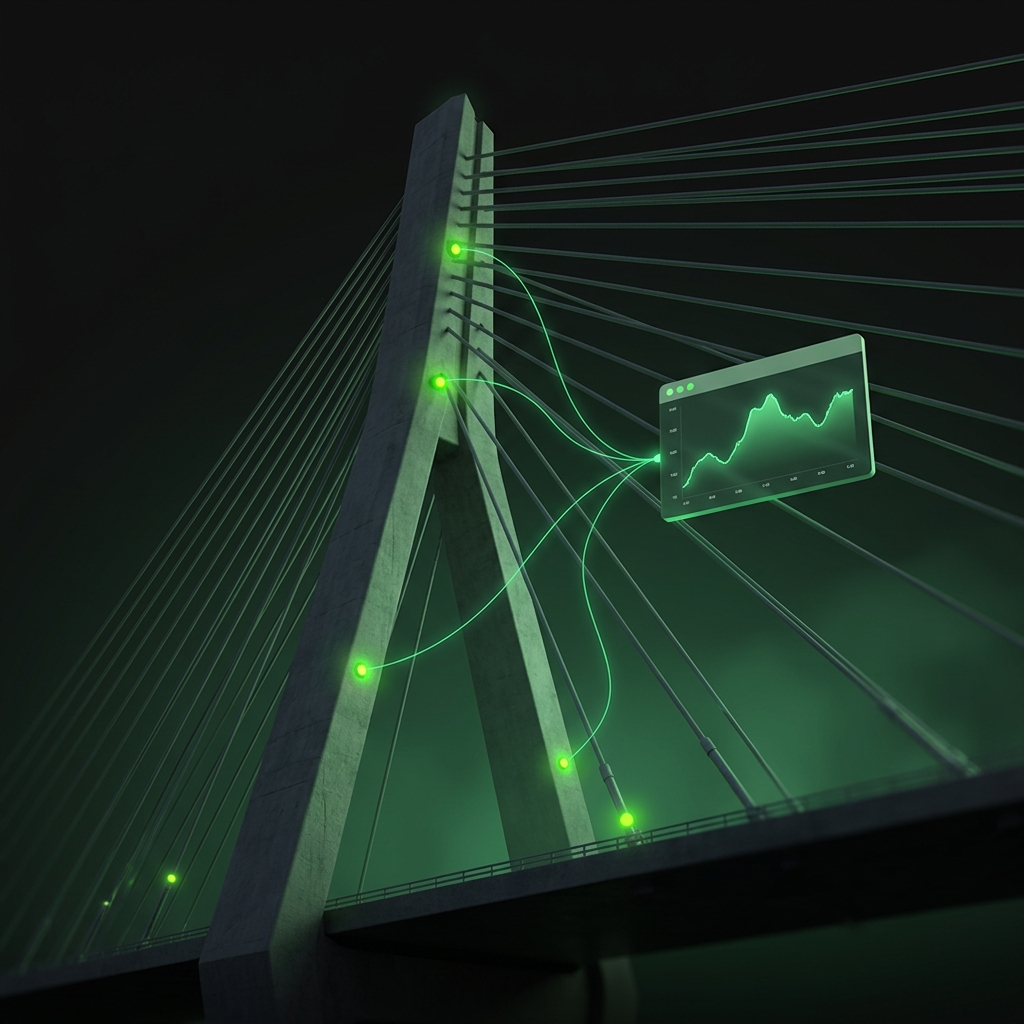
Structural Health Monitoring (SHM) for bridges involves a continuous, automated process of data collection and analysis. Unlike periodic manual inspections, which may occur only once or twice a year, SHM provides high-frequency data on physical parameters such as strain, tilt, vibration, and displacement. For decision-makers at NHAI or RITES, this data serves as a quantitative basis for maintenance scheduling and life-cycle cost optimization. By integrating bridge monitoring solutions, engineers can transition from reactive repairs to predictive maintenance, aligning with the standards set by IRC:114 for the management of concrete bridges.
The Regulatory Framework: IBMS and IRC Standards
The process of monitoring bridges in India is governed by the Indian Bridge Management System (IBMS), which is the largest digital database of bridges in the world. The IBMS categorizes bridges based on their structural condition and socio-economic importance. For national highways, the monitoring protocols must adhere to IRC:SP-35 (Guidelines for Inspection and Maintenance of Bridges) and IRC:SP-37 (Guidelines for Evaluation of Load Carrying Capacity of Bridges). These codes specify the types of distress to be monitored, including carbonation, chloride ingress, and reinforcement corrosion.
For complex structures such as cable-stayed or extra-dosed bridges, the monitoring requirements are even more stringent. Under the strategic guidance of experts like Sandeep Gupta, IRSE (former CAO Indian Railways), Geolook emphasizes the importance of specialized monitoring for long-span structures. These bridges require real-time tracking of stay-cable tension and pylon verticality to ensure they remain within the design limits specified in IRC:112. The integration of SHM data into the IBMS allows for a centralized view of the health of the entire highway network, enabling MoRTH to prioritize funding for the most critical structures.
Step 1: Sensor Deployment and Data Acquisition
The first step in the bridge monitoring process is the installation of a sensor network tailored to the bridge's typology. For a standard RCC T-beam bridge, this typically includes strain gauges on the main girders, tiltmeters on the piers, and accelerometers on the deck. In projects like the SHM sensor types comparison, we see that the choice of sensor depends on the specific engineering objective. For instance, vibrating wire strain gauges are preferred for long-term stability in harsh Indian climates, while MEMS-based accelerometers are used for dynamic vibration analysis.
- Strain Monitoring: Sensors measure the internal deformation of concrete or steel members in micro-strain units.
- Tilt and Inclination: Biaxial tiltmeters detect pier settlement or rotation in degrees or mm/m.
- Vibration Analysis: Accelerometers capture the natural frequency of the bridge in Hz, which changes if structural stiffness degrades.
- Environmental Factors: Anemometers and temperature sensors correlate structural movements with wind loads and thermal expansion.
Geolook has supplied bridge monitoring accessories to IIT-Mandi, supporting academic research into how these sensors perform under varying load conditions. The data from these sensors is collected by a Data Acquisition System (DAQ). For remote highway locations, Neeladari Buildtech has utilized wireless DAQ systems to transmit data without the need for extensive cabling, reducing installation time and costs.
Step 2: Real-Time Data Transmission and Processing
Once the sensors capture the physical signals, the DAQ converts these analog signals into digital data. This data is transmitted via GSM, GPRS, or satellite links to a centralized server. In the context of national highways, real-time bridge data India allows for immediate alerts if a parameter exceeds a pre-defined threshold. For example, if a pier tilts beyond 0.5 degrees, an automated SMS or email notification is sent to the project manager and the NHAI regional office.
The processing stage involves filtering noise from the raw data to identify true structural trends. This is particularly important for bridges subjected to heavy traffic loads and seismic activity. By following IS 1893 (Part 3) for seismic evaluation, the monitoring system can distinguish between normal traffic vibrations and seismic events. The processed data is then stored in a secure cloud environment, providing a historical record of the bridge's performance over time, which is invaluable for forensic engineering if distress is later discovered.
Step 3: Digital Twin and VR Visualization
Modern bridge health monitoring goes beyond simple graphs and tables. For RITES Ltd, Geolook developed a 3D Digital Twin and VR Visualization Platform for Bridge Health Monitoring Systems. A digital twin is a virtual replica of the physical bridge that updates in real-time based on sensor data. This allows engineers to visualize stress concentrations and deformation patterns in a 3D environment, making it easier to identify potential problem areas.
Virtual Reality (VR) integration takes this a step further by allowing decision-makers to conduct virtual inspections. This is especially useful for bridges in inaccessible terrains, such as the Himalayan region or over large river bodies. By using the SHM software platform, stakeholders can 'walk' through the digital model and see real-time data overlays on specific structural components. This level of visualization improves the speed and accuracy of decision-making, ensuring that maintenance resources are directed where they are most needed.
Step 4: Structural Integrity Assessment and Reporting
The final step in the process is the interpretation of data to assess the bridge's overall health. This involves comparing the observed behavior with the design model and historical baseline. Engineers look for deviations in natural frequencies or permanent sets in strain readings that might indicate fatigue or structural damage. Regular reports are generated, summarizing the bridge's condition in accordance with the IBMS rating system.
For EPC contractors like L&T or Tata Projects, these reports provide proof of structural performance during the defect liability period. In more complex scenarios, such as the Ramban-Banihal NH-44 project where Geolook monitors tunnels and associated structures, the data helps in managing the risks associated with slope stability and convergence. By documenting the structural response to environmental and live loads, the monitoring system provides a 'health certificate' for the bridge, extending its service life and ensuring the safety of the commuting public.
Comparison of Bridge Monitoring Methodologies
| Parameter | Visual Inspection (Traditional) | Automated SHM (Modern) | Digital Twin Integration |
|---|---|---|---|
| Data Frequency | Annual or Bi-annual | Continuous (Real-time) | Continuous + Predictive |
| Accuracy | Subjective/Qualitative | Objective/Quantitative | High-fidelity Simulation |
| Detection of Hidden Flaws | Limited to Surface | Detects Internal Strain | Full Structural Analysis |
| Regulatory Compliance | Basic IBMS Requirement | Enhanced IRC:SP-35 | Advanced Digital Mandate |
| Cost Impact | High Long-term (Reactive) | Optimized (Proactive) | Lowest Life-cycle Cost |
Frequently Asked Questions
Q: What is the primary purpose of bridge health monitoring?
A: Bridge health monitoring is a systematic process of using sensors to continuously track the structural integrity and performance of a bridge. It aims to detect early signs of distress, such as cracks or settlement, to prevent catastrophic failures and optimize maintenance schedules according to IRC:SP-35 standards for national highway safety.
Q: How does the Indian Bridge Management System (IBMS) use SHM data?
A: The IBMS uses SHM data to assign a structural condition rating to bridges across the national highway network. This quantitative data allows MoRTH and NHAI to prioritize repair works and budget allocations based on the actual physical condition of the assets rather than just their age or visual appearance.
Q: Which sensors are most commonly used for bridge monitoring in India?
A: Common sensors include vibrating wire strain gauges for measuring internal stress, MEMS tiltmeters for pier inclination, and accelerometers for dynamic vibration analysis. These sensors are often supplemented by displacement transducers and environmental sensors to provide a comprehensive view of the bridge's response to traffic and weather loads.
Q: Can SHM systems be installed on existing old bridges?
A: Yes, SHM systems can be retrofitted onto existing bridges to monitor their remaining service life and structural stability. For older structures, monitoring is often focused on specific areas of concern, such as corrosion of reinforcement or pier scour, helping engineers decide between rehabilitation or replacement based on real-time data.
Q: What role does a Digital Twin play in bridge monitoring?
A: A Digital Twin is a real-time virtual model of the bridge that integrates sensor data to simulate structural behavior. It allows engineers to visualize stress patterns and perform 'what-if' scenarios, such as the impact of increased heavy vehicle traffic, providing a superior decision-making tool compared to traditional 2D reports.
See live bridge demo
Geolook provides end-to-end structural health monitoring solutions that transform raw sensor data into actionable engineering intelligence. From supplying accessories to IIT-Mandi to developing 3D Digital Twin platforms for RITES Ltd, our expertise ensures your infrastructure meets the highest safety standards. Explore our transport infrastructure solutions or contact our technical team to see a live demonstration of our bridge monitoring dashboard.
Project inquiry
Talk to a Geolook™ specialist
Share your monitoring requirement and our team will help identify the right next step.
By submitting, you agree that Geolook™ may contact you about this inquiry. Your details are not added to a marketing list.