What Sensors Are Used for Real-Time Structural Monitoring of Bridges in India?
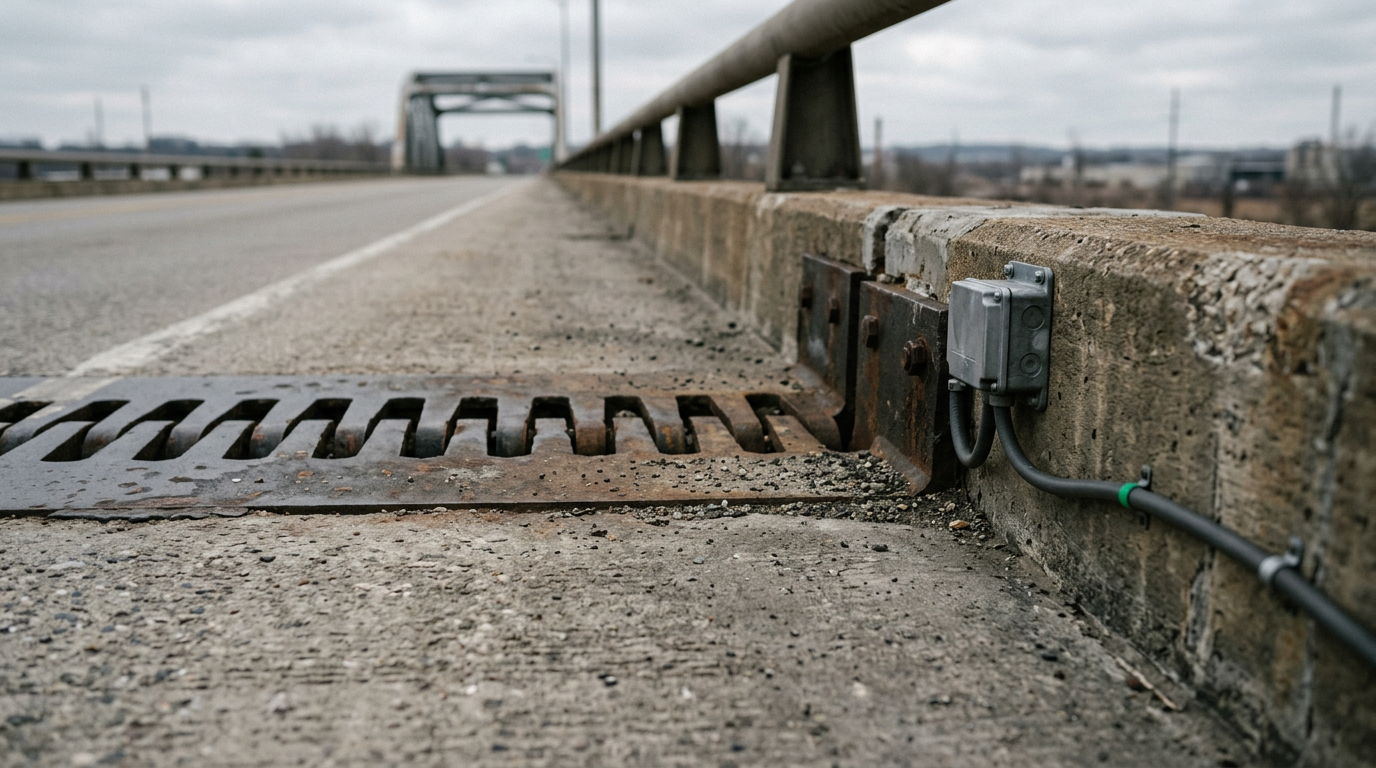
In August 2016, the Majerhat Bridge in Kolkata showed visible distress for months before its partial collapse in 2018 claimed three lives and disrupted a critical arterial corridor — a failure that the West Bengal government's inquiry attributed partly to the absence of continuous structural surveillance. Understanding what sensors are used for real-time structural monitoring of bridges in India is no longer an academic question; it is a procurement and engineering mandate. IRC SP-35 and the emerging framework under IRC:114 both recognise instrumentation as a core component of bridge asset management, and agencies such as NHAI, RITES, and RVNL are increasingly specifying sensor-based health monitoring systems in their project contracts. This guide maps every major sensor category, its measurand, its typical specification range, and the Indian infrastructure context in which it is deployed.
Key Takeaways
- Real-time bridge structural monitoring in India typically integrates six to eight sensor types simultaneously, each measuring a distinct physical parameter — strain, displacement, acceleration, tilt, crack width, or temperature.
- IRC SP-35 and IRC:114 provide the Indian regulatory framework for bridge inspection and instrumentation; IS 1893 governs seismic demand calculations that determine accelerometer placement and range.
- Vibrating-wire strain gauges remain the dominant technology for long-term embedment in concrete bridge elements due to their drift-free, frequency-based output.
- Wireless data acquisition systems, as deployed by Geolook for Neeladari Buildtech's bridge health monitoring project, reduce cabling cost and enable remote access to sensor data without compromising measurement integrity.
- RITES Ltd has engaged Geolook for a 3D Digital Twin and VR Visualization Platform for bridge health monitoring, illustrating how sensor data feeds into higher-order analytics and digital twin environments.
What Real-Time Structural Monitoring of Bridges Means
Real-time structural monitoring of bridges is the continuous, automated measurement of physical parameters — strain, displacement, acceleration, tilt, and temperature — using permanently installed sensors connected to a data acquisition system that transmits readings at defined intervals, typically 1 Hz to 100 Hz depending on the measurand, enabling engineers to detect anomalies before they become failures.
This is distinct from periodic visual inspection under IRC SP-35, which relies on trained inspectors visiting a structure at intervals of one to five years. Continuous monitoring captures dynamic events — seismic excitation, heavy vehicle impact, flood scour — that a scheduled inspection will never observe. For long-span structures such as cable-stayed and extra-dosed bridges, where load redistribution is complex and fatigue accumulation is a design-life concern, real-time data is the only reliable basis for condition assessment. Sandeep Gupta, IRSE, former Chief Administrative Officer of Indian Railways and Strategic Advisor at Geolook, has noted that cable-stayed and extra-dosed bridges demand sensor strategies that account for both static load effects and dynamic cable tension variation — a dual requirement that shapes sensor selection from the outset.
For a broader introduction to the discipline, see why is structural health monitoring important for bridges.
Vibrating-Wire Strain Gauges: The Workhorse of Bridge Sensors India
The vibrating-wire (VW) strain gauge is the most widely specified bridge sensor in India for embedded concrete applications. It measures micro-strain by detecting the resonant frequency of a tensioned steel wire; because frequency is an absolute quantity unaffected by cable resistance drift, VW gauges maintain calibration over multi-decade service lives without the zero-drift that plagues resistive foil gauges in humid or thermally variable environments.
Typical specification ranges for embedment-type VW strain gauges used in bridge decks and pier caps are: measurement range ±3,000 to ±5,000 micro-strain; resolution 1 micro-strain; operating temperature −20 °C to +80 °C; gauge length 150 mm to 200 mm. A thermistor is usually co-located within the gauge body to allow temperature-corrected strain readings, which is essential when ambient temperature swings exceed 15 °C — a common condition on NH-44 bridges in Jammu and Kashmir or on viaducts crossing the Thar Desert in Rajasthan.
IIT-Mandi engaged Geolook for bridge health monitoring accessories supply, a project that required VW strain gauges capable of surviving the freeze-thaw cycles and seismic activity characteristic of the western Himalayan zone. Embedment gauges were specified to IRC:112 concrete cover requirements, ensuring that sensor installation did not compromise the structural section.
Explore Geolook's vibrating-wire embedment strain gauge specifications and datasheets for full technical parameters.
Accelerometers for Bridge Dynamic Response and Seismic Monitoring
An accelerometer bridge sensor measures the dynamic acceleration of a structural element — typically in units of mm/s² or g — and is the primary instrument for modal analysis, seismic response recording, and vehicle-induced vibration assessment. In Indian bridge monitoring practice, accelerometers serve two distinct functions: ambient vibration testing to extract natural frequencies and mode shapes, and continuous seismic monitoring under IS 1893 Part 1 and Part 3 requirements for bridges in Seismic Zones III, IV, and V.
MEMS-based accelerometers are now widely used for permanent installation because they offer flat frequency response from DC to several hundred Hz, low power consumption, and digital output compatible with standard DAQ systems. Piezoelectric accelerometers are preferred where high-frequency impact events — such as rail traffic on railway bridges — must be captured above 1 kHz. Typical specification parameters: measurement range ±2 g to ±10 g for ambient vibration; ±2 g to ±50 g for seismic; noise floor below 1 µg/√Hz for sensitive modal work; sampling rate 100 Hz to 1,000 Hz.
For cable-stayed bridges, accelerometers are mounted at mid-span and quarter-span of the deck, at the pylon head, and on individual stay cables to monitor cable tension indirectly through vibration frequency — a technique validated in published literature and referenced in MORTH guidelines for long-span bridge inspection.
Displacement and Settlement Sensors: LVDT, Tiltmeters, and Crack Meters
Displacement measurement in bridge monitoring covers three distinct physical phenomena: relative movement between structural elements (measured by LVDTs or wire-draw transducers), absolute tilt of piers and abutments (measured by biaxial tiltmeters), and crack propagation in concrete or steel elements (measured by vibrating-wire or resistive crack meters).
LVDTs (Linear Variable Differential Transformers) are used at expansion joints, bearing seats, and mid-span deflection points. Resolution is typically 0.01 mm over ranges of ±25 mm to ±150 mm. For long-span bridges where thermal expansion of a 200-metre span can reach 40–60 mm, the sensor range must be selected with a margin above the calculated thermal movement per IRC:6 temperature load combinations.
Biaxial tiltmeters monitor pier verticality and abutment rotation. Resolution of 0.001° (approximately 0.017 mrad) is standard; operating range is typically ±15° to ±30°. Tiltmeter data is particularly critical for bridges on expansive soils or in areas of known ground movement, where differential settlement can induce bearing uplift or girder misalignment.
Vibrating-wire crack meters measure joint opening or crack width to a resolution of 0.025 mm over a range of 0 to 50 mm. They are embedded across pre-identified crack planes in concrete piers, abutments, and deck soffits, and are specified under IS 13311 Part 1 for ultrasonic pulse velocity cross-referencing during initial condition assessment.
For a comprehensive view of how these sensors integrate into a complete monitoring architecture, see SHM sensor types comparison for civil infrastructure.
Piezometers, Load Cells, and Environmental Sensors
A complete bridge health monitoring system extends beyond structural response sensors to include geotechnical and environmental instruments that capture the boundary conditions driving structural behaviour.
Vibrating-wire piezometers are installed in bridge foundations and approach embankments to monitor pore water pressure during flood events. Scour — the leading cause of bridge failure in India according to CWC flood damage records — is preceded by elevated pore pressure and bed-level change. Piezometers with a range of 0 to 500 kPa and resolution of 0.1 kPa are standard for river-crossing bridges on alluvial foundations. IRC:78 specifies foundation design requirements, and piezometer data provides the real-time boundary condition against which design assumptions can be validated.
Load cells at bearing positions measure the actual vertical reaction force at each support, typically in the range of 500 kN to 10,000 kN depending on span and superstructure type. Bearing load cells are particularly valuable on skewed bridges and curved ramp structures where load distribution deviates significantly from simple beam theory.
Environmental sensors — including temperature sensors, relative humidity sensors, and anemometers — provide the context needed to separate thermally induced strain from mechanically induced strain, and to correlate wind speed with deck acceleration on long-span structures. Temperature sensors embedded in concrete elements also feed into maturity calculations during post-tensioning operations on prestressed concrete bridges per IS 1343.
Wireless Data Acquisition and Telemetry for Bridge Monitoring Systems
Sensor data is only as useful as the system that collects, transmits, and stores it. In Indian bridge monitoring deployments, data acquisition systems (DAQ) must handle multi-channel synchronous sampling, on-board signal conditioning, and reliable telemetry over distances that can exceed several kilometres on river-crossing or mountain-pass bridges.
Geolook supplied a wireless DAQ system for Neeladari Buildtech's bridge health monitoring project, demonstrating that wireless architectures can eliminate the cabling vulnerabilities — rodent damage, water ingress at conduit joints, and voltage drop over long cable runs — that have historically compromised wired installations on remote bridges. Wireless nodes typically operate on 2.4 GHz or sub-GHz ISM bands, with mesh networking protocols that maintain data continuity even if individual nodes lose line-of-sight to the gateway.
RITES Ltd engaged Geolook to develop a 3D Digital Twin and VR Visualization Platform for Bridge Health Monitoring System, integrating live sensor streams with a geometric model of the bridge to enable remote condition assessment by engineers who may be hundreds of kilometres from the structure. This architecture — sensor → DAQ → cloud → digital twin — represents the current state of practice for government-owned bridge assets in India.
Learn more about how these systems are deployed across national highway infrastructure at how does bridge health monitoring work for national highways in india.
Bridge Sensor Comparison: Measurand, Technology, and Specification Matrix
The table below summarises the primary sensor types used in real-time structural monitoring of bridges in India, their measurands, typical specification ranges, and the Indian Standard or agency guideline most relevant to their application. This matrix is intended to support procurement specification writing and sensor selection during detailed design.
| Sensor Type | Measurand | Typical Range | Resolution | Output / Technology | Relevant Indian Standard / Guideline | Typical Bridge Application |
|---|---|---|---|---|---|---|
| VW Embedment Strain Gauge | Strain (micro-strain) | ±3,000 to ±5,000 µε | 1 µε | Frequency (Hz), VW | IRC:112, IRC SP-35 | Deck slab, pier cap, prestressed girder |
| MEMS Accelerometer | Acceleration (mm/s², g) | ±2 g to ±10 g | <1 µg/√Hz | Digital (I²C / SPI / 4–20 mA) | IS 1893 Part 3, IRC:6 | Deck mid-span, pylon, stay cables |
| Biaxial Tiltmeter | Rotation (°, mrad) | ±15° to ±30° | 0.001° | 4–20 mA / RS-485 | IRC:78, IRC SP-35 | Pier verticality, abutment rotation |
| LVDT / Wire-Draw Transducer | Displacement (mm) | ±25 mm to ±150 mm | 0.01 mm | Analog voltage / 4–20 mA | IRC:6 (thermal loads), IRC:112 | Expansion joints, bearing seats, mid-span deflection |
| VW Crack Meter | Crack width / joint opening (mm) | 0 to 50 mm | 0.025 mm | Frequency (Hz), VW | IS 13311 Part 1 | Concrete pier cracks, deck soffit, abutment joints |
| VW Piezometer | Pore water pressure (kPa) | 0 to 500 kPa | 0.1 kPa | Frequency (Hz), VW | IRC:78, CWC scour guidelines | Foundation, approach embankment |
| Bearing Load Cell | Vertical reaction force (kN) | 500 kN to 10,000 kN | 0.1% FS | Strain gauge bridge / 4–20 mA | IRC:6, IRC:112 | Bearing positions on all support types |
| Anemometer | Wind speed (m/s) | 0 to 60 m/s | 0.1 m/s | Pulse / 4–20 mA | IRC:6 (wind loads) | Long-span deck, pylon top |
For a detailed guide to sensor selection across bridge types, visit real time bridge monitoring sensors india.
Sensor Placement Strategy for Cable-Stayed and Extra-Dosed Bridges
Cable-stayed and extra-dosed bridges present a sensor placement challenge that does not arise on simply supported or continuous girder bridges: the structural system is highly indeterminate, load paths change with cable tension variation, and the dynamic behaviour of the deck is coupled to the dynamic behaviour of the cables and the pylon. Sandeep Gupta, IRSE, Strategic Advisor at Geolook with direct experience in cable-stayed and extra-dosed bridge engineering on the Indian Railways network, emphasises that sensor plans for these structures must be developed from a modal analysis model, not from a generic checklist.
Key placement principles for cable-stayed bridges: accelerometers at deck quarter-points and mid-span in three axes (longitudinal, transverse, vertical); VW strain gauges at the pylon base and pylon head where bending moment is maximum under asymmetric live load; load cells or vibrating-wire force transducers at cable anchorages to monitor tension directly; tiltmeters at the pylon top to detect any permanent lean that could indicate foundation movement. For extra-dosed bridges, where the cable profile is shallower and the deck carries a larger proportion of the load in bending, embedment strain gauges in the deck cross-section at mid-span and at the deviator saddle locations are critical.
See the full product range for bridge instrumentation at Geolook bridge monitoring sensor systems.
Frequently Asked Questions
Q: What sensors are used for real-time structural monitoring of bridges in India?
A: Real-time structural monitoring of bridges in India uses vibrating-wire strain gauges, MEMS accelerometers, biaxial tiltmeters, LVDTs, vibrating-wire crack meters, piezometers, bearing load cells, and environmental sensors such as anemometers and temperature probes. Each sensor targets a specific measurand — strain in micro-strain, acceleration in mm/s², displacement in mm, or pressure in kPa — and feeds data to a centralised or wireless DAQ system.
Q: What is a vibrating-wire strain gauge and why is it preferred for bridge monitoring?
A: A vibrating-wire strain gauge measures structural strain by detecting the resonant frequency of a tensioned steel wire embedded in or bonded to a structural element. It is preferred for long-term bridge monitoring because its frequency-based output is immune to cable resistance drift, making it stable over multi-decade service lives in humid, thermally variable Indian environments without recalibration.
Q: How are accelerometers used in bridge structural health monitoring?
A: An accelerometer in bridge structural health monitoring measures dynamic acceleration of the deck, pylon, or cables — typically in mm/s² or g — to extract natural frequencies, detect mode shape changes, and record seismic response. Placement follows IS 1893 Part 3 seismic zone requirements and is guided by a modal analysis model of the specific bridge geometry and span configuration.
Q: Which Indian Standard codes govern bridge sensor instrumentation and monitoring?
A: Bridge sensor instrumentation in India is governed by IRC SP-35 for inspection and maintenance, IRC:6 for load combinations including thermal and seismic, IRC:78 for foundation design and scour, IRC:112 for concrete bridge elements, and IRC:114 for the emerging seismic design framework. IS 1893 Part 3 applies to seismic instrumentation, and CWC guidelines govern scour and piezometer requirements at river crossings.
Q: What is the difference between wired and wireless DAQ systems for bridge health monitoring?
A: A wired DAQ system connects sensors to a central logger via shielded cables, offering high data reliability but requiring extensive conduit installation and being vulnerable to cable damage over long bridge spans. A wireless DAQ system uses radio-frequency nodes to transmit sensor data, reducing installation cost and eliminating cable-related failure modes, making it well-suited to remote or long-span bridge sites where cable runs would exceed several hundred metres.
Compare sensor specs
Selecting the right sensor combination for a bridge health monitoring system depends on bridge type, span, seismic zone, foundation condition, and the data acquisition architecture available on site. Geolook's engineering team works with consulting engineers and procurement leads at NHAI, RITES, RVNL, and EPC contractors to develop sensor schedules, DAQ specifications, and digital twin integration plans tailored to each structure.
To review full technical datasheets, measurement ranges, and installation specifications for Geolook's bridge monitoring sensor range, or to request a sensor schedule for your project, contact Geolook's bridge instrumentation team. You can also explore the complete transport infrastructure monitoring solutions portfolio for highway, railway, and urban bridge applications.
Project inquiry
Talk to a Geolook™ specialist
Share your monitoring requirement and our team will help identify the right next step.
By submitting, you agree that Geolook™ may contact you about this inquiry. Your details are not added to a marketing list.