Real-Time Bridge Monitoring Sensors: Selection Guide for Indian Highways
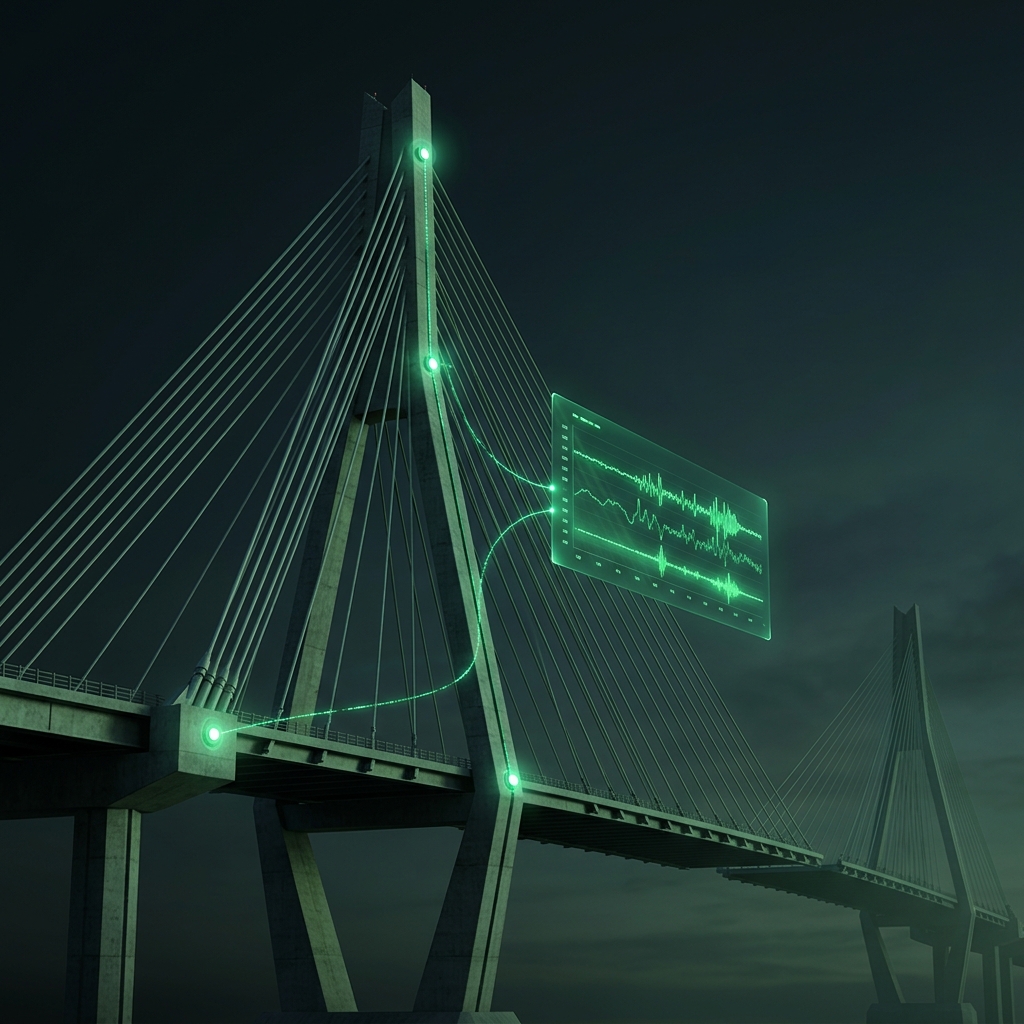
According to the Ministry of Road Transport and Highways (MoRTH), India manages a network of over 173,000 bridges, many of which are exceeding their design life of 50 to 100 years. The collapse of the Majerhat Bridge in 2018 and the Morbi suspension bridge in 2022 underscored the critical necessity for continuous, automated structural health monitoring (SHM) systems. For EPC contractors and NHAI consultants, transitioning from periodic visual inspections to bridge health monitoring systems is no longer optional but a regulatory mandate under IRC:SP:35 and IRC:114 guidelines.
Structural health monitoring relies on the precise conversion of physical phenomena—strain, displacement, vibration, and tilt—into digital signals. In the Indian context, where ambient temperatures can fluctuate by 40°C and monsoon-induced scour is a constant threat, sensor selection must prioritize long-term stability and signal integrity. This guide details the technical specifications of real time bridge monitoring sensors india requires for high-performance infrastructure intelligence.
The Role of IRC SP-35 and IRC 114 in Sensor Selection
The Indian Roads Congress (IRC) provides the foundational framework for bridge instrumentation. IRC:SP:35 (Guidelines for Inspection and Maintenance of Bridges) and IRC:114 (Guidelines for Seismic Design of Road Bridges) dictate the parameters that must be monitored to ensure public safety. For extra-dosed and cable-stayed bridges, the complexity of load distribution requires a higher density of vibrating wire bridge sensors and accelerometers.
Geolook, under the strategic guidance of Sandeep Gupta (IRSE), former CAO of Indian Railways and an expert in cable-stayed and extra-dosed bridge engineering, emphasizes that sensor placement must align with the bridge's influence lines. Whether monitoring a 30-metre RCC girder or a 500-metre cable-stayed span, the instrumentation plan must account for dead loads, live loads, and environmental factors such as wind speed and thermal expansion as per IRC:6 loading standards.
Primary Sensor Types for Bridge Health Monitoring
Effective SHM requires a multi-modal sensor array. Each sensor type addresses a specific structural vulnerability:
- Vibrating Wire Strain Gauges: These are the industry standard for long-term monitoring of concrete and steel members. They operate on the principle that the resonant frequency of a tensioned wire changes with the strain of the substrate. They are preferred for their immunity to electrical noise and long-term stability in harsh Indian climates.
- MEMS Accelerometers: Used for dynamic characterization, these sensors measure the natural frequencies and damping ratios of the bridge. Significant shifts in these frequencies often indicate structural degradation or loss of stiffness.
- Tiltmeters and Inclinometers: Essential for monitoring pier stability and abutment rotation. High-precision MEMS tiltmeters can detect changes as small as 0.001 degrees, providing early warning of foundation settlement or scour-induced instability.
- Linear Variable Differential Transformers (LVDT): Used for measuring expansion joint movement and crack propagation with sub-millimetre accuracy.
Geolook has supplied critical bridge health monitoring accessories to IIT-Mandi, supporting academic and field research into sensor reliability and data fusion techniques for Indian infrastructure.
Wireless Data Acquisition and Connectivity
The shift from manual data logging to real-time telemetry is driven by the need for immediate actionable intelligence. Wireless Data Acquisition Systems (DAQ) eliminate the need for extensive cabling, which is often prone to damage during construction or by local fauna. For instance, Neeladari Buildtech utilized wireless DAQ systems for bridge health monitoring to ensure seamless data transmission from remote pier locations to a centralized gateway.
In high-stakes environments like the Ramban-Banihal NH-44 project, where Geolook deployed real-time SHM across five tunnels in association with DRAIPL, the integration of sensor data into a unified dashboard allowed NHAI regional offices to monitor convergence and structural integrity in real-time. This same principle applies to bridges, where LoRaWAN or 4G/5G connectivity ensures that data reaches the cloud with minimal latency.
Digital Twins and VR Visualization in SHM
Modern bridge management goes beyond simple data plots. The integration of 3D Digital Twins allows engineers to visualize sensor data within a spatial context. Geolook developed a 3D Digital Twin and VR Visualization Platform for RITES Ltd, specifically designed for bridge health monitoring systems. This platform enables stakeholders to perform virtual inspections and simulate load scenarios based on real-time sensor inputs.
Furthermore, immersive training platforms, such as those delivered by Geolook and MIT-WPU for BRO officers at the College of Military Education, Pune, ensure that the personnel responsible for maintaining these bridges are proficient in interpreting complex sensor data. This synergy between hardware and advanced visualization is the future of SHM sensor types comparison and implementation.
Technical Comparison of Bridge Monitoring Sensors
Selecting the right sensor involves balancing precision, durability, and cost. The following table compares the primary technologies used in Indian highway projects.
| Sensor Type | Primary Parameter | Typical Range | Resolution | Best Use Case |
|---|---|---|---|---|
| Vibrating Wire Strain Gauge | Micro-strain (με) | 3000 με | 0.1 με | Long-term static strain in concrete/steel |
| MEMS Accelerometer | Acceleration (mg) | ±2g to ±5g | 0.01 mg | Dynamic vibration and modal analysis |
| Electrolytic Tiltmeter | Rotation (arc-sec) | ±0.5° | 1 arc-sec | High-precision pier tilt monitoring |
| Potentiometric Displacement | Linear Movement (mm) | 0-150 mm | 0.01 mm | Expansion joint and bearing movement |
| Fiber Bragg Grating (FBG) | Strain/Temp | 10,000 με | 1.0 με | EMI-heavy environments or long distances |
Installation Protocols and Calibration
The reliability of a bridge health monitoring system is only as good as its installation. Sensors must be bonded or embedded according to manufacturer specifications and IS codes. For vibrating wire sensors, initial "zero" readings must be taken at a stable temperature to establish a baseline. In steel structures, spot welding or bolting is common, while in concrete, sensors are often tied to the rebar cage before pouring.
Calibration is another critical factor. Sensors should be calibrated against national standards (NABL accredited labs) to ensure that the kPa or MPa readings reflected on the dashboard are accurate. Regular validation of the DAQ system ensures that signal attenuation over long cable runs does not compromise data quality.
Data Analytics and Threshold Management
Raw data from real time bridge monitoring sensors india must be processed into meaningful metrics. This involves filtering environmental noise—such as temperature-induced strain—from structural strain. Advanced algorithms can set multi-level thresholds: Alert (Level 1), Action (Level 2), and Alarm (Level 3).
When a sensor detects a parameter exceeding the Level 3 threshold, such as a sudden increase in vibration mm/s2 or a significant tilt in kPa equivalent pressure, the system automatically notifies NHAI or EPC project managers. This proactive approach prevents catastrophic failures and allows for targeted maintenance, extending the bridge's service life as per IRC:112 durability requirements.
Frequently Asked Questions
Q: What are the primary sensors required for a bridge health monitoring system?
A: A bridge health monitoring system typically requires vibrating wire strain gauges for static load analysis, MEMS accelerometers for dynamic vibration monitoring, and tiltmeters for pier stability. Additionally, displacement transducers monitor expansion joints, while anemometers and temperature sensors provide environmental context. These sensors work in unison to provide a comprehensive view of structural integrity and safety.
Q: How do vibrating wire sensors handle the high temperatures found in India?
A: Vibrating wire sensors are inherently stable in high-temperature environments because they measure frequency rather than voltage. Most industrial-grade vibrating wire sensors include an internal thermistor to measure temperature simultaneously. This allows engineers to apply thermal correction factors to the strain data, ensuring that expansion caused by heat is not mistaken for structural stress.
Q: What is the difference between static and dynamic bridge monitoring?
A: Static monitoring focuses on slow-changing parameters like long-term settlement, creep, and thermal expansion using strain gauges and tiltmeters. Dynamic monitoring captures high-frequency events such as traffic loads, wind gusts, and seismic activity using accelerometers. Both are essential for a complete SHM strategy, as static data indicates long-term health while dynamic data reveals immediate structural response.
Q: Are wireless sensors reliable for large-span bridges like cable-stayed structures?
A: Wireless sensors are highly reliable for large-span bridges when using robust protocols like LoRaWAN or mesh networking. These systems overcome the challenges of long cable runs, which are susceptible to lightning strikes and signal degradation. By using localized gateways and high-gain antennas, wireless DAQs can transmit data across several kilometers, making them ideal for complex highway infrastructure.
Q: How does IRC:SP:35 influence the design of an instrumentation plan?
A: IRC:SP:35 provides the guidelines for the inspection and maintenance of bridges, emphasizing the need for objective data to supplement visual inspections. It influences the instrumentation plan by defining the critical components that require monitoring, such as bearings, expansion joints, and primary load-carrying members. Following these guidelines ensures that the SHM system meets Indian regulatory and safety standards.
Request sensor datasheet
Geolook provides end-to-end instrumentation and monitoring solutions for NHAI, RITES, and major EPC contractors. Our technical team, supported by the expertise of Sandeep Gupta (IRSE), ensures that your bridge monitoring project adheres to the highest engineering standards and IRC codes.
To receive detailed technical specifications for our vibrating wire sensors, wireless DAQ systems, or digital twin platforms, please contact our engineering team today for a consultation or to request a sensor datasheet.
Project inquiry
Talk to a Geolook™ specialist
Share your monitoring requirement and our team will help identify the right next step.
By submitting, you agree that Geolook™ may contact you about this inquiry. Your details are not added to a marketing list.