Bridge Structural Monitoring: End-to-End Guide
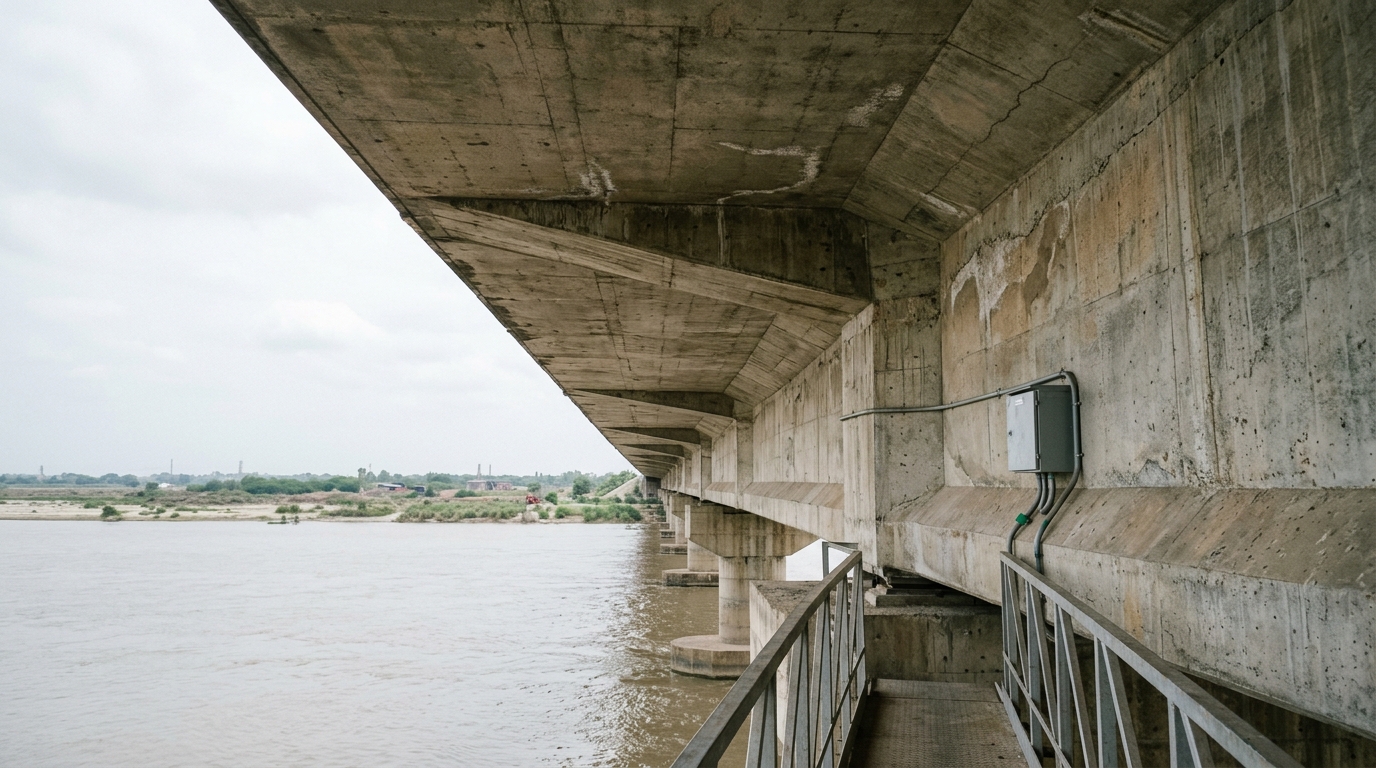
In August 2016, the Majerhat Bridge in Kolkata showed visible distress signals for months before its partial collapse killed three people and disrupted a major arterial corridor for over a year. Post-incident investigations confirmed that no instrumented monitoring programme was in place. India operates more than 1.5 lakh bridges on its national and state highway network, and IRC SP-35 explicitly calls for systematic inspection and monitoring of bridges — yet instrumented bridge structural monitoring remains the exception rather than the rule on most corridors. For engineers and project managers responsible for these assets, that gap is both a technical problem and a liability.
This guide walks through every stage of a bridge structural monitoring programme — from sensor selection and installation to datalogger configuration, telemetry, and the bridge data dashboard — with reference to applicable Indian Standards, agency mandates, and real deployments.
Key Takeaways
- Bridge structural monitoring is mandated under IRC SP-35 and increasingly required by NHAI, RITES, and RVNL for long-span and critical bridges.
- A complete SHM bridge system integrates sensors, signal conditioning, dataloggers, telemetry, and a cloud or on-premise bridge data dashboard into a single data pipeline.
- Sensor selection depends on bridge typology: strain gauges and accelerometers for girder bridges; tiltmeters, displacement transducers, and anemometers for cable-stayed and extra-dosed spans.
- Wireless DAQ systems reduce installation cost and civil works on operational bridges without compromising data fidelity at sampling rates up to 1000 Hz.
- Digital twin integration — as demonstrated in Geolook's engagement with RITES Ltd for a 3D Digital Twin and VR Visualization Platform for Bridge Health Monitoring — enables predictive maintenance and regulatory reporting from a single interface.
What Is Bridge Structural Monitoring?
Bridge structural monitoring is the continuous or periodic measurement of physical parameters — strain, deflection, vibration, crack width, tilt, temperature, and load — across a bridge structure to assess its real-time condition, detect anomalies, and support maintenance decisions in accordance with design limits and applicable codes such as IRC:6, IRC:112, and IRC SP-35.
Unlike visual inspection, which is periodic and subjective, an instrumented bridge monitoring system captures quantitative data at defined intervals — from quasi-static readings every few minutes to dynamic acceleration data sampled at hundreds of hertz during traffic or seismic events. This data forms the evidentiary basis for remaining useful life assessments, load rating revisions, and intervention scheduling.
The discipline sits at the intersection of structural engineering, geotechnical instrumentation, electronics, and data science. IRC SP-37 provides guidance on load testing of bridges, and the data collected during such tests is most reliably captured through a calibrated SHM bridge instrumentation system rather than manual gauging.
Sensor Layer: Selecting the Right Instruments for Each Bridge Type
No single sensor suite fits every bridge. The selection process begins with the structural typology, the dominant failure modes identified in the design basis, and the monitoring objectives — whether proof-of-concept load testing, long-term condition monitoring, or seismic event capture.
For reinforced and prestressed concrete girder bridges governed by IRC:112, the primary parameters are flexural strain at mid-span and support sections, rebar corrosion potential, and crack propagation. Vibrating wire strain gauges embedded in the concrete or surface-mounted on steel elements provide stable long-term readings with drift below 1 micro-strain per year under controlled conditions. Crack meters with a resolution of 0.001 mm track discrete crack widths against the permissible limits in IS 456 and IRC:112.
For cable-stayed and extra-dosed bridges — a typology where Geolook's Strategic Advisor Sandeep Gupta, IRSE and former CAO of Indian Railways, brings direct domain expertise — the sensor suite expands significantly. Load cells or vibrating wire force transducers on stay cables measure axial force variations caused by live load, temperature differential, and cable relaxation. Anemometers at deck and pylon level capture wind speed and direction for flutter and vortex-induced vibration analysis. Biaxial tiltmeters at pylon bases and expansion joints monitor differential settlement and rotation, with typical resolution requirements of 0.001°. MEMS or servo accelerometers at deck mid-span and quarter-points capture dynamic response with flat frequency response from DC to 200 Hz or higher.
For railway bridges under RVNL and Indian Railways jurisdiction, IS 1893 Part 3 governs seismic design, and the monitoring system must capture both quasi-static train loading effects and dynamic impact factors. Strain gauges on rail seats and cross-girders, combined with wheel-load detectors, provide the data needed to validate design assumptions against actual traffic loading.
IIT-Mandi's bridge health monitoring programme, for which Geolook supplied instrumentation accessories, operates in a seismically active zone (Zone IV per IS 1893), making accelerometer placement and trigger thresholds particularly critical. Neeladari Buildtech's deployment of a wireless DAQ system for a bridge health monitoring system demonstrates that cable-free sensor networks can achieve the data integrity required for structural assessment even in remote or operationally constrained sites.
Explore the full range of bridge structural monitoring instruments and sensor packages available for different bridge typologies and project scales.
Signal Conditioning and Datalogger Configuration
Raw sensor output — whether millivolt bridge signals from vibrating wire gauges, 4–20 mA current loops from pressure transducers, or digital MEMS outputs — must be conditioned, digitised, and time-stamped before transmission. The datalogger is the central node in this chain.
Key datalogger specifications for a bridge monitoring system include: input channel count (typically 16 to 64 differential channels for a medium-span bridge), sampling rate (1 Hz for quasi-static parameters; 200–1000 Hz for dynamic channels), analogue-to-digital resolution (minimum 24-bit for vibrating wire and strain channels), onboard storage (sufficient for at least 30 days of data at full sampling rate in the event of communication loss), and operating temperature range (−20°C to +70°C for exposed bridge environments).
Channel multiplexing must be configured to avoid cross-talk between high-impedance vibrating wire channels and low-impedance current-loop channels. Excitation voltage stability directly affects strain gauge accuracy; a regulated 5 V ± 0.1% excitation is standard for full-bridge configurations. For dynamic channels, anti-aliasing filters set at half the Nyquist frequency prevent spectral folding in the frequency domain analysis used for modal identification.
For wireless deployments, the datalogger integrates a radio module — typically 900 MHz or 2.4 GHz — with mesh networking capability to route data around obstructions common on long-span bridges. Power is supplied by solar panels with battery backup sized for at least 72 hours of autonomous operation, a requirement that becomes critical during monsoon periods when solar irradiance drops and inspection access is restricted.
Review Geolook's industrial-grade dataloggers for structural health monitoring to understand channel configurations, sampling rates, and communication options suited to bridge deployments.
Telemetry, Communication Architecture, and Data Transmission
Data transmission from bridge sites to a central server or cloud platform must be reliable, low-latency, and secure. The communication architecture choice depends on site connectivity, data volume, and the criticality of near-real-time alerting.
On national highway corridors with 4G coverage, cellular modems with dual-SIM failover provide the most practical solution. Data is transmitted via MQTT or HTTP/S protocols to a cloud server, with local buffering on the datalogger ensuring no data loss during connectivity interruptions. For remote bridges — such as those on NH-44 in J&K or high-altitude crossings managed by BRO — satellite communication (VSAT or BGAN) may be the only viable option, with transmission intervals set to 15–60 minutes to manage bandwidth costs.
For bridges within a campus or port environment, fibre-optic backbone with Ethernet-connected dataloggers offers the highest bandwidth and immunity to electromagnetic interference from heavy equipment. Fibre also serves as the physical medium for distributed fibre-optic sensing (DFOS) systems using Brillouin or Rayleigh scattering, which can measure strain and temperature along the entire length of a cable or embedded fibre at spatial resolutions of 0.5 m — particularly valuable for long-span bridges where discrete sensor placement would be impractical.
Cybersecurity is a non-negotiable requirement for government-owned bridge monitoring systems. Data encryption (TLS 1.2 or higher), role-based access control, and audit logging are baseline requirements for NHAI and RITES-procured platforms. The RITES 3D Digital Twin and VR Visualization Platform for Bridge Health Monitoring System, developed in collaboration with Geolook, incorporates these security layers alongside its visualisation and analytics stack.
Bridge Data Dashboard: From Raw Readings to Actionable Intelligence
A bridge data dashboard is the interface through which engineers, asset managers, and regulatory bodies interact with the monitoring data. Its design determines whether the investment in sensors and dataloggers translates into maintenance decisions or remains an archive of unused numbers.
An effective dashboard for a bridge monitoring system presents data at three levels of abstraction. At the raw data level, engineers can access time-series plots of any channel, apply filters, and export data in standard formats (CSV, HDF5) for offline analysis in MATLAB, Python, or SAP2000. At the processed data level, the dashboard displays derived parameters: natural frequencies from FFT analysis of accelerometer data, influence lines from strain gauge arrays, and displacement envelopes from LVDT or total-station data. At the alert level, the system compares processed parameters against threshold values defined in the monitoring plan — typically set at 70% and 90% of the design limit state — and triggers SMS, email, or API-based notifications to responsible engineers.
Digital twin integration elevates the dashboard from a monitoring tool to a decision-support system. A 3D model of the bridge, updated with real sensor data, allows engineers to visualise stress distributions, identify anomalous zones, and run what-if scenarios — for example, assessing the structural response to an overloaded vehicle or a seismic event of specified PGA. The RITES engagement with Geolook for a 3D Digital Twin and VR Visualization Platform for Bridge Health Monitoring System exemplifies this integration at a government PSU level, combining sensor data streams with BIM geometry and VR visualisation for inspection training and condition assessment.
Learn more about Geolook's SHM software platform and bridge data dashboard capabilities for real-time monitoring and digital twin integration.
For a broader view of how monitoring integrates across transport infrastructure, see Geolook's structural health monitoring solutions for transport infrastructure.
Sensor-to-Dashboard Process: Stage-by-Stage Workflow
A complete bridge structural monitoring programme follows a defined sequence from project inception to operational monitoring. The stages below represent the engineering workflow that governs system design, installation, commissioning, and ongoing operation.
- Monitoring Objective Definition: Identify the structural parameters of concern — deflection under live load, natural frequency shift, cable force variation, crack growth — and set threshold values referenced to IRC:6 load combinations and IRC:112 serviceability limits.
- Sensor Layout Design: Determine sensor type, quantity, and location based on finite element model output. Critical sections — mid-span, quarter-span, support zones, pylon bases — receive priority. The layout is documented in a Monitoring Instrumentation Plan (MIP).
- Civil Works and Installation: Surface preparation, embedment, or attachment of sensors per manufacturer specifications and IS 13311 guidance on non-destructive testing where applicable. Cable routing in conduit or wireless node placement with line-of-sight verification.
- Datalogger Configuration and Calibration: Channel assignment, excitation voltage setting, sampling rate programming, and factory calibration verification. Each sensor's calibration certificate is logged against its channel ID.
- Communication Setup and Testing: SIM provisioning, server endpoint configuration, firewall rules, and end-to-end data transmission test. Latency and packet loss are measured and documented.
- Baseline Data Acquisition: A minimum 30-day baseline period under normal traffic and environmental conditions establishes the reference state for anomaly detection. Seasonal temperature effects on strain readings — typically 10–15 micro-strain per °C for steel elements — are characterised during this phase.
- Dashboard Configuration and Alert Thresholds: Channel naming, unit conversion, derived parameter formulas, and alert threshold entry. User accounts with role-based access are created for the bridge owner, maintenance engineer, and regulatory reviewer.
- Operational Monitoring and Reporting: Continuous data acquisition with automated daily health checks. Monthly condition reports and annual structural assessment reports are generated from dashboard exports, fulfilling IRC SP-35 documentation requirements.
Monitoring Parameters by Bridge Typology: A Comparison
The table below compares the primary monitoring parameters, typical sensor types, and applicable Indian Standards across five common bridge typologies encountered on Indian national highways, railways, and urban expressways.
| Bridge Typology | Primary Monitoring Parameters | Typical Sensors | Sampling Rate (typical) | Applicable Indian Standard / Code |
|---|---|---|---|---|
| RC Girder (simply supported) | Mid-span deflection, flexural strain, crack width, bearing settlement | LVDT, vibrating wire strain gauge, crack meter, settlement point | 1 Hz (quasi-static) | IRC:112, IRC SP-35, IS 456 |
| Prestressed Concrete Box Girder | Tendon force loss, camber change, shear strain at diaphragms, temperature gradient | Vibrating wire load cell, tiltmeter, embedded thermocouple, strain gauge | 1–10 Hz | IRC:112, IRC:18, IRC SP-35 |
| Steel Truss / Plate Girder | Axial and bending strain, fatigue cycle count, connection slip, corrosion potential | Foil strain gauge (full bridge), MEMS accelerometer, half-cell potential probe | 100–500 Hz (dynamic) | IRC:24, IRC:6, IS 800 |
| Cable-Stayed / Extra-Dosed | Stay cable force, pylon tilt, deck flutter, wind speed/direction, temperature differential | Vibrating wire force transducer, biaxial tiltmeter, servo accelerometer, anemometer | 200–1000 Hz (dynamic) | IRC:6, IRC SP-35, IS 1893 Part 3 |
| Railway Bridge (open/ballasted deck) | Rail seat strain, impact factor, bearing displacement, dynamic amplification factor | Strain gauge on cross-girder, wheel-load detector, LVDT at bearings | 500–1000 Hz (dynamic) | IRS Bridge Rules, IS 1893 Part 3, IRC:6 |
For cable-stayed and extra-dosed bridge monitoring — where dynamic parameter capture and cable force trending are most demanding — the expertise of Geolook's Strategic Advisor Sandeep Gupta, IRSE, informs both sensor layout design and threshold-setting methodology based on long-span railway bridge engineering practice.
Regulatory and Compliance Context for Indian Bridge Owners
Bridge owners and concessionaires operating under NHAI, RVNL, RITES, or state PWD mandates face an evolving compliance landscape. IRC SP-35 (Guidelines for Inspection and Maintenance of Bridges) requires periodic inspection at defined intervals and documentation of structural condition. For bridges on national highways, NHAI's standard concession agreements increasingly include provisions for instrumented monitoring on major crossings, particularly those with spans exceeding 60 m or located in seismic zones III, IV, or V per IS 1893.
The Dam Safety Act 2021, while primarily applicable to dams, has prompted parallel discussions within MoRTH and the Ministry of Railways about mandatory SHM for critical bridge infrastructure — a regulatory direction that bridge owners should anticipate in procurement planning. RITES, as a technical consultancy arm of the Ministry of Railways, has already moved in this direction through its 3D Digital Twin and VR Visualization Platform for Bridge Health Monitoring System, setting a precedent for PSU-level adoption of integrated monitoring and visualisation.
For bridges in seismically active zones — including the Himalayan belt, the Andaman Islands, and parts of the Northeast — IS 1893 Part 3 governs the seismic design of bridges, and post-earthquake structural assessment requires pre-event baseline data that only a continuous bridge monitoring system can provide. Without a baseline, post-event inspection is qualitative at best.
Understand how structural health monitoring is important for bridges from a regulatory and lifecycle cost perspective.
For a detailed look at sensor technologies deployed on Indian highway bridges, see real time bridge monitoring sensors india — a technical reference covering sensor types, installation methods, and data quality considerations.
Implementation Considerations: Wireless vs. Wired Bridge Monitoring Systems
The choice between wired and wireless data acquisition architecture has significant implications for installation cost, data reliability, and long-term maintenance on operational bridges. Neither architecture is universally superior; the decision depends on bridge length, traffic management constraints, power availability, and the required sampling rate for dynamic channels.
Wired systems using shielded twisted-pair cable or fibre-optic backbone offer the lowest signal noise floor and support the highest sampling rates without latency. They are preferred for dynamic monitoring applications — flutter analysis, seismic event capture, train-induced vibration — where data integrity at 500 Hz or above is non-negotiable. The primary constraint is cable installation on operational bridges, which often requires lane closures, conduit drilling through structural members, and ongoing cable maintenance against UV degradation and rodent damage.
Wireless DAQ systems, such as those deployed by Neeladari Buildtech for a bridge health monitoring system in collaboration with Geolook, eliminate cable runs between sensor nodes and the central datalogger. This reduces installation time and civil works cost significantly on long or operationally constrained bridges. Modern wireless nodes achieve synchronisation accuracy of ±1 ms using GPS or IEEE 1588 PTP, sufficient for modal analysis and influence line measurement. The practical upper limit for wireless dynamic sampling is typically 200–500 Hz per node, which covers most civil engineering monitoring requirements outside of high-frequency fatigue analysis.
Battery life and solar charging reliability are the primary operational risks for wireless systems. Node power budgets must account for worst-case monsoon irradiance and maximum transmission duty cycle. A minimum 72-hour battery autonomy at full operation is a standard design requirement for bridge sites in India.
Read about how bridge health monitoring works for national highways in India, including procurement pathways and NHAI compliance requirements.
Frequently Asked Questions
Q: What is a bridge structural monitoring system and what does it measure?
A: A bridge structural monitoring system is an integrated network of sensors, dataloggers, communication hardware, and software that continuously measures physical parameters — including strain (micro-strain), deflection (mm), vibration (mm/s²), tilt (degrees), crack width (mm), and cable force (kN) — to assess a bridge's structural condition against design limits defined in codes such as IRC:112 and IRC:6.
Q: Which Indian Standard codes govern bridge structural monitoring in India?
A: IRC SP-35 (Guidelines for Inspection and Maintenance of Bridges) is the primary reference for bridge monitoring programmes in India. IRC:6 governs loads, IRC:112 covers concrete bridge design limits, and IS 1893 Part 3 applies to seismic monitoring requirements. For railway bridges, IRS Bridge Rules and IS 1893 Part 3 apply alongside RITES and Indian Railways technical specifications.
Q: How does a bridge data dashboard generate structural alerts?
A: A bridge data dashboard generates structural alerts by comparing processed sensor data — such as computed mid-span deflection, natural frequency, or cable force — against pre-set threshold values defined in the monitoring plan. Thresholds are typically set at 70% and 90% of the design limit state. When a threshold is crossed, the system sends automated SMS, email, or API notifications to designated engineers.
Q: What is the difference between wired and wireless bridge monitoring systems?
A: Wired bridge monitoring systems use shielded cable or fibre-optic connections between sensors and dataloggers, offering the lowest noise floor and supporting sampling rates above 500 Hz for dynamic applications. Wireless systems eliminate cable runs, reducing installation cost and civil works on operational bridges, but are typically limited to 200–500 Hz per node and require solar power with battery backup sized for at least 72 hours of autonomous operation.
Q: How long does it take to establish a monitoring baseline for a bridge SHM system?
A: Establishing a reliable monitoring baseline for an SHM bridge system typically requires a minimum of 30 days of continuous data acquisition under normal traffic and environmental conditions. This period characterises seasonal temperature effects on strain readings — typically 10–15 micro-strain per °C for steel elements — and establishes the reference state against which anomalies and long-term trends are detected.
Request bridge proposal
Whether you are specifying a bridge monitoring system for a new long-span crossing, retrofitting instrumentation on an existing national highway bridge, or building a compliance-ready SHM bridge programme for a PSU or EPC contract, Geolook's engineering team can develop a sensor-to-dashboard solution matched to your structural typology, regulatory requirements, and site constraints.
Our engagements span academic institutions such as IIT-Mandi, government PSUs such as RITES, and EPC contractors deploying wireless DAQ on operational bridges — giving us direct experience across the full spectrum of Indian bridge monitoring procurement and delivery.
To discuss your project requirements, review sensor layouts, or receive a detailed technical proposal, contact Geolook's bridge structural monitoring team or explore our complete bridge monitoring product range to begin scoping your system.
Project inquiry
Talk to a Geolook™ specialist
Share your monitoring requirement and our team will help identify the right next step.
By submitting, you agree that Geolook™ may contact you about this inquiry. Your details are not added to a marketing list.