Best Cloud SHM Software for Bridges and Dams India
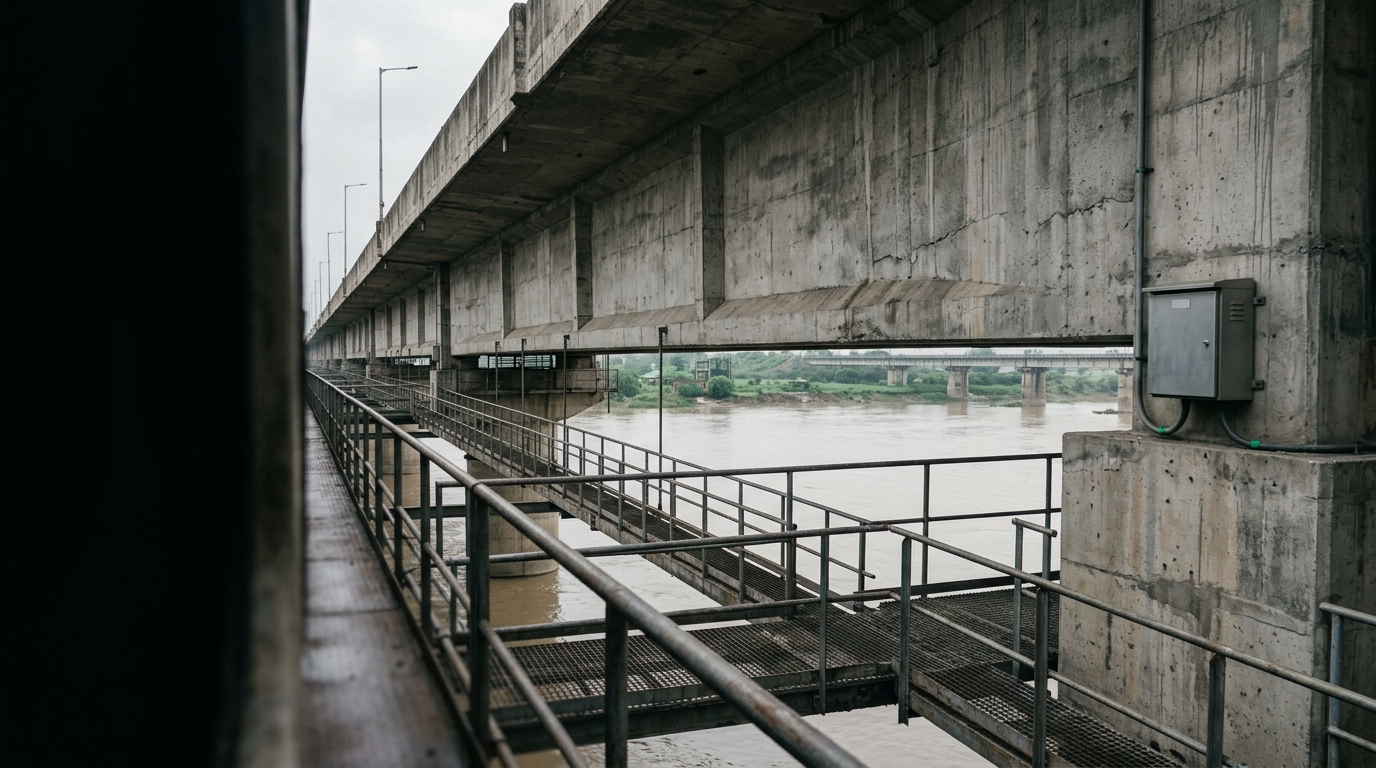
In August 2016, the Majerhat Bridge in Kolkata collapsed, killing three people and injuring dozens — a structure that had been flagged for distress years earlier but lacked any continuous automated monitoring. India's Ministry of Road Transport and Highways subsequently mandated structural health monitoring provisions under IRC SP-35 and IRC SP-37 for major bridges, yet procurement teams across NHAI, RVNL, and state PWDs still face a fragmented market when evaluating the best cloud based structural health monitoring software for India. Choosing the wrong platform means data locked in proprietary formats, no IRC-compliant alert thresholds, and dashboards that civil engineers cannot act on without a data scientist in the room.
This post cuts through that noise. It compares the core functional requirements that procurement and IT teams must evaluate — sensor protocol support, data sovereignty, digital twin integration, dam platform capability, and compliance with Indian standards — so that your next software tender is grounded in engineering reality rather than vendor marketing.
Key Takeaways
- The best cloud based structural health monitoring software for India must support IRC SP-35, IRC SP-37, and IS 1893 alert thresholds natively, not as post-processing add-ons.
- Bridge software must ingest data from vibrating wire sensors, MEMS accelerometers, and wireless DAQ nodes simultaneously, with timestamps accurate to ±1 ms for dynamic load analysis.
- Dam platforms operating under the Dam Safety Act 2021 require CWC-compliant seepage and piezometric reporting modules built into the core product, not bolted on.
- 3D digital twin visualisation — as deployed by RITES Ltd for their Bridge Health Monitoring System — is now a procurement differentiator, not a luxury feature.
- Data residency within Indian data centres is a non-negotiable requirement for PSU and government contracts under MeitY cloud policy guidelines.
What Is Cloud-Based Structural Health Monitoring Software?
Cloud-based structural health monitoring (SHM) software is a platform that continuously acquires, transmits, stores, and analyses sensor data from civil infrastructure — bridges, dams, tunnels, and high-rises — via internet-connected edge devices, presenting processed results through a web or mobile dashboard accessible to authorised engineers in real time.
In the Indian context, this definition carries regulatory weight. IRC SP-37 specifies inspection and monitoring requirements for highway bridges, while the Dam Safety Act 2021 (No. 35 of 2021) mandates instrumentation and safety review for all specified dams. A cloud SHM platform that cannot map its alert logic to these codes is not fit for purpose on a government contract. Procurement teams should treat code-native alert configuration as a mandatory requirement, not a desirable feature.
For a deeper grounding in sensor types that feed these platforms, see our guide on SHM sensor types and their structural monitoring applications.
Why India-Specific Features Matter for Bridge and Dam Platforms
Generic SHM platforms designed for European or North American markets embed assumptions that do not translate to Indian infrastructure. Seismic zonation under IS 1893:2016 divides India into Zones II through V, with peak ground acceleration values ranging from 0.10g to 0.36g. A bridge software platform that uses a flat acceleration alert threshold rather than zone-specific values will generate either chronic false alarms in Zone II or dangerous under-alerts in Zone V.
Similarly, India's monsoon hydrology imposes pore-pressure fluctuation cycles on dam foundations that are more severe and more rapid than temperate-climate norms. A dam platform must support piezometer data at sampling intervals as short as 15 minutes during flood season, with automated comparison against CWC-prescribed phreatic line limits. If the platform cannot ingest vibrating wire piezometer readings at that cadence and flag exceedances against IS 7894 criteria, it is not a dam platform — it is a generic time-series database with a bridge logo.
India's connectivity landscape adds another constraint. Many bridge sites on NH-44 in J&K, or on RVNL viaducts in the Northeast, operate in low-bandwidth or intermittent-connectivity environments. The software must support edge buffering — storing up to 72 hours of raw sensor data locally at the DAQ node and synchronising to the cloud when connectivity is restored, without data loss or timestamp corruption.
Geolook's work supplying bridge health monitoring accessories to IIT-Mandi, and the wireless DAQ system delivered to Neeladari Buildtech for their Bridge Health Monitoring System, both required exactly this kind of edge-first architecture. Academic and commercial deployments in Himalayan terrain leave no room for platforms that assume continuous 4G uptime.
Explore how these field requirements translate into system design in our detailed post on how bridge health monitoring works for national highways in India.
Core Modules Every SHM Software Platform Must Include
Before comparing platforms, procurement teams need a checklist of non-negotiable modules. The following are derived from IRC SP-35, IRC SP-37, IRC:6 (live load combinations), IRC:112 (concrete bridge design), and CWC dam safety guidelines.
Sensor ingestion layer: Must support vibrating wire (VW) sensors, MEMS accelerometers (output in mm/s² or g), strain gauges (output in micro-strain, µε), tiltmeters (output in milliradians or arc-seconds), and crack meters (output in mm). Wireless DAQ nodes using 900 MHz or LoRaWAN protocols must be supported alongside wired RS-485 Modbus chains.
Structural response analytics: Fast Fourier Transform (FFT) for natural frequency extraction, modal analysis for mode shape tracking, and influence line computation for live load assessment under IRC:6 load combinations. For cable-stayed and extra-dosed bridges — a specialisation area of Geolook's Strategic Advisor Sandeep Gupta, IRSE, former Chief Administrative Officer at Indian Railways — cable tension monitoring via frequency-based methods must be a native module, not a custom script.
Alert and notification engine: Multi-tier alert thresholds (advisory, warning, critical) configurable per sensor channel, with SMS and email dispatch to named engineers. Thresholds must be settable in engineering units, not raw ADC counts.
Reporting and compliance: Automated generation of periodic inspection reports in formats compatible with NHAI, RVNL, and PWD submission requirements. For dams, automated seepage and piezometric summary reports aligned with CWC guidelines.
Digital twin integration: 3D model linkage so that sensor readings are visualised on the structural geometry, not just in tabular dashboards. RITES Ltd's deployment of a 3D Digital Twin and VR Visualisation Platform for their Bridge Health Monitoring System demonstrates that this capability is already being procured at the PSU level in India.
Feature Comparison Matrix: Cloud SHM Software Capabilities for Indian Infrastructure
| Feature / Requirement | Minimum Acceptable Standard | Advanced Capability | Relevant Indian Standard or Mandate | Bridge Relevance | Dam Relevance |
|---|---|---|---|---|---|
| Sensor protocol support | VW, 4–20 mA, RS-485 Modbus | VW + MEMS + LoRaWAN + wireless DAQ | IRC SP-35, IRC SP-37 | High | High |
| Seismic alert thresholds | Fixed acceleration limit (mm/s²) | Zone-specific PGA per IS 1893:2016, auto-configured by site zone | IS 1893:2016 | High | High |
| Edge buffering (offline mode) | 4-hour local storage at DAQ node | 72-hour local buffer with lossless cloud sync on reconnect | NHAI SHM tender specifications | Critical for NH sites | Critical for remote dams |
| Digital twin / 3D visualisation | 2D schematic with sensor overlays | Full 3D BIM-linked model with real-time sensor colour mapping | RITES BHM platform precedent | High | Medium |
| Dam Safety Act compliance module | Manual data entry for CWC reports | Automated piezometric and seepage reporting per CWC guidelines | Dam Safety Act 2021, IS 7894 | Not applicable | Mandatory |
| Cable tension monitoring | Manual frequency input | Automated FFT-based cable tension from accelerometer data (kN output) | IRC SP-37, IRC:6 | Critical for cable-stayed bridges | Not applicable |
| Data residency | International cloud with data export | Indian data centre (MeitY empanelled cloud provider) | MeitY cloud policy for government data | Mandatory for PSU contracts | Mandatory for PSU contracts |
| Multi-structure dashboard | Single structure per account | Portfolio view across 50+ structures with fleet-level alerts | NHAI network monitoring requirements | High for NHAI/RVNL | High for CWC/state dam agencies |
| IRC:6 live load influence lines | Not available | Real-time influence line computation from strain gauge arrays (µε to kN·m) | IRC:6-2017 | High | Not applicable |
| API and SCADA integration | CSV export only | REST API, MQTT, and OPC-UA for integration with SCADA and BMS systems | Industry standard for PSU IT integration | Medium | High |
Procurement teams should convert this matrix directly into a Request for Proposal (RFP) evaluation scorecard. Weight the Dam Safety Act compliance module at zero for bridge-only contracts, and weight cable tension monitoring at zero for dam-only contracts. Every other row applies to both asset classes.
Evaluating SHM Software India Deployments: What the Tender Record Shows
India's public procurement record for SHM software India deployments reveals a consistent pattern: the gap between what vendors claim in pre-bid presentations and what gets delivered at site commissioning is widest in three areas — edge buffering reliability, IRC-compliant alert configuration, and digital twin fidelity.
The RITES Ltd engagement for a 3D Digital Twin and VR Visualisation Platform for Bridge Health Monitoring System is instructive. RITES, as a Schedule-A Miniratna PSU under the Ministry of Railways, specified not just sensor data acquisition but a full 3D visualisation layer with VR walkthrough capability. This requirement forced vendors to demonstrate actual BIM model integration, not a marketing render. Procurement teams at NHAI, RVNL, and state PWDs can use the RITES specification as a benchmark when drafting their own tender technical schedules.
For wireless DAQ deployments — as supplied by Geolook to Neeladari Buildtech for their Bridge Health Monitoring System — the critical evaluation criterion is not the wireless protocol itself but the data integrity guarantee across link dropouts. Procurement should require vendors to demonstrate a 30-day continuous operation log from a live site, showing timestamp continuity and zero data gaps during connectivity interruptions.
Academic deployments, such as the IIT-Mandi bridge health monitoring accessories supply, set a different benchmark: research-grade accuracy. IIT-Mandi's Himalayan Bridge Laboratory context demands sensor accuracy at sub-millimetre displacement resolution and strain measurement to ±1 µε. If a commercial platform cannot meet research-grade accuracy, it should not be positioned for long-span or cable-stayed bridge monitoring where fatigue life calculations depend on high-fidelity strain histories.
For a full breakdown of sensor selection for these deployments, read our post on real time bridge monitoring sensors india.
Dam Platform Requirements Under the Dam Safety Act 2021
The Dam Safety Act 2021 (No. 35 of 2021) created the National Committee on Dam Safety (NCDS) and State Dam Safety Organisations (SDSOs), and mandated instrumentation, inspection, and emergency action plans for all specified dams. This legislative framework has direct procurement implications: any dam platform procured by a state dam agency or CWC must be able to generate the instrumentation data reports required under the Act's Rules.
IS 7894:1975 (Safety of Dams — Code of Practice) specifies the instrumentation parameters that must be monitored: uplift pressure (kPa), seepage discharge (litres per second), settlement (mm), horizontal displacement (mm), and piezometric levels (metres above datum). A dam platform that cannot report all five parameter classes in a single consolidated dashboard, with automated comparison against design-basis limits, is not compliant with the spirit of the Act.
CWC's Guidelines for Instrumentation of Dams further specify that piezometric data must be recorded at a minimum frequency of once per day during normal operation and once per hour during flood season. Any cloud platform must therefore support configurable sampling rates per sensor channel, not a single global sampling interval. This is a specific technical requirement that should appear verbatim in dam monitoring RFPs.
Seismic response monitoring at dam sites must comply with IS 1893 Part 1:2016 for the relevant seismic zone. For dams in Zone IV or V — which includes large parts of Uttarakhand, Himachal Pradesh, and Northeast India — the platform must support strong-motion accelerograph data ingestion at 200 samples per second minimum, with automated peak ground acceleration (PGA) extraction and comparison against design-basis earthquake (DBE) thresholds.
IT Architecture and Data Governance for Indian Government Contracts
For procurement and IT teams at PSUs and government agencies, software evaluation cannot stop at functional features. The IT architecture layer — data residency, access control, audit logging, and disaster recovery — is equally subject to tender scrutiny.
MeitY's cloud policy for government data requires that sensitive infrastructure data be hosted on MeitY-empanelled cloud service providers with data centres located in India. Any SHM software vendor offering a platform hosted exclusively on non-empanelled international infrastructure cannot legally be awarded a central government contract for bridge or dam monitoring. IT teams should verify the cloud hosting certificate as part of the technical bid evaluation, not as an afterthought during contract negotiation.
Role-based access control (RBAC) is a minimum requirement. A typical bridge monitoring deployment involves at least four user roles: field sensor technician (read-only, site-specific), structural engineer (read-write, alert configuration), project manager (read-only, multi-site dashboard), and system administrator (full access). Platforms that offer only two access tiers create both security vulnerabilities and operational friction.
Audit logging — a complete, tamper-evident record of every alert acknowledgement, threshold change, and data export — is required for any deployment where the monitoring data may be used as evidence in a structural safety review or post-incident investigation. This is not a theoretical concern: the Forensic Engineering Society of India (FESI) and IRC technical committees have increasingly referenced SHM data in post-failure investigations.
For a broader view of how monitoring platforms integrate with bridge management systems, see our overview of bridge structural monitoring methods and instrumentation.
Procurement Checklist: Shortlisting the Best Cloud Based Structural Health Monitoring Software for India
The following checklist consolidates the technical and governance requirements discussed above into a format suitable for inclusion in a Request for Proposal or a pre-qualification questionnaire.
- IRC and IS code compliance: Does the platform natively support alert threshold configuration in accordance with IRC SP-35, IRC SP-37, IS 1893, and IS 7894? Request a demonstration with a live sensor feed, not a slide deck.
- Sensor protocol coverage: Can the platform ingest data from vibrating wire sensors, MEMS accelerometers, tiltmeters, crack meters, and wireless DAQ nodes from multiple manufacturers without custom middleware?
- Edge buffering specification: What is the maximum local storage duration at the DAQ node, and what is the data integrity guarantee (zero-loss or best-effort) during cloud connectivity interruptions?
- Digital twin capability: Can the vendor demonstrate a live 3D model with real-time sensor data overlaid on structural geometry, as opposed to a static BIM viewer?
- Data residency certificate: Is the platform hosted on a MeitY-empanelled cloud provider? Request the empanelment certificate number.
- Dam Safety Act module: For dam contracts, can the platform auto-generate CWC-format instrumentation reports? Request a sample report from a live deployment.
- Reference deployments: Has the vendor delivered to a PSU, IIT, or government agency in India? Request contact details for at least two reference sites.
- API documentation: Is a REST API available for integration with existing SCADA or asset management systems? Request the API specification document.
Geolook's cloud SHM software platform is designed to meet each of these criteria for Indian bridge and dam deployments. For bridge-specific hardware and software integration, see the bridge monitoring product suite.
Frequently Asked Questions
Q: What is the best cloud based structural health monitoring software for India?
A: The best cloud based structural health monitoring software for India is a platform that natively supports IRC SP-35 and IRC SP-37 alert thresholds, ingests data from vibrating wire and MEMS sensors, provides edge buffering for low-connectivity sites, and is hosted on a MeitY-empanelled Indian data centre. No single international platform meets all these India-specific requirements without significant customisation.
Q: Does SHM software India need to comply with the Dam Safety Act 2021?
A: SHM software India deployed for dam monitoring must support the instrumentation reporting requirements of the Dam Safety Act 2021 and CWC guidelines, including automated piezometric, seepage, and settlement reporting. The Act mandates instrumentation for all specified dams under State Dam Safety Organisations, making compliance a legal requirement, not a procurement preference.
Q: What sensor types must a bridge software platform support in India?
A: A bridge software platform for Indian deployments must support vibrating wire sensors, MEMS accelerometers outputting in mm/s², strain gauges reading in micro-strain (µε), tiltmeters in milliradians, crack meters in mm, and wireless DAQ nodes using LoRaWAN or 900 MHz protocols. IRC SP-37 and IRC:6 load combination analysis require all these sensor classes to be ingested simultaneously.
Q: What is a digital twin in the context of bridge health monitoring?
A: A digital twin in bridge health monitoring is a 3D geometric model of the structure linked to live sensor data, so that strain, displacement, and vibration readings are visualised directly on the structural geometry rather than in abstract tables. RITES Ltd's 3D Digital Twin and VR Visualisation Platform for Bridge Health Monitoring System is a documented example of this capability at the Indian PSU procurement level.
Q: How does edge buffering work in a cloud SHM platform for remote bridge sites?
A: Edge buffering stores raw sensor data locally at the DAQ node when cloud connectivity is interrupted, then synchronises the buffered data to the cloud server when the link is restored, preserving timestamp continuity and preventing data gaps. For bridge sites on NH-44 in J&K or RVNL viaducts in the Northeast, a minimum 72-hour buffer capacity is recommended to cover typical connectivity outage durations.
Request software demo
Geolook's cloud SHM platform has been deployed for bridge health monitoring at IIT-Mandi, for wireless DAQ-based bridge monitoring with Neeladari Buildtech, and for a 3D Digital Twin and VR Visualisation Platform with RITES Ltd. Each deployment was engineered to meet the specific IRC, IS, and CWC compliance requirements described in this post.
If your organisation is preparing an RFP for bridge or dam monitoring software, or evaluating platforms for an existing tender, our engineering team can walk you through a live demonstration using real sensor data from an active deployment — not a simulated environment.
To schedule a technical demonstration or request our procurement evaluation guide for the best cloud based structural health monitoring software for India, contact the Geolook engineering team. You can also explore our transport infrastructure monitoring solutions for a full view of how the platform integrates across highway, railway, and waterway asset classes.
For further reading on how monitoring systems are specified and deployed at the network level, see our post on best bridge health monitoring system in india and our technical overview of real time remote monitoring platform for bridges and dams.
Project inquiry
Talk to a Geolook™ specialist
Share your monitoring requirement and our team will help identify the right next step.
By submitting, you agree that Geolook™ may contact you about this inquiry. Your details are not added to a marketing list.