Dam Safety Monitoring: Instruments, Compliance & Real-Time Systems
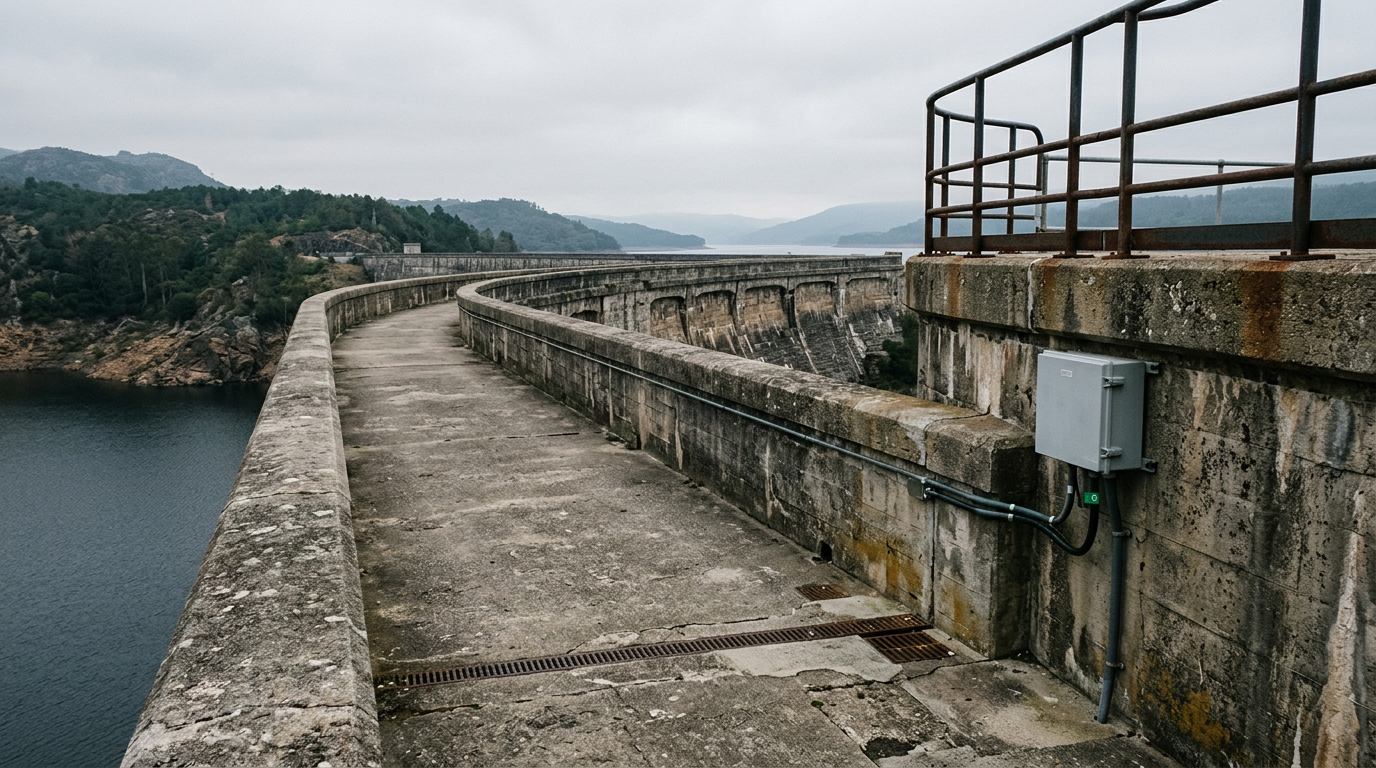
In August 2018, the Kakki reservoir in Kerala experienced severe stress during the catastrophic floods that killed over 400 people and displaced nearly a million — events that exposed critical gaps in India's dam surveillance infrastructure. India operates more than 5,700 large dams, the third-largest inventory in the world, yet the Central Water Commission's own assessments have repeatedly flagged that a significant proportion lack continuous, instrument-based dam safety monitoring. The Dam Safety Act 2021, which received Presidential assent on 30 December 2021, converted this long-standing advisory concern into a statutory obligation: dam owners must now maintain surveillance, inspection, and instrumentation programmes under enforceable law.
This guide is written for dam safety officers, CWC engineers, state dam safety organisations (SDSOs), and project engineers responsible for compliance under the Act. It covers the physical instruments used in a dam monitoring system, the regulatory framework, a practical compliance checklist, and the architecture of real-time automated data acquisition.
Key Takeaways
- The Dam Safety Act 2021 mandates instrumentation, regular inspection, and emergency action plans for all large dams in India — non-compliance carries legal liability for dam owners.
- A complete dam monitoring system measures pore water pressure, seepage, deformation, settlement, and seismic response — each parameter requiring a specific class of sensor calibrated to IS 7894 and CWC guidelines.
- Vibrating wire sensors remain the industry standard for long-term embankment and concrete dam monitoring because of their immunity to cable resistance errors over distances exceeding 500 m.
- Real-time automated data acquisition with threshold-based alerts is now technically feasible at Indian dam sites and is increasingly expected by CWC dam safety review panels.
- Periodic manual inspection alone is insufficient for high-hazard dams; continuous monitoring closes the surveillance gap between annual inspections and actual structural behaviour.
What Is Dam Safety Monitoring?
Dam safety monitoring is the systematic, instrument-based measurement of physical parameters — including pore water pressure, seepage flow, structural deformation, settlement, and seismic acceleration — that indicate the structural and hydraulic integrity of a dam and its foundation over time.
The discipline draws on geotechnical, structural, and hydraulic engineering principles simultaneously. A dam is not a static structure; it responds to reservoir filling, drawdown, seasonal temperature cycles, and seismic events. Monitoring captures this dynamic behaviour and compares it against design assumptions and threshold values established during construction. Deviations from expected behaviour are the earliest warning of potential distress — often appearing months or years before any visible sign of deterioration.
Under IS 7894 (Code of Practice for Safety Inspection of Dams), the Bureau of Indian Standards prescribes the minimum parameters to be monitored for different dam types. CWC guidelines further specify observation frequencies, data recording formats, and reporting obligations. The Dam Safety Act 2021 elevates these technical requirements into statutory duties enforceable by the National Committee on Dam Safety (NCDS) and State Dam Safety Organisations.
For a deeper technical foundation on sensor selection and installation practice, refer to our resource on dam instrumentation india.
Regulatory Framework: Dam Safety Act 2021 and CWC Guidelines
The Dam Safety Act 2021 is the primary legislation governing dam safety in India. It applies to all specified dams — those with a height of 15 m or more from the lowest foundation level, or between 10 m and 15 m with specific design complications — and imposes obligations on dam owners that include:
- Comprehensive safety inspection at least once every five years by a panel of dam safety experts.
- Annual inspection before and after each monsoon season.
- Maintenance of an instrumentation programme appropriate to the dam's hazard classification.
- Preparation and periodic updating of an Emergency Action Plan (EAP).
- Reporting of distress or unusual behaviour to the relevant State Dam Safety Organisation within 24 hours.
The Act establishes the National Committee on Dam Safety (NCDS) under the Union Government and mandates each state to constitute a State Dam Safety Organisation (SDSO) and a State Committee on Dam Safety (SCDS). CWC functions as the technical secretariat to NCDS and has published detailed guidelines — including the Manual on Dam Safety (2019 edition) — that specify instrumentation requirements by dam type and hazard potential.
Hazard classification under CWC guidelines is based on downstream consequences: High Hazard (HC), Significant Hazard (SC), and Low Hazard (LC). High Hazard dams require the most comprehensive dam monitoring system, including automated data acquisition and telemetry where feasible. Failure to comply with the Act's provisions exposes dam owners — which include state governments, irrigation departments, hydropower utilities, and industrial entities — to penalties under Section 30 of the Act.
Core Instruments in a Dam Monitoring System
A complete dam monitoring system integrates multiple instrument types, each measuring a distinct physical parameter. The following are the principal instrument categories used in Indian dam practice.
Piezometers (Pore Water Pressure): Pore water pressure is the most critical parameter in embankment dam safety. Excess pore pressure in the dam body or foundation reduces effective stress and can trigger internal erosion or slope instability. Vibrating wire piezometers (VWPs) are the standard choice for long-term installations because their frequency-based output is immune to cable resistance changes over long lead lengths — a practical necessity when instruments are embedded 20–40 m below the crest. Typical measurement range is 0–700 kPa, with resolution better than 0.025% FS. For a detailed explanation of sensor physics, see our guide on vibrating wire piezometer working principle. Standpipe (Casagrande) piezometers remain in use for manual observation programmes at lower-hazard dams.
Seepage Measurement (V-Notch Weirs and Flumes): Seepage through the dam body, foundation, and abutments is measured volumetrically using calibrated V-notch weirs or Parshall flumes at the downstream drainage gallery. CWC guidelines require seepage to be measured and recorded at each inspection. A sudden increase in seepage volume, or the appearance of turbid seepage, is a Category 1 alert condition requiring immediate investigation.
Settlement and Deformation (Settlement Gauges, Inclinometers, Total Stations): Vertical settlement of the dam crest and embankment slopes is measured using precise levelling benchmarks and, increasingly, automated total stations. Horizontal deformation of the upstream and downstream faces is monitored using inclinometers installed in vertical boreholes. Inclinometer casings are typically read at 0.5 m depth intervals; cumulative displacement profiles are compared against design-stage finite element predictions. For monsoon-season continuous deformation surveillance, refer to our technical note on continuous dam deformation monitoring during monsoon.
Stress and Strain (Vibrating Wire Strain Gauges, Load Cells): In concrete gravity and arch dams, embedded vibrating wire strain gauges measure concrete stress at critical sections — typically the base of the dam, the heel, and the toe. Strain gauges are installed in pairs to separate mechanical strain from thermally induced strain. Load cells monitor anchor forces in post-tensioned concrete dams.
Seismic Monitoring (Strong Motion Accelerographs): IS 1893 (Part 1) classifies India into seismic zones II through V. High Hazard dams in Zones III, IV, and V are required by CWC guidelines to be equipped with strong motion accelerographs (SMAs) capable of recording peak ground acceleration (PGA) in mm/s². Triggered recording with a threshold of 0.005g is standard practice. Data from SMAs feeds into post-earthquake safety assessments.
Joint Meters and Crack Meters: In concrete dams, vibrating wire joint meters measure opening and closing of construction joints and contraction joints. Crack meters monitor the width of any visible cracks in the dam body or gallery walls. Both instruments provide millimetre-resolution displacement data.
Explore the full range of dam safety monitoring instruments and systems available for Indian dam projects.
Instrument Selection by Dam Type: A Comparison
The appropriate instrument suite depends on dam type, foundation conditions, hazard classification, and the specific failure modes being guarded against. The table below summarises standard instrument selection practice aligned with CWC guidelines and IS 7894.
| Parameter | Earthfill / Rockfill Dam | Concrete Gravity Dam | Concrete Arch Dam | Primary Standard / Guideline |
|---|---|---|---|---|
| Pore water pressure | Vibrating wire piezometer (embedded), standpipe piezometer | Vibrating wire piezometer (foundation drainage) | Vibrating wire piezometer (abutment) | IS 7894, CWC Manual on Dam Safety |
| Seepage flow | V-notch weir, flume at drainage blanket outlets | V-notch weir in inspection gallery | V-notch weir in gallery | CWC guidelines |
| Settlement / vertical deformation | Surface settlement monuments, hydraulic settlement gauges | Precise levelling benchmarks | Precise levelling, plumb lines | IS 7894 |
| Horizontal deformation | Inclinometer, surface alignment monuments | Plumb lines (direct and inverted), collimation | Inverted plumb lines, extensometers | IS 7894, CWC Manual |
| Stress / strain | Earth pressure cells (embankment stress) | VW strain gauges, stress meters | VW strain gauges, joint meters | CWC Manual on Dam Safety |
| Seismic response | Strong motion accelerograph (Zones III–V) | Strong motion accelerograph | Strong motion accelerograph (mandatory) | IS 1893 Part 1, CWC guidelines |
| Uplift pressure | Not typically applicable | Uplift pressure cells in gallery floor | Uplift pressure cells | IS 7894 |
Real-Time Dam Monitoring: Data Acquisition Architecture
Manual reading programmes — where a dam safety officer physically visits each instrument location and records readings in a logbook — were the norm for decades. While manual readings remain a regulatory requirement for certain parameters, they are insufficient as the sole surveillance mechanism for High Hazard dams. A single monsoon event can cause pore pressure changes of 50–150 kPa within hours; a weekly manual reading schedule cannot capture this transient behaviour.
A real-time dam monitoring system uses automated data loggers connected to vibrating wire readout modules, 4–20 mA transmitters, or digital sensor interfaces. Data is transmitted via GPRS, 4G LTE, or satellite link to a central server where it is stored in a time-series database. Threshold-based alert logic generates SMS or email notifications when any parameter crosses a pre-defined warning level or alarm level.
The architecture typically comprises three tiers:
- Field tier: Sensors (piezometers, strain gauges, seepage weirs, accelerographs) connected to field data loggers housed in weatherproof enclosures rated to IP67. Scan intervals are configurable — typically 15 minutes for routine monitoring, switching to 1-minute intervals when a trigger condition (e.g., reservoir level rise exceeding 0.5 m/hour) is detected.
- Communication tier: Wired RS-485 Modbus backbone within the inspection gallery, with GPRS/4G modems at the dam crest transmitting to a cloud server. Redundant communication paths (primary 4G, backup satellite) are recommended for High Hazard dams in remote locations.
- Analysis and reporting tier: Web-based dashboard displaying real-time parameter values, trend plots, and threshold exceedance history. Automated generation of CWC-format observation reports reduces the administrative burden on dam safety officers.
For hydropower dam operators, integrated monitoring also supports operational decisions — reservoir management, turbine loading, and flood routing — making the investment in a real-time system recoverable across multiple operational functions. See how Geolook's monitoring capabilities extend to energy sector infrastructure monitoring.
Dam Safety Act 2021 Compliance Checklist
The following checklist is structured around the obligations imposed by the Dam Safety Act 2021 and the technical requirements of CWC guidelines. Dam owners and SDSOs can use this as a self-assessment framework prior to formal inspection.
Legal and Administrative Compliance
- Dam registered with the relevant State Dam Safety Organisation (SDSO) as required under Section 11 of the Act.
- Hazard classification (High / Significant / Low) formally assigned and documented.
- Designated Dam Safety Unit (DSU) constituted with qualified engineers as per Section 10.
- Emergency Action Plan (EAP) prepared, approved by SDSO, and updated within the last three years.
- Operation and Maintenance Manual current and accessible to dam safety personnel.
Inspection Programme
- Pre-monsoon inspection completed and report submitted to SDSO.
- Post-monsoon inspection completed and report submitted to SDSO.
- Comprehensive safety inspection by expert panel conducted within the last five years.
- Inspection findings from previous cycles closed out or under active remediation with documented timelines.
Instrumentation and Monitoring
- Piezometer network functional with all instruments reading within expected range; last calibration date recorded.
- Seepage measurement points operational; baseline seepage values documented from first impoundment.
- Settlement monuments surveyed at prescribed frequency; cumulative settlement plotted against design predictions.
- Inclinometer readings current; no anomalous lateral displacement trend identified.
- Strong motion accelerograph (where required by IS 1893 zone) operational and data retrievable.
- Instrument observation registers maintained in CWC-prescribed format.
- Malfunctioning instruments identified, reported, and replacement/repair scheduled.
Data Management and Reporting
- Observation data entered into the National Register of Large Dams (NRLD) portal as required.
- Threshold values (warning and alarm levels) defined for each monitored parameter and documented.
- Unusual behaviour reporting protocol established; contact chain to SDSO and NCDS confirmed.
- Historical data (minimum 10 years) archived and accessible for trend analysis.
Structural and Hydraulic Integrity
- Spillway capacity verified against current Probable Maximum Flood (PMF) estimates; hydrological review current.
- Seismic safety review conducted if dam is in Zone III, IV, or V and more than 25 years old.
- Downstream channel clear of encroachments that would impede flood discharge.
Vibrating Wire Sensors: Why They Dominate Long-Term Dam Monitoring
Vibrating wire (VW) technology has been the preferred transduction principle for embedded dam instruments since the 1970s, and its dominance in long-term applications is not a matter of convention — it is a consequence of measurable physical advantages.
A vibrating wire sensor measures the resonant frequency of a tensioned steel wire. Because frequency is a ratio measurement, it is independent of cable resistance, connector resistance, and supply voltage variation. In a dam where instrument cables may run 300–600 m from the embedded sensor to the readout unit, and where cable joints may corrode over decades, this property is decisive. Resistance-based sensors (such as 4–20 mA transmitters or Wheatstone bridge strain gauges) are susceptible to errors introduced by cable resistance changes of even a few ohms — errors that can translate to tens of kPa of apparent pore pressure change.
VW piezometers used in Indian dam practice typically have a measurement range of 0–350 kPa or 0–700 kPa, a resolution of 0.025% FS (approximately 0.09 kPa for a 350 kPa range), and a long-term stability specification of ±0.1% FS per year. These specifications are sufficient to detect the slow, progressive pore pressure changes associated with internal erosion initiation — which may develop over months at rates of 1–5 kPa per week.
MEMS-based pressure sensors offer higher resolution and faster response, and are increasingly used in surface-mounted or short-term applications. For a direct technical comparison of the two technologies in the Indian dam context, see our analysis of how do vibrating wire strain gauges compare to mems sensors for dam monitoring in india.
The thermistor integrated into every VW sensor provides simultaneous temperature measurement, enabling thermal correction of readings — important in concrete dams where diurnal and seasonal temperature cycles of 15–25°C can induce apparent strain changes that must be separated from mechanically induced strain.
Common Deficiencies Found During CWC Dam Safety Inspections
CWC inspection reports and NDMA assessments have consistently identified a recurring set of instrumentation and monitoring deficiencies at Indian dams. Understanding these failure patterns helps dam safety officers prioritise remediation effort.
Instrument attrition without replacement: Many dams commissioned in the 1970s and 1980s have lost 40–60% of their original piezometer network to cable damage, siltation of standpipes, or simple neglect. Readings from the surviving instruments are extrapolated across the dam cross-section — a practice that introduces unquantifiable uncertainty into safety assessments.
Absence of baseline data: Instruments installed during construction but never read during first impoundment provide no baseline against which subsequent readings can be compared. CWC guidelines require readings to be taken at defined reservoir levels during initial filling, but this requirement is frequently not met.
Manual reading gaps during monsoon: The period of greatest hydraulic loading — the monsoon — is also the period when access to instruments is most difficult. Manual reading programmes routinely have gaps of 4–8 weeks during heavy rainfall, precisely when continuous surveillance is most needed.
Seepage turbidity not recorded: Volume of seepage is measured, but turbidity — which indicates particle migration and potential piping initiation — is rarely monitored systematically. CWC guidelines recommend visual inspection of seepage quality at every reading, but this is inconsistently practised.
EAP not tested: Emergency Action Plans exist on paper but have not been exercised through tabletop or field drills. Communication chains to downstream communities are untested and may be outdated.
Frequently Asked Questions
Q: What does the Dam Safety Act 2021 require for dam instrumentation?
A: The Dam Safety Act 2021 requires dam owners to maintain an instrumentation programme appropriate to the dam's hazard classification, conduct pre- and post-monsoon inspections annually, and undertake a comprehensive expert panel inspection every five years. High Hazard dams must have functional piezometer networks, seepage measurement, deformation monitoring, and — in seismic zones III to V — strong motion accelerographs, all in accordance with CWC guidelines and IS 7894.
Q: What is a vibrating wire piezometer and why is it used in dams?
A: A vibrating wire piezometer is a geotechnical sensor that measures pore water pressure by detecting the resonant frequency of a tensioned steel wire, which changes in proportion to applied pressure. It is preferred for long-term dam monitoring because its frequency-based output is immune to cable resistance errors over lead lengths of 300–600 m, delivers resolution better than 0.025% FS, and maintains stability over decades of embedded service.
Q: How often must seepage be measured at a large dam under CWC guidelines?
A: CWC guidelines require seepage to be measured and recorded at every scheduled inspection — at minimum before and after each monsoon season. For High Hazard dams with automated monitoring systems, continuous or daily seepage flow logging is recommended. Any sudden increase in seepage volume or appearance of turbid seepage must be reported to the State Dam Safety Organisation immediately as a potential indicator of internal erosion.
Q: What is the difference between a warning level and an alarm level in dam monitoring?
A: A warning level is a pre-defined threshold value for a monitored parameter — such as pore water pressure in kPa or seepage flow in litres per minute — at which heightened surveillance and investigation are triggered without necessarily requiring operational intervention. An alarm level is a higher threshold at which immediate action, including possible reservoir drawdown or evacuation of downstream areas per the Emergency Action Plan, is initiated.
Q: Which Indian standard governs safety inspection of dams?
A: IS 7894, titled Code of Practice for Safety Inspection of Dams, is the primary Bureau of Indian Standards code governing dam safety inspection in India. It specifies minimum parameters to be monitored, observation frequencies, and reporting formats for different dam types. IS 7894 is used in conjunction with the CWC Manual on Dam Safety and the statutory requirements of the Dam Safety Act 2021 to define a complete compliance framework.
Download compliance guide
Dam safety compliance under the Dam Safety Act 2021 involves coordinating instrumentation programmes, inspection schedules, data management obligations, and emergency planning across multiple regulatory tiers — NCDS, SDSO, and CWC. Geolook has prepared a structured compliance reference document that consolidates the Act's instrumentation requirements, CWC guideline specifications, and IS 7894 observation parameters into a single, field-usable format.
The guide includes instrument specification tables, observation frequency schedules, threshold-setting methodology, and a pre-inspection checklist aligned with SDSO audit criteria.
Contact Geolook to request the dam safety monitoring compliance guide or to discuss instrumentation requirements for your dam project with our geotechnical monitoring engineers.
You can also explore our vibrating wire piezometer product range for technical specifications, installation guidance, and compatibility with automated data acquisition systems used in Indian dam monitoring programmes.
Project inquiry
Talk to a Geolook™ specialist
Share your monitoring requirement and our team will help identify the right next step.
By submitting, you agree that Geolook™ may contact you about this inquiry. Your details are not added to a marketing list.