What Is Structural Health Monitoring and How Does It Work for Critical Infrastructure?
In August 2014, a portion of the Savitri River bridge on NH-17 in Maharashtra collapsed, killing 28 people and severing a critical coastal highway link for months. An investigation found that progressive scour and material degradation had gone undetected for years — conditions that continuous, sensor-based monitoring would have flagged long before failure. That single event reshaped how Indian infrastructure agencies think about what is structural health monitoring and how does it work for critical infrastructure, accelerating demand for real-time data systems across bridges, tunnels, dams, and high-rise structures.
Understanding what is structural health monitoring and how does it work for critical infrastructure is no longer a question reserved for instrumentation specialists. Project directors at NHAI, procurement leads at RITES, and EPC programme managers are now expected to evaluate SHM proposals, interpret sensor data dashboards, and satisfy compliance requirements under the Dam Safety Act 2021 and IRC SP-35 guidelines. This explainer walks through the concept, the process, and the practical decisions that determine whether an SHM deployment delivers actionable intelligence or merely generates data noise.
Explore how Geolook delivers infrastructure intelligence across India's most demanding projects to understand the full scope of services behind the technology described here.
Key Takeaways
- Structural health monitoring (SHM) is a continuous or periodic measurement system that converts physical responses — strain, displacement, vibration, pore pressure — into engineering decisions about structural condition.
- A complete SHM system has five functional layers: sensing, data acquisition, transmission, processing, and decision support. Weakness in any layer degrades the entire system.
- Indian regulatory frameworks — including the Dam Safety Act 2021, IRC SP-35, and IS 1893 — now either mandate or strongly recommend instrumented monitoring for critical assets.
- Digital twin platforms, such as those deployed by Geolook for RITES Ltd, allow 3D visualisation of sensor data, enabling non-technical stakeholders to interpret structural behaviour without reading raw time-series outputs.
- SHM critical infrastructure deployments in India span tunnels on NH-44, railway bridges, high-rise foundations in Gurugram, and academic excellence centres — demonstrating that the technology is operationally proven, not experimental.
What Is Structural Health Monitoring? A Working Definition
Structural health monitoring (SHM) is the process of implementing a damage identification and characterisation strategy for engineering structures by embedding or attaching sensors that continuously or periodically measure physical parameters — including strain in micro-strain (µε), displacement in millimetres, acceleration in mm/s², temperature in °C, and pore water pressure in kPa — and processing those measurements through software algorithms to assess structural condition and remaining service life.
The definition matters because SHM is often conflated with simple data logging or periodic visual inspection. It is neither. Visual inspection, as codified under IRC SP-35 for bridges, captures surface condition at a point in time. Data logging records numbers without interpretation. SHM integrates both into a system that detects anomalies, trends, and threshold exceedances in near-real time, then routes that intelligence to engineers who can act on it.
For non-technical stakeholders, the clearest analogy is an electrocardiogram for a structure. Just as an ECG translates the heart's electrical activity into a waveform a cardiologist can read, an SHM platform translates a bridge's or tunnel's physical responses into condition indicators a structural engineer — or a well-briefed project director — can interpret.
Why Critical Infrastructure in India Needs SHM Now
India operates over 1.5 lakh bridges on its national and state highway network, thousands of kilometres of tunnels under construction or in service, and more than 5,000 large dams. The Dam Safety Act 2021 mandates instrumentation and safety reviews for all large dams, creating a statutory obligation for SHM deployment at reservoir infrastructure. IRC SP-35 recommends periodic and continuous monitoring for bridges in seismic zones III, IV, and V as classified under IS 1893. MORTH's standard data item list for highway projects increasingly includes SHM as a deliverable, not an optional extra.
Beyond compliance, the economic case is straightforward. Unplanned closure of a national highway bridge or tunnel disrupts freight movement, triggers emergency repair costs, and — in the case of failure — generates liability that dwarfs the cost of any monitoring system. SHM critical infrastructure deployments shift maintenance from reactive to condition-based, allowing asset owners to prioritise intervention budgets on structures that actually show deterioration rather than applying uniform maintenance schedules regardless of actual condition.
Geolook's deployment across five tunnels on the Ramban-Banihal section of NH-44 in Jammu & Kashmir, executed in association with DRAIPL and reviewed with the NHAI Regional Office, illustrates this operational reality. In NATM tunnels, convergence measurements — typically taken at cross-sections every 5 to 10 metres — must be tracked continuously during and after construction. Automated SHM replaced manual tape extensometer readings, reducing human error and providing NHAI with a live data feed rather than periodic inspection reports.
How SHM Works: The Five-Layer Process
Understanding how SHM works requires tracing data from the physical structure to the decision-maker's screen. The process has five functional layers, each with distinct engineering requirements.
- Sensing layer. Transducers convert physical phenomena into electrical signals. Common sensor types for SHM critical infrastructure include vibrating wire strain gauges (resolution typically ±1 µε), MEMS accelerometers (measuring dynamic response in mm/s²), fibre Bragg grating (FBG) sensors for distributed strain and temperature, piezometers for pore water pressure in kPa, crack meters, tiltmeters, and displacement transducers. Sensor selection depends on the structural type, the damage mechanism being monitored, and the required measurement frequency. IS 13311 provides guidance on non-destructive testing methods that complement sensor-based SHM.
- Data acquisition layer. A data acquisition unit (DAQ) conditions, digitises, and time-stamps sensor signals. Industrial-grade DAQs — such as those deployed by Geolook at DLF Downtown Gurgaon with Ahluwalia Constructions for deep excavation monitoring — operate across wide temperature ranges and provide synchronised multi-channel sampling. Sampling rates range from 1 Hz for quasi-static parameters like settlement to 1,000 Hz or higher for dynamic structural response.
- Transmission layer. Data moves from the DAQ to a central server or cloud platform via wired (RS-485, Ethernet) or wireless (4G LTE, LoRaWAN, Wi-Fi) protocols. In remote locations such as the Ramban-Banihal tunnels, cellular connectivity with local data buffering ensures no data loss during network outages. Neeladari Buildtech's wireless DAQ deployment for bridge health monitoring demonstrates that wireless architectures are viable for permanent bridge installations where cabling is impractical.
- Processing layer. Raw time-series data is filtered, calibrated against baseline readings, and analysed using algorithms that range from simple threshold comparison to modal analysis and machine learning-based anomaly detection. This layer converts numbers into engineering parameters: raw voltage from a vibrating wire gauge becomes strain in µε; acceleration time-series becomes natural frequency in Hz, which is then compared against the structure's baseline modal signature.
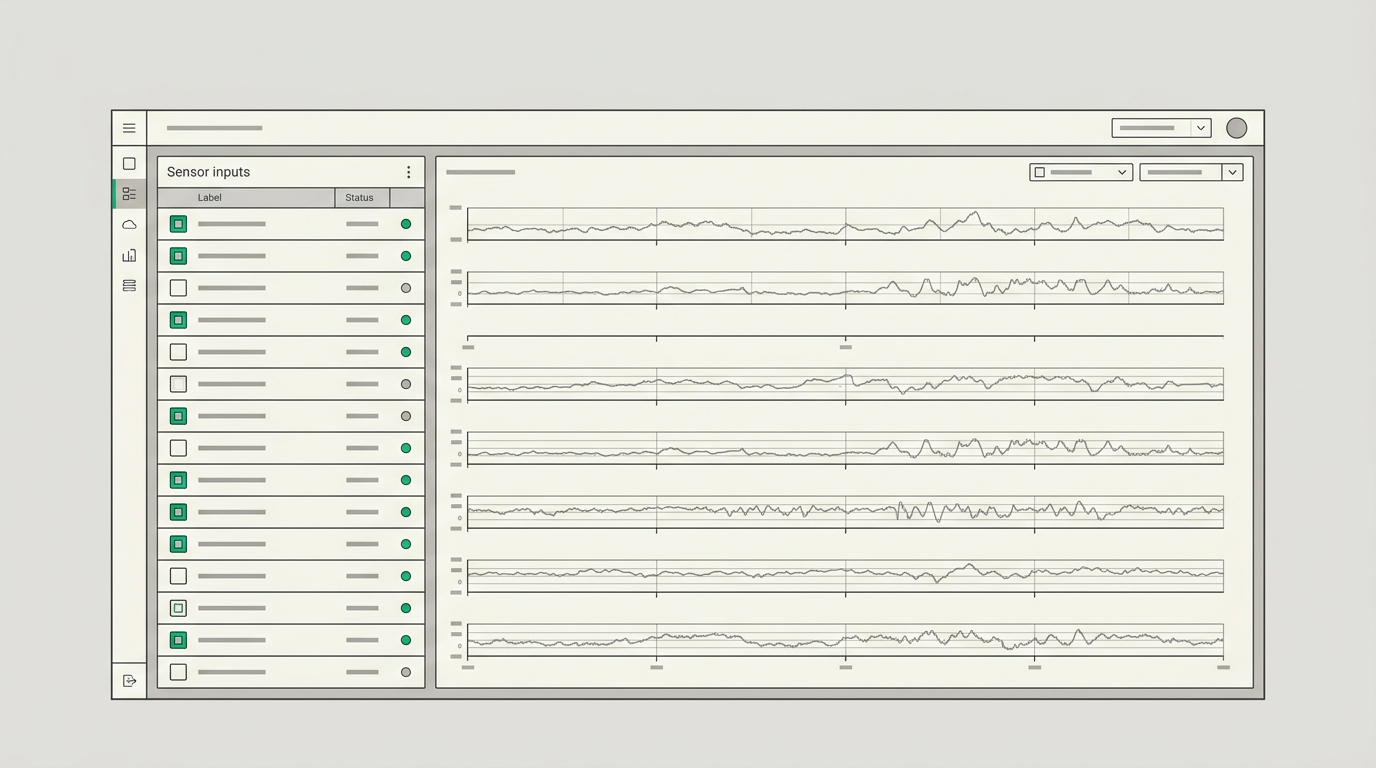
- Decision support layer. Processed data is presented through a software dashboard that displays current readings, trend plots, alert statuses, and — in advanced deployments — a 3D digital twin of the structure. Geolook's platform for RITES Ltd delivers a 3D digital twin and VR visualisation environment for bridge health monitoring, allowing engineers and project managers to navigate a virtual model of the bridge and interrogate sensor readings at specific locations without visiting the site. This layer is where SHM transitions from an instrumentation exercise into an infrastructure intelligence system.
Sensor Technologies Compared: Choosing the Right Measurement Approach
No single sensor technology is optimal for every SHM application. The table below compares the principal measurement approaches used in SHM critical infrastructure deployments against the parameters most relevant to Indian project conditions.
| Sensor Technology | Measured Parameter | Typical Resolution | Best Application | Key Limitation |
|---|---|---|---|---|
| Vibrating Wire Strain Gauge | Strain, stress | ±1 µε | Concrete and steel structures, long-term monitoring | Point measurement only; not distributed |
| MEMS Accelerometer | Acceleration, vibration | ±0.001 mm/s² | Dynamic response, modal analysis, seismic events | Requires high sampling rate; large data volumes |
| Fibre Bragg Grating (FBG) | Distributed strain and temperature | ±1 µε, ±0.1 °C | Long-span bridges, tunnels, piles | Higher unit cost; specialist interrogator required |
| Piezometer | Pore water pressure | ±0.1 kPa | Dams, embankments, retaining walls | Requires de-airing; susceptible to clogging |
| Tiltmeter / Inclinometer | Angular displacement | ±0.001° | Retaining walls, pile caps, tunnel linings | Cumulative drift over long deployments |
| Crack Meter | Crack width displacement | ±0.01 mm | Concrete structures, masonry, tunnel linings | Measures only pre-identified crack locations |
| Total Station (Robotic) | 3D displacement | ±0.5 mm | Settlement monitoring, pavement, urban excavation | Requires line of sight; affected by atmospheric conditions |
For projects where multiple damage mechanisms must be tracked simultaneously — as is the case in NATM tunnels where convergence, lining stress, and groundwater pressure all require monitoring — a multi-sensor array feeding a single DAQ and unified software platform is the standard approach. Geolook's deployment at the MIT-WPU Tunnel Health Monitoring and Digital Twin Excellence Centre in Pune, inaugurated by Union Minister Sh. Nitin Gadkari, integrates multiple sensor modalities into a single AI-enabled platform used for both live monitoring and engineer training.
The Role of Digital Twins and Software Platforms in Modern SHM
A digital twin in the SHM context is a georeferenced, parametric 3D model of a structure that is continuously updated with live sensor data, allowing engineers to visualise structural behaviour in spatial context rather than reading abstract time-series plots. This distinction matters for non-technical stakeholders: a digital twin makes sensor data interpretable without requiring the viewer to understand signal processing.
Geolook's platform for RITES Ltd — a 3D digital twin and VR visualisation environment for bridge health monitoring — demonstrates what this looks like in practice for a government PSU client. Project managers can navigate a photorealistic model of the bridge, select a sensor node, and view its current reading, historical trend, and alert status in a single interface. The same platform supports VR-based training, allowing engineers to rehearse inspection and response protocols in a simulated environment before working on the live structure.
For procurement leads evaluating SHM software platforms, the critical questions are: Does the platform support open data formats (CSV, JSON, IFC) to avoid vendor lock-in? Does it provide configurable alert thresholds with audit trails? Does it integrate with existing project management or asset management systems? And does it scale from a single structure to a portfolio of assets across a highway corridor or railway network?
Explore Geolook's structural health monitoring software platform for detailed specifications on data architecture, alert logic, and digital twin capabilities. For a broader view of the software ecosystem, see Geolook's infrastructure intelligence software suite.
SHM Across Infrastructure Sectors: Transport, Energy, and Urban
The principles of how SHM works are consistent across asset types, but the specific parameters, thresholds, and regulatory frameworks differ by sector.
Transport infrastructure — bridges, tunnels, and highways — is governed by IRC codes and MORTH guidelines. For bridges, IRC SP-35 defines inspection categories and IRC:6 specifies live load combinations that inform dynamic monitoring thresholds. For tunnels under NATM construction, convergence monitoring at defined cross-sections is a contractual requirement on most NHAI projects. Geolook's work on the Ramban-Banihal NH-44 tunnels and the IIT-Mandi bridge health monitoring accessories supply both sit within this sector. Learn more about SHM applications for transport infrastructure in India.
Energy infrastructure — dams, reservoirs, and power plant structures — is now subject to the Dam Safety Act 2021, which requires instrumentation, data collection, and safety review for all large dams as defined under the Act. Parameters monitored include seepage in litres per second, pore water pressure in kPa, crest settlement in mm, and uplift pressure. IS 7894 and CWC guidelines provide the technical framework. Learn about SHM solutions for energy and dam infrastructure.
Urban and building infrastructure — high-rise towers, deep excavations, and metro tunnels — requires monitoring of settlement (typically in mm), differential settlement, tilt, and vibration during construction and in service. IS 1892 governs site investigation, and IS 13920 addresses ductile detailing for seismic zones. Geolook's deployments at DLF Downtown Gurgaon with Ahluwalia Constructions, DLF Privana with ACC India, and L&T Constructions Noida Realty in Sector-120 represent the full range of urban SHM applications, from industrial-grade DAQ for deep excavation to integrated sensor analytics for completed high-rise structures.
Implementing SHM: What Project Teams Need to Know Before Procurement
Successful SHM deployment begins with a monitoring plan, not a sensor order. The monitoring plan defines the structural parameters to be measured, the damage mechanisms being targeted, the required measurement frequency and resolution, the alert thresholds tied to engineering limit states, and the data management and reporting obligations. Without a monitoring plan, procurement teams risk specifying sensors that measure the wrong parameters or acquiring data at a resolution that is either insufficient for detection or unnecessarily expensive to store and process.
Key decisions in the monitoring plan include: whether monitoring is continuous (24/7 automated) or periodic (scheduled manual or automated campaigns); whether the system must satisfy a contractual or regulatory reporting obligation with defined data formats; and whether the output needs to be interpretable by non-specialist stakeholders — in which case a digital twin or dashboard interface is not optional but essential.
For EPC contractors working under NHAI or RVNL contracts, SHM deliverables are increasingly specified in the contract data requirements list (CDRL). Understanding what is structural health monitoring and how does it work for critical infrastructure at a system level — not just at the sensor level — is what allows project teams to evaluate whether a proposed SHM solution actually meets the contract requirement or merely satisfies it on paper.
For a comprehensive technical foundation, read our detailed guide on structural health monitoring covering sensor selection, data interpretation, and system design for Indian infrastructure projects. You may also find value in our post on what is structural health monitoring and why does it matter for asset owners and project directors navigating compliance and risk.
Frequently Asked Questions
Q: What is structural health monitoring in simple terms?
A: Structural health monitoring is a system of sensors, data acquisition hardware, and software that continuously measures a structure's physical responses — such as strain in micro-strain, displacement in millimetres, or vibration in mm/s² — and converts those measurements into condition assessments. It allows engineers and project managers to detect deterioration or anomalies before they become safety-critical, without relying solely on periodic visual inspection.
Q: How does SHM work for bridges and tunnels specifically?
A: SHM for bridges and tunnels works by attaching or embedding sensors at critical structural locations — strain gauges on girders, accelerometers at mid-span, piezometers in tunnel linings — that feed data to a central DAQ unit. Software processes the data against baseline readings and engineering thresholds defined under IRC SP-35 or NATM monitoring protocols, generating alerts when readings approach limit states. Digital twin platforms visualise this data spatially for non-specialist users.
Q: Is SHM mandatory for infrastructure projects in India?
A: SHM is mandatory for large dams under the Dam Safety Act 2021, which requires instrumentation and periodic safety reviews. For bridges, IRC SP-35 recommends continuous monitoring in seismic zones III, IV, and V under IS 1893. MORTH and NHAI project specifications increasingly include SHM as a contractual deliverable for major highway and tunnel projects, making it effectively mandatory for those contracts even where no single statute requires it universally.
Q: What is a digital twin in the context of SHM critical infrastructure?
A: A digital twin in SHM is a georeferenced 3D model of a structure that is continuously updated with live sensor data, allowing engineers to visualise structural behaviour spatially rather than reading raw time-series outputs. Geolook's platform for RITES Ltd delivers a 3D digital twin and VR visualisation environment for bridge health monitoring, enabling project managers to interrogate sensor readings at specific structural locations through an interactive virtual model.
Q: What sensors are used in a typical SHM system for Indian infrastructure?
A: A typical SHM system for Indian infrastructure uses vibrating wire strain gauges (resolution ±1 µε), MEMS accelerometers, piezometers (measuring pore pressure in kPa), tiltmeters, crack meters, and — for settlement monitoring — robotic total stations accurate to ±0.5 mm. Fibre Bragg grating sensors are used where distributed strain measurement is required along a tunnel lining or bridge deck. Sensor selection is governed by the damage mechanism being monitored and the applicable Indian Standard or IRC code.
See SHM in action
Geolook has deployed structural health monitoring systems across tunnels on NH-44, bridges for RITES and IIT-Mandi, high-rise foundations in Gurugram, and a national digital twin excellence centre inaugurated by the Union Minister for Road Transport. Each deployment is engineered to the specific structural type, regulatory framework, and data output requirements of the client — not adapted from a generic template.
If you are evaluating SHM for a bridge, tunnel, dam, or urban structure and need a monitoring plan, sensor specification, or software demonstration, the next step is a technical conversation with Geolook's engineering team.
Request a technical consultation with Geolook's SHM engineering team to discuss your project requirements, applicable Indian Standards, and the right sensor and software architecture for your asset.
Project inquiry
Talk to a Geolook™ specialist
Share your monitoring requirement and our team will help identify the right next step.
By submitting, you agree that Geolook™ may contact you about this inquiry. Your details are not added to a marketing list.