What Is Structural Health Monitoring and Why Does It Matter
In August 2016, a portion of the Majerhat Bridge in Kolkata collapsed, killing three people and disrupting a major arterial route for months. The bridge had been flagged as distressed years earlier, yet no continuous monitoring system was in place to quantify the rate of deterioration or trigger a timely intervention. That gap — between visual inspection and actionable data — is precisely what structural health monitoring is designed to close.
Understanding what is structural health monitoring and why does it matter is no longer an academic exercise for Indian infrastructure owners. India's National Infrastructure Pipeline (NIP) targets over ₹111 lakh crore in infrastructure investment through 2025, spanning highways, railways, urban transit, and water infrastructure. Protecting that investment requires more than periodic manual inspections. It requires continuous, sensor-based intelligence embedded into the structure itself.
This post explains what SHM is, how it works in plain terms, why SHM importance is growing under Indian regulatory frameworks, and what decision-makers at government agencies and EPC firms need to know before specifying or procuring a monitoring system.
Key Takeaways
- Structural health monitoring (SHM) is the continuous, automated measurement of a structure's physical condition using embedded or attached sensors that transmit data in real time.
- India's Dam Safety Act 2021 and MORTH guidelines for bridges make instrumentation-based monitoring a regulatory expectation, not an optional upgrade.
- SHM replaces subjective visual inspection with quantified parameters — strain in micro-strain (µε), displacement in millimetres, vibration in mm/s², and crack width in tenths of a millimetre.
- Digital twin platforms, such as those deployed by Geolook for RITES Ltd, allow decision-makers to visualise structural behaviour in 3D without visiting the site.
- Early detection of anomalies through SHM enables planned maintenance rather than emergency repair, reducing lifecycle risk for bridges, tunnels, dams, and high-rise structures.
What Is Structural Health Monitoring? A Working Definition
Structural health monitoring (SHM) is the process of implementing a damage-detection and characterisation strategy for engineering structures through the continuous or periodic measurement of structural response parameters using an integrated sensor network, data acquisition system, and analytical software platform.
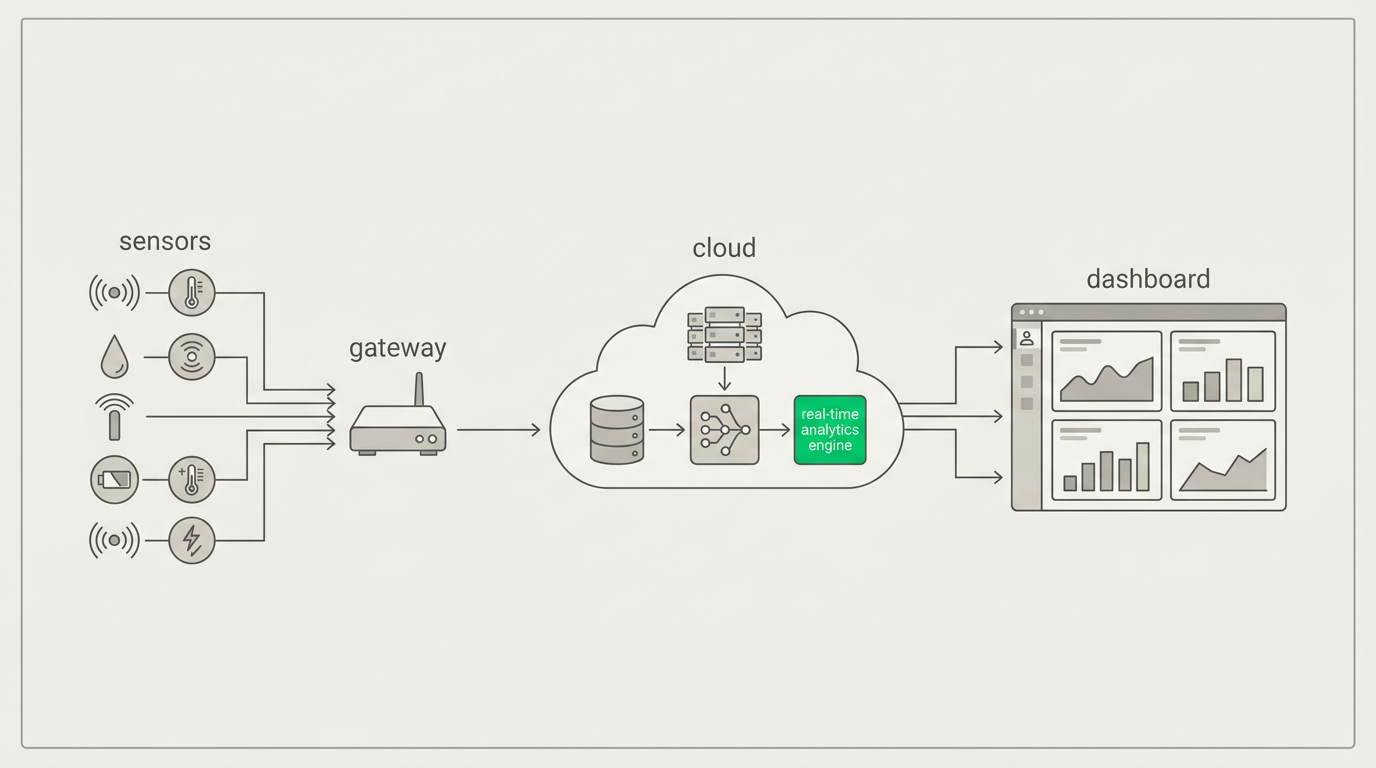
In practical terms, sensors — strain gauges, accelerometers, tiltmeters, crack meters, piezometers, and displacement transducers — are installed at critical points on a structure. These sensors measure physical quantities such as stress (in kPa or MPa), deformation (in mm), tilt (in arc-seconds or milliradians), and dynamic acceleration (in mm/s²). Readings are transmitted automatically to a central data logger, then to a cloud or on-premise software platform where engineers set alert thresholds and review trend data.
To understand what is structural health monitoring and how does it work for critical infrastructure at a deeper technical level, the sensor-to-dashboard chain involves signal conditioning, analogue-to-digital conversion, wireless or wired telemetry, and automated anomaly detection — each step governed by instrument accuracy specifications and sampling rates appropriate to the structural type.
The goal is not simply to collect data. The goal is to detect, locate, and quantify damage or deterioration early enough that engineers can act before a structure reaches a limit state defined under IS 1893 (seismic), IRC:6 (bridge loading), or IS 13311 (concrete integrity testing).
Why SHM Matters: The Indian Regulatory and Risk Context
India manages one of the world's largest inventories of civil infrastructure: over 1.7 lakh bridges on national and state highways alone, more than 5,000 large dams, thousands of kilometres of tunnels under construction or in service, and a rapidly expanding stock of high-rise buildings in seismically active zones. The consequences of structural failure in this context are not abstract.
The Dam Safety Act 2021 — India's first dedicated legislation for dam safety — mandates instrumentation and regular safety reviews for all large dams. CWC guidelines specify that dams above 30 metres height must have continuous seepage, pore pressure, and deformation monitoring. For bridges, MORTH and IRC SP-35 recommend periodic structural assessment, and NHAI's project agreements increasingly include SHM as a contractual deliverable for long-span and critical bridges.
SHM India deployments are therefore increasingly driven by compliance, not just engineering best practice. For decision-makers at agencies such as NHAI, RVNL, RITES, BRO, and CWC, specifying SHM is a risk management decision with regulatory backing. For EPC contractors such as L&T, Tata Projects, and Ahluwalia Constructions, SHM during construction protects against liability by providing a documented record of structural behaviour from day one.
The Geolook SHM solutions portfolio addresses this compliance-driven demand across bridges, tunnels, dams, slopes, and buildings, with sensor systems, data loggers, and software platforms configured to the specific monitoring parameters each structure type requires.
What SHM Measures: Parameters That Matter to Decision-Makers
A common misconception is that SHM is simply about placing sensors and watching numbers. In reality, each parameter measured corresponds to a specific failure mode or performance criterion defined in Indian Standards or IRC codes.
For bridges, key parameters include: dynamic strain at mid-span and support sections (µε), natural frequency shifts that indicate stiffness loss, bearing displacement (mm), and crack width at expansion joints. IRC:112 defines serviceability limit states for concrete bridges that SHM systems are calibrated to detect.
For tunnels constructed using the New Austrian Tunnelling Method (NATM), convergence monitoring — measuring the inward movement of tunnel walls in millimetres — is a primary safety indicator. Geolook's deployment across five tunnels on NH-44 in the Ramban-Banihal corridor, in association with DRAIPL and under NHAI oversight, uses automated convergence monitoring to provide real-time alerts when wall movement exceeds design thresholds.
For high-rise buildings and deep excavations, settlement monitoring at raft foundation level (mm), inclinometer readings for lateral soil movement (mm/m), and vibration monitoring during adjacent construction (mm/s²) are standard. IS 1892 governs subsurface investigation requirements that inform sensor placement for geotechnical monitoring.
For dams, piezometric head (metres of water column or kPa), seepage flow rate (litres per second), and crest settlement (mm) are the primary parameters tracked under CWC guidelines and IS 7894.
Explore the full range of Geolook structural monitoring sensors used across these parameter types, from vibrating wire strain gauges to MEMS accelerometers and automated total stations.
Periodic Inspection Versus Continuous SHM: A Comparison
The distinction between traditional periodic inspection and continuous SHM is not merely one of frequency. It is a difference in the type of information produced and the decisions that information can support.
| Criterion | Periodic Visual Inspection | Continuous SHM |
|---|---|---|
| Frequency | Annual or biennial, per IRC SP-35 schedule | Continuous — readings every few seconds to minutes |
| Data type | Qualitative observations, photographs, inspector judgement | Quantitative: µε, mm, mm/s², kPa — logged with timestamp |
| Damage detection | Visible surface damage only; internal deterioration missed | Sub-surface and internal changes detected via parameter drift |
| Response time | Weeks to months between inspection and report | Real-time alerts when thresholds are breached |
| Traceability | Inspector-dependent; difficult to audit or compare over time | Full audit trail; trend analysis over months and years |
| Applicability during events | Inspection suspended during flood, seismic event, or storm | Monitoring continues through extreme events — most critical data captured |
| Regulatory alignment | Meets minimum IRC SP-35 and Dam Safety Act inspection requirements | Meets and exceeds CWC, NHAI, and Dam Safety Act instrumentation mandates |
This comparison illustrates why SHM importance is not simply about technology preference. For structures where failure consequences are irreversible — a dam serving a downstream population, a tunnel under active traffic, a cable-stayed bridge on a national highway — continuous monitoring is the only approach that provides the data density needed for informed decisions.
Digital Twins and Software Platforms: Making SHM Accessible to Decision-Makers
One of the most significant developments in why SHM matters today is the emergence of digital twin platforms that translate raw sensor data into visual, navigable models that non-technical decision-makers can interpret directly.
Geolook developed a 3D Digital Twin and VR Visualisation Platform for RITES Ltd's Bridge Health Monitoring System. This platform allows engineers and project managers to navigate a photorealistic 3D model of a bridge, click on any structural element, and view its current sensor readings, historical trend, and alert status — without needing to interpret raw data files or engineering reports.
Similarly, the MIT-WPU Tunnel Health Monitoring and Digital Twin Excellence Centre in Pune — inaugurated by Hon'ble Minister Sh. Nitin Gadkari — serves as both a live monitoring facility and a research and training hub where engineers learn to interpret SHM data within a digital twin environment. This centre demonstrates how AI-enabled analytics can process thousands of sensor readings per hour and flag anomalies that would be invisible in periodic inspection data.
For procurement leads and project directors, the implication is practical: modern SHM is not a black box operated only by instrumentation specialists. A well-configured SHM software platform presents structural condition as a dashboard — colour-coded alerts, trend graphs, and automated reports — that supports decisions at the project director level, not just the site engineer level.
To understand how what is the best cloud based software platform for structural health monitoring in india can be evaluated for your specific project type, the key criteria include data latency, alert configurability, integration with existing SCADA or project management systems, and compliance with data sovereignty requirements for government projects.
SHM Across Structure Types: Where It Is Applied in India
Understanding what is structural health monitoring and why does it matter requires seeing it applied across the full range of structure types that Indian infrastructure agencies manage.
Bridges: Long-span bridges — cable-stayed, extra-dosed, and prestressed concrete box girder — are the most common SHM candidates. IIT-Mandi's bridge health monitoring programme and Neeladari Buildtech's wireless bridge monitoring deployment both illustrate how sensor networks can be retrofitted to existing structures as well as embedded in new construction. IRC:114 provides guidance on seismic design of bridges, and SHM systems are increasingly specified to verify that bridges perform within design envelopes during seismic events.
Tunnels: NATM tunnels under active construction require real-time convergence and shotcrete stress monitoring. Geolook's five-tunnel deployment on NH-44 in J&K demonstrates how SHM data feeds directly into construction decision-making — adjusting support installation timing based on measured deformation rates rather than fixed schedules.
High-rise buildings and deep excavations: Urban construction in Delhi NCR, where projects such as DLF Downtown Gurgaon (with Ahluwalia Constructions and B L Kashyap) and DLF Privana Gurgaon (with ACC India) use industrial-grade DAQ systems for real-time settlement monitoring, shows how SHM protects adjacent structures and documents contractor compliance with IS 1892 geotechnical requirements.
Dams: Under the Dam Safety Act 2021, all large dams must have an approved instrumentation plan. SHM systems for dams integrate piezometers, seepage measurement weirs, and geodetic survey points into a unified monitoring platform reviewed by the State Dam Safety Organisation (SDSO).
Explore how remote infrastructure monitoring extends SHM capability to structures in geographically remote or access-restricted locations, including high-altitude bridges and tunnels in J&K and Himachal Pradesh.
What Decision-Makers Need to Ask Before Specifying SHM
For project directors, procurement leads, and agency officials evaluating SHM for the first time, the following questions frame the specification process correctly.
What are the critical failure modes for this structure? SHM system design starts with a failure mode and effects analysis (FMEA) specific to the structure type, loading conditions, and environmental exposure. A tunnel in a seismically active zone has different monitoring priorities than a coastal bridge subject to chloride-induced corrosion.
What parameters need to be measured, at what frequency, and with what accuracy? Strain gauges for a prestressed concrete bridge may need resolution to 1 µε. Settlement monitoring for a raft foundation may need resolution to 0.1 mm. These accuracy requirements determine sensor selection and data logger specification. Review the Geolook data logger range for channel capacity, sampling rate, and communication protocol options relevant to your project scale.
Who will own and interpret the data? SHM generates large volumes of time-series data. Without a defined data management plan — including alert thresholds, escalation protocols, and periodic reporting obligations — the data has limited operational value. Specifying a software platform with automated reporting is as important as specifying the sensors themselves.
What are the contractual and regulatory obligations? For NHAI projects, RVNL viaducts, or CWC-regulated dams, the monitoring plan may need to be submitted to the relevant authority for approval. Understanding the regulatory framework early avoids redesign costs later.
To understand the full scope of what Geolook delivers across sensor supply, data acquisition, and software, visit what we do at Geolook for a structured overview of our end-to-end SHM capability.
Frequently Asked Questions
Q: What is structural health monitoring in simple terms?
A: Structural health monitoring (SHM) is the use of sensors permanently installed on a structure — a bridge, tunnel, dam, or building — to continuously measure physical parameters such as strain, displacement, vibration, and crack width, and to transmit that data automatically to engineers who can detect deterioration or damage before it becomes a safety risk.
Q: Is SHM mandatory for infrastructure projects in India?
A: SHM is mandated or strongly recommended under several Indian frameworks. The Dam Safety Act 2021 requires instrumentation for all large dams. CWC guidelines specify continuous monitoring parameters for dams above 30 metres. NHAI project agreements for long-span and critical bridges increasingly include SHM as a contractual deliverable. MORTH and IRC SP-35 recommend periodic structural assessment that SHM systems directly support.
Q: How is SHM different from a routine bridge inspection?
A: A routine bridge inspection, as defined under IRC SP-35, is a periodic visual and manual assessment that produces qualitative observations. SHM produces continuous, quantified data — strain in micro-strain, displacement in millimetres, vibration in mm/s² — with timestamps, trend history, and automated alerts. SHM detects internal or sub-surface changes that visual inspection cannot identify, and it operates continuously through floods, seismic events, and other conditions when physical inspection is suspended.
Q: What does an SHM system cost, and who bears that cost?
A: SHM system cost depends on structure type, number of monitoring points, sensor types, communication infrastructure, and software platform requirements. For government projects under NHAI, RVNL, or CWC, SHM is typically a line item in the project cost estimate, funded through the project budget. For EPC contractors, SHM during construction is often specified in the contract scope. The relevant agency or project owner should engage an SHM specialist early in the design phase to size the system correctly.
Q: Can SHM data be used as evidence in structural safety assessments or legal proceedings?
A: Yes. SHM data logged with calibrated instruments, traceable timestamps, and documented sensor calibration records constitutes an auditable engineering record. It can support structural safety assessments submitted to the State Dam Safety Organisation, NHAI, or other regulatory bodies, and it provides a documented baseline that is admissible in technical investigations or legal proceedings related to structural performance or contractor liability.
Talk to SHM experts
India's infrastructure investment cycle is accelerating. Bridges, tunnels, dams, and urban structures being built or upgraded today will be in service for 50 to 100 years. The decisions made now about monitoring — what to measure, how often, and with what system — will determine whether owners have the data they need to manage those assets safely across their full design life.
Geolook's team of structural, geotechnical, and instrumentation engineers has deployed SHM systems for NHAI, RITES, BRO-affiliated institutions, and leading EPC contractors across India. Whether you are at the feasibility stage, preparing a monitoring plan for regulatory submission, or evaluating sensor and software options for a specific structure, we can help you define the right system for your project's risk profile and budget.
To discuss your project requirements with our SHM engineering team, contact Geolook directly and we will arrange a technical consultation at no obligation. You can also explore our end-to-end capability through the structural health monitoring resource library, which covers sensor selection, data acquisition architecture, and software platform evaluation in depth.
Project inquiry
Talk to a Geolook™ specialist
Share your monitoring requirement and our team will help identify the right next step.
By submitting, you agree that Geolook™ may contact you about this inquiry. Your details are not added to a marketing list.