Tunnel Health Monitoring: Sensors, Systems & Real-Time Safety
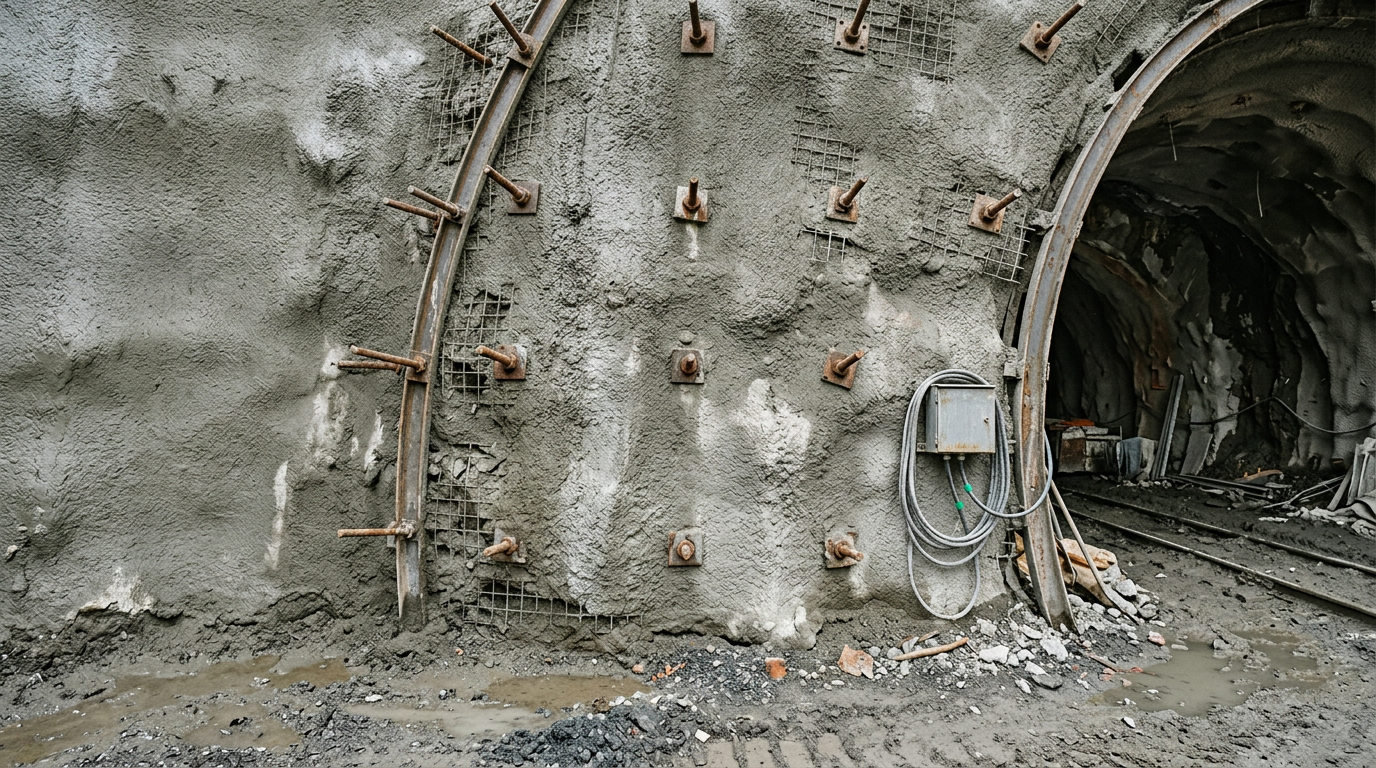
In August 2014, a section of the Banihal-Qazigund road tunnel on NH-44 in Jammu & Kashmir experienced significant structural distress during construction, exposing the consequences of inadequate real-time deformation tracking in geologically complex terrain. That event accelerated the case for continuous, sensor-based tunnel health monitoring on Indian highway and metro projects — a discipline that has since moved from post-incident investigation to proactive, data-driven safety management. For tunnel engineers and metro authorities overseeing assets that carry millions of passengers or connect strategically critical corridors, the question is no longer whether to instrument a tunnel, but how to do it with the precision and redundancy that the structure demands. This guide covers sensor selection, placement logic, convergence measurement, data acquisition architecture, and the regulatory context that governs tunnel instrumentation in India.
Key Takeaways
- Tunnel health monitoring is the continuous measurement of structural deformation, stress, groundwater pressure, and environmental parameters inside a tunnel to detect unsafe conditions before they become failures.
- Convergence — the inward displacement of tunnel walls — is the primary indicator of ground-structure interaction and must be tracked to sub-millimetre resolution in NATM and metro bored tunnels.
- Indian highway tunnels under NHAI and BRO jurisdiction increasingly require real-time SHM as a condition of project completion; the Ramban-Banihal NH-44 corridor is an active example.
- A complete tunnel monitoring system integrates geotechnical sensors, structural sensors, a data acquisition unit (DAQ), and a cloud or edge analytics platform capable of threshold-based alerting.
- Sensor placement must follow the excavation sequence: face instrumentation first, followed by lining instrumentation, and finally long-term embedded sensors for operational-phase monitoring.
What Is Tunnel Health Monitoring
Tunnel health monitoring is the systematic, continuous measurement of mechanical, geotechnical, and environmental parameters within a tunnel structure to assess its safety, detect anomalous behaviour, and support maintenance decisions throughout the asset's operational life.
The discipline draws on geotechnical instrumentation principles codified in IS 1892 and IS 2720, combined with structural sensing methods aligned with IS 13311 for concrete assessment. In the Indian context, it applies across three primary tunnel categories: highway tunnels under NHAI and MORTH jurisdiction, metro rail tunnels governed by DMRC, CMRL, BMRCL, and other urban metro corporations, and strategic tunnels under BRO in high-altitude and seismically active zones.
The physical parameters measured include radial convergence (mm), crown settlement (mm), axial and hoop stress in the primary lining (MPa), pore water pressure in the surrounding ground (kPa), rock bolt load (kN), shotcrete strain (micro-strain), and ambient temperature and humidity. Each parameter maps to a specific failure mode: convergence excess indicates ground squeezing or inadequate support; elevated pore pressure signals potential hydraulic instability; lining stress anomalies point to load redistribution from adjacent excavation or surcharge.
For metro projects, additional parameters include vibration velocity (mm/s) and acceleration (mm/s²) from train-induced dynamic loading, which must be assessed against IS 1893 Part 1 thresholds for underground structures in seismic zones III, IV, and V — zones that cover most of peninsular and northern India.
Sensor Types and Their Engineering Role
A well-designed tunnel monitoring system is not a single instrument but a layered sensor network, each layer addressing a distinct failure mechanism. The following sensor categories are standard in Indian tunnel instrumentation practice.
Convergence measurement systems: Automated total stations (ATS) and robotic total stations measure 3D displacement of prism targets fixed to the tunnel lining at cross-section intervals of 5 m to 20 m depending on ground class. Resolution is typically 0.1 mm to 0.3 mm. In NATM tunnels, convergence sections are established within 1–2 diameters behind the advancing face. Manual tape extensometers remain in use for baseline verification but cannot provide the continuous data streams required for real-time alerting.
Tunnel deformation sensors — embedded and surface-mounted: Vibrating wire strain gauges (VWSG) embedded in shotcrete or cast-in-place concrete lining measure hoop and axial strain in micro-strain units. A typical VWSG has a gauge length of 150 mm and a resolution of ±1 micro-strain. Fibre Bragg Grating (FBG) sensors offer distributed strain measurement along the lining circumference and are increasingly used in metro tunnels where the lining geometry is uniform and cable routing is manageable. A complete range of geotechnical and structural sensors for tunnel applications covers both vibrating wire and FBG technologies suited to Indian site conditions.
Rock bolts and load cells: Instrumented rock bolts with vibrating wire load cells measure axial force (kN) in the bolt shank. In squeezing ground — common in the Himalayan geology of the Ramban-Banihal corridor — bolt loads can approach yield capacity within days of installation, making real-time load monitoring operationally critical.
Piezometers: Vibrating wire piezometers installed in boreholes adjacent to the tunnel measure pore water pressure (kPa) in the surrounding rock or soil mass. Pressure changes correlate with drainage effectiveness and can precede convergence acceleration by hours, providing early warning time.
Accelerometers and geophones: In operational metro tunnels, MEMS accelerometers measure vibration acceleration (mm/s²) from train passage. Velocity transducers (geophones) measure peak particle velocity (mm/s) at the lining surface. These readings are compared against DGMS and IS 1893 limits to assess fatigue loading on the lining over time.
Inclinometers and tiltmeters: Biaxial tiltmeters mounted on the lining or portal structures detect rotational deformation (arc-seconds or milli-radians) that may indicate differential settlement or portal instability. In-place inclinometers in vertical boreholes track lateral ground movement profiles adjacent to the tunnel envelope.
Sensor Placement Strategy Across the Tunnel Life Cycle
Sensor placement in a tunnel is not static — it must follow the construction sequence and then transition to an operational monitoring regime. Misplacing sensors relative to the excavation face or lining pour sequence is one of the most common causes of data gaps in Indian tunnel projects.
Construction phase — face and near-face instrumentation: During NATM excavation, the first convergence section should be established within one tunnel diameter (D) behind the face. Typical cross-section geometry includes three convergence targets: one at the crown and two at the springline on each side. In full-face excavation of a 10 m diameter tunnel, this means the first section is set at 8–10 m from the face. Shotcrete strain gauges are cast into the primary lining at the same cross-section. Rock bolt load cells are installed at the same station on the most critically loaded bolts.
Construction phase — intermediate instrumentation: As excavation advances, additional convergence sections are established at 10 m to 20 m intervals. Piezometers are drilled from the tunnel invert or from surface boreholes to monitor groundwater response to excavation. Settlement points on the surface above the tunnel alignment — typically at 5 m to 10 m spacing — track surface subsidence, which in urban metro tunnels must be controlled to within ±10 mm to ±25 mm depending on proximity to existing structures.
Operational phase — permanent embedded instrumentation: After secondary lining placement, a subset of sensors transitions to permanent monitoring. These include embedded VWSGs in the secondary lining, piezometers in sealed boreholes, and surface-mounted accelerometers for dynamic load monitoring. The permanent system is connected to a DAQ unit with GPRS or fibre-optic data transmission to a central monitoring platform. For metro tunnels, the platform must support multi-channel simultaneous acquisition at sampling rates up to 1 kHz for dynamic events.
The MIT-WPU Tunnel Health Monitoring and Digital Twin Excellence Centre in Pune, inaugurated under the patronage of Hon'ble Minister Sh. Nitin Gadkari, has established a reference framework for sensor placement protocols and digital twin integration that is now informing training curricula for tunnel engineers across India. This centre provides a physical testbed where sensor placement scenarios — including NATM, TBM, and cut-and-cover geometries — can be simulated before field deployment.
Convergence Monitoring: The Core Metric in NATM and Metro Tunnels
Convergence is the inward displacement of the tunnel cross-section walls relative to their initial position after excavation. It is the single most diagnostic parameter in tunnel health monitoring because it integrates the combined effect of ground pressure, support stiffness, and time-dependent rock or soil behaviour.
In NATM tunnels, convergence is assessed against the New Austrian Tunnelling Method's three-category alert system. Category A (normal behaviour) allows construction to proceed. Category B (warning) requires review of support measures. Category C (critical) mandates immediate stoppage and remedial action. The threshold values are project-specific and derived from the geomechanical model, but typical Category B thresholds for a 10 m diameter tunnel in Class IV rock are in the range of 50–80 mm total convergence, with a rate threshold of 2–5 mm per day.
In metro bored tunnels constructed by TBM, convergence is measured on the segmental lining using automated total stations or laser scanning. The allowable deformation is tighter — typically ±5 mm to ±15 mm radially — because the precast concrete segments have limited ductility and joint rotation capacity. Exceeding these limits can open gasket joints, leading to water ingress and long-term durability loss.
On the Ramban-Banihal NH-44 corridor in Jammu & Kashmir, Geolook deployed real-time SHM across five tunnels in association with DRAIPL, with convergence data transmitted continuously to NHAI's regional office for review. The Himalayan geology of this corridor — characterised by highly jointed phyllites, slates, and thrust zones — produces time-dependent squeezing behaviour that makes continuous convergence tracking operationally essential rather than merely good practice. Regular review meetings with the NHAI Regional Office ensured that alert thresholds were calibrated against observed ground behaviour rather than generic design assumptions.
For metro authorities, convergence data from the construction phase also feeds the as-built structural model, which becomes the baseline for operational monitoring. Any subsequent convergence detected during operations — from adjacent construction, groundwater changes, or seismic events — is measured against this baseline. Explore how structural instrumentation for metro rail projects in Indian cities integrates convergence monitoring with broader SHM frameworks.
Data Acquisition Architecture for Tunnel Monitoring Systems
A tunnel monitoring system's value is determined not only by sensor quality but by the integrity of the data acquisition and transmission chain. In underground environments, this chain faces specific challenges: electromagnetic interference from construction equipment, limited wireless signal propagation through rock and concrete, high humidity, and the need for intrinsically safe equipment in tunnels with explosive atmospheres during construction.
DAQ unit specifications: Industrial-grade DAQ units for tunnel applications typically support 16 to 64 channels of vibrating wire input, with simultaneous sampling capability. Resolution should be 0.001 Hz for vibrating wire frequency output, corresponding to approximately 0.1 micro-strain or 0.01 kPa depending on sensor type. Units must operate across the temperature range of 0°C to 60°C and meet IP67 ingress protection as a minimum for underground deployment.
Communication architecture: In long tunnels, a distributed DAQ topology is preferred: multiple field units placed at 200 m to 500 m intervals along the tunnel, connected by RS-485 or CAN bus to a master unit at the portal, which then transmits via GPRS, 4G, or fibre optic to the cloud platform. This architecture avoids the signal attenuation and cable management problems of centralised single-unit systems. For the Ramban-Banihal tunnels, the communication design had to account for the absence of reliable cellular coverage in the Banihal range, requiring a hybrid wired-wireless architecture.
Alert and reporting logic: The monitoring platform must implement multi-level alerting: green (within design limits), amber (approaching threshold — increased monitoring frequency), and red (threshold exceeded — immediate notification to site engineer and project authority). Alerts should be delivered via SMS, email, and dashboard notification simultaneously. Data logging frequency should be configurable from 1-minute intervals during active construction to 15-minute or hourly intervals during steady-state operations.
Digital twin integration: Advanced implementations link the sensor data stream to a parametric structural model — a digital twin — that updates in near-real time. The MIT-WPU Tunnel Health Monitoring and Digital Twin Excellence Centre has developed protocols for this integration, enabling engineers to visualise deformation patterns in 3D and run scenario analyses against the live data. This capability is particularly valuable for metro authorities managing multiple tunnel assets simultaneously across a network. Learn more about tunnel monitoring with IoT sensors and how edge computing is changing data acquisition in underground environments.
Sensor Performance Comparison for Tunnel Monitoring Applications
Selecting the right tunnel deformation sensor requires matching the measurement principle to the physical parameter, the installation environment, and the required data frequency. The table below compares the principal sensor technologies used in Indian tunnel monitoring practice.
| Sensor Type | Parameter Measured | Typical Resolution | Installation Phase | Data Output | Suitability for Indian Metro Tunnels |
|---|---|---|---|---|---|
| Vibrating Wire Strain Gauge (VWSG) | Lining strain (micro-strain) | ±1 micro-strain | Construction (embedded in lining) | Frequency (Hz), converted to strain | High — robust in humid underground conditions, long service life |
| Fibre Bragg Grating (FBG) | Distributed strain along lining (micro-strain) | ±0.5 micro-strain | Construction (surface-bonded or embedded) | Wavelength shift (nm) | High for TBM tunnels; cable routing requires planning in NATM |
| Automated Total Station (ATS) | 3D convergence displacement (mm) | 0.1–0.3 mm | Construction and operational | 3D coordinates (mm) | Very high — standard for metro and highway tunnel convergence |
| Vibrating Wire Piezometer | Pore water pressure (kPa) | ±0.025% FS | Construction (borehole installation) | Frequency (Hz), converted to kPa | High — essential in water-bearing ground and monsoon-sensitive zones |
| Instrumented Rock Bolt (Load Cell) | Bolt axial force (kN) | ±0.1% FS | Construction (installed with bolt) | Frequency (Hz), converted to kN | High for NATM tunnels in squeezing Himalayan geology |
| MEMS Accelerometer | Vibration acceleration (mm/s²) | ±0.001 g | Operational (surface-mounted) | Analogue or digital (g or mm/s²) | High for operational metro tunnels — train-induced dynamic monitoring |
| In-Place Inclinometer | Lateral ground displacement (mm) | ±0.02 mm per 500 mm gauge | Construction (borehole) | Tilt angle (arc-seconds) | Moderate — used at portals and in soft-ground metro sections |
For a broader view of how these sensor technologies apply across tunnel, bridge, and dam assets, the guide on structural health monitoring for bridges dams and tunnels india provides a comparative framework across infrastructure types.
Regulatory and Standards Framework for Tunnel Instrumentation in India
India does not yet have a single unified standard exclusively governing tunnel health monitoring, but the regulatory framework is assembled from several overlapping codes and agency guidelines that together define minimum instrumentation requirements.
MORTH and NHAI requirements: The Ministry of Road Transport and Highways' standard specifications for road tunnels require instrumentation during construction for all tunnels longer than 100 m. NHAI project-specific requirements, particularly on NH-44 and other national highway tunnels in seismically active zones, increasingly mandate real-time monitoring with data accessible to the regional office. The Ramban-Banihal project is a direct example of this mandate in practice.
IS 1892 and IS 2720: These standards govern subsurface investigation and soil testing, providing the geotechnical baseline against which tunnel instrumentation data is interpreted. Piezometer readings, for instance, are meaningful only in the context of the pre-excavation groundwater regime established through IS 1892-compliant investigation.
IS 1893 Part 1 (2016): Seismic design provisions apply to underground structures in zones III, IV, and V. Metro tunnels in Delhi (Zone IV), Mumbai (Zone III), and Chennai (Zone III) must be designed and monitored with seismic loading in mind. Accelerometer networks in operational metro tunnels provide the data needed to verify that dynamic loads remain within IS 1893 limits.
DMRC and metro corporation guidelines: Delhi Metro Rail Corporation, Chennai Metro Rail Limited, Bangalore Metro Rail Corporation, and other metro authorities have project-specific instrumentation specifications embedded in their civil works contracts. These typically specify convergence monitoring frequency (daily during construction, weekly during commissioning, monthly during operations), alert thresholds, and reporting formats.
Dam Safety Act 2021 analogy: While not directly applicable to tunnels, the Dam Safety Act 2021's mandatory instrumentation provisions for large dams have set a legislative precedent that tunnel safety advocates cite when arguing for statutory monitoring requirements for critical tunnel infrastructure. A similar legislative framework for tunnels is under discussion within MORTH technical committees.
For a detailed treatment of underground structure instrumentation requirements across Indian project types, the guide on underground structure instrumentation covers bored tunnels, cut-and-cover structures, and underground stations.
Geolook's Approach: From Sensor to Decision
Geolook's tunnel monitoring deployments are engineered around the principle that sensor data has no value unless it reaches the right decision-maker in time to act. This means the instrumentation design, DAQ architecture, communication system, and analytics platform are specified as an integrated system rather than assembled from independent components.
On the Ramban-Banihal NH-44 tunnels — five tunnels in geologically challenging terrain in Jammu & Kashmir — the deployment involved real-time convergence monitoring, rock bolt load tracking, and piezometric pressure measurement, with data transmitted to NHAI's regional office for continuous review. The system was designed to maintain data continuity through the communication constraints of the Banihal range, using a hybrid architecture that combined wired field networks with cellular uplinks at portal locations.
At the MIT-WPU Tunnel Health Monitoring and Digital Twin Excellence Centre in Pune, Geolook has contributed to building a permanent reference installation where tunnel engineers can study sensor placement, DAQ configuration, and digital twin visualisation in a controlled environment. The centre, inaugurated under the patronage of Hon'ble Minister Sh. Nitin Gadkari, serves as both a research facility and a training platform for the next generation of tunnel monitoring practitioners in India.
The integration of IoT-enabled DAQ units with cloud analytics platforms allows Geolook's systems to deliver threshold-based SMS and email alerts within seconds of a sensor reading crossing a pre-set limit — a capability that is particularly critical during the high-risk construction phase when ground conditions can change rapidly. Explore the full range of underground monitoring solutions that Geolook deploys for metro, highway, and strategic tunnel projects across India.
Frequently Asked Questions
Q: What is tunnel health monitoring and why is it required on Indian metro projects?
A: Tunnel health monitoring is the continuous measurement of structural deformation, stress, groundwater pressure, and dynamic loading in a tunnel to detect unsafe conditions in real time. On Indian metro projects, it is required by metro corporation civil specifications and by IS 1893 seismic provisions for underground structures in zones III, IV, and V, ensuring that construction-phase deformation and operational dynamic loads remain within design limits.
Q: What is convergence in tunnel monitoring and what are typical alert thresholds?
A: Convergence is the inward displacement of tunnel walls measured in millimetres at defined cross-sections after excavation. In NATM tunnels, alert thresholds are project-specific but typically fall in the range of 50–80 mm total convergence or 2–5 mm per day rate for a 10 m diameter tunnel in Class IV rock. In metro TBM tunnels, radial deformation limits are tighter, typically ±5 mm to ±15 mm, to protect segmental lining joint integrity.
Q: Which sensors are used in a tunnel deformation sensor network for metro bored tunnels?
A: A tunnel deformation sensor network for metro bored tunnels typically includes automated total stations for 3D convergence measurement, vibrating wire strain gauges or fibre Bragg grating sensors embedded in the segmental lining, vibrating wire piezometers in adjacent boreholes, and MEMS accelerometers for train-induced vibration monitoring. Each sensor type addresses a distinct failure mechanism in the lining and surrounding ground.
Q: How does a tunnel monitoring system transmit data from deep underground to a control centre?
A: A tunnel monitoring system uses a distributed DAQ topology: field units placed at 200–500 m intervals along the tunnel collect sensor data and transmit it via RS-485 or CAN bus to a master unit at the portal, which then sends data to a cloud platform via GPRS, 4G, or fibre optic. This architecture maintains data continuity even in tunnels with limited wireless coverage, such as those in the Himalayan ranges.
Q: What Indian standards and agency guidelines govern tunnel instrumentation requirements?
A: Tunnel instrumentation in India is governed by MORTH standard specifications for road tunnels, NHAI project-specific requirements for national highway tunnels, IS 1892 and IS 2720 for geotechnical baseline investigation, IS 1893 Part 1 (2016) for seismic loading on underground structures, and metro corporation civil specifications from DMRC, CMRL, BMRCL, and other urban metro authorities. There is currently no single unified Indian standard exclusively for tunnel health monitoring.
Design tunnel system
Every tunnel is a unique geomechanical problem. The sensor types, placement intervals, DAQ architecture, and alert thresholds that work on a TBM metro tunnel in Chennai's marine clay are different from those required on a NATM highway tunnel in the phyllitic schists of the Banihal range. Getting the instrumentation design right at the project outset — before excavation begins — is the only way to ensure that the data collected is actionable rather than archival.
Geolook's engineering team works with tunnel designers, EPC contractors, and metro authorities from the instrumentation specification stage through to operational monitoring. Whether you are specifying a tunnel health monitoring system for a new metro project, retrofitting sensors into an existing operational tunnel, or building a multi-tunnel monitoring network for a highway corridor, the starting point is a structured conversation about your ground conditions, construction method, regulatory requirements, and data management needs.
Contact Geolook's tunnel monitoring team to discuss your project requirements and receive a sensor placement and system architecture recommendation specific to your tunnel geometry and ground conditions.
Project inquiry
Talk to a Geolook™ specialist
Share your monitoring requirement and our team will help identify the right next step.
By submitting, you agree that Geolook™ may contact you about this inquiry. Your details are not added to a marketing list.