Structural Health Monitoring for Bridges Dams and Tunnels India
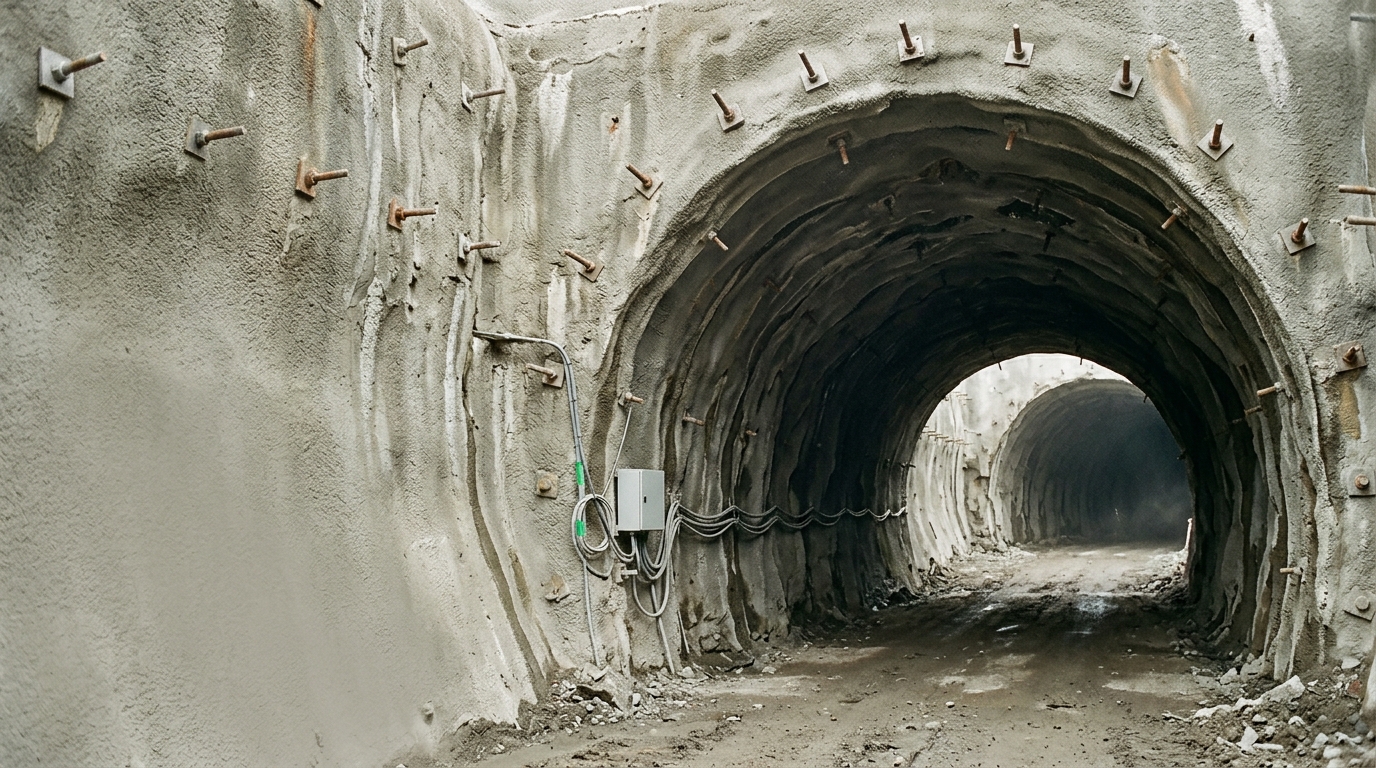
In August 2016, a portion of the Majerhat Bridge in Kolkata showed distress signals that went undetected until its catastrophic collapse in September 2018, killing three people and disrupting a critical urban corridor for months. The incident prompted the Ministry of Road Transport and Highways (MoRTH) to accelerate bridge condition assessment mandates and brought structural health monitoring for bridges dams and tunnels India into sharp focus across every tier of infrastructure governance.
India currently operates more than 1.5 lakh bridges on national highways alone, manages over 5,000 large dams under the Dam Safety Act 2021, and is executing the world's largest tunnel construction programme under NHAI, RVNL, and BRO. Each asset class carries a distinct failure mode, a distinct regulatory framework, and a distinct sensor architecture. This post maps all three, grounding every application in the Indian Standards, agency mandates, and field deployments that practising engineers need.
Key Takeaways
- Structural health monitoring for bridges dams and tunnels India is governed by distinct Indian Standards: IRC SP-35 and IRC:114 for bridges, IS 7894 and the Dam Safety Act 2021 for dams, and NATM-aligned convergence protocols for tunnels.
- Each infrastructure type demands a specific sensor suite — vibrating wire strain gauges, MEMS accelerometers, piezometers, and fibre-optic distributed sensing — selected against the dominant failure mechanism of that asset.
- Real-time data acquisition systems (DAQ) with threshold-based alerting reduce the window between anomaly onset and engineering response, which is critical in seismically active zones classified under IS 1893.
- Digital twin platforms, such as those developed at the MIT-WPU Tunnel Health Monitoring and Digital Twin Excellence Centre in Pune, are transforming raw sensor streams into actionable 3D visualisations for asset managers.
- NHAI, CWC, and BRO are increasingly specifying continuous SHM as a contractual deliverable on new projects, making instrumentation literacy a procurement-critical skill for EPC teams.
What Is Structural Health Monitoring for Infrastructure Assets
Structural health monitoring (SHM) is the process of implementing a damage-identification and characterisation strategy for engineering structures by embedding or attaching sensors that continuously or periodically measure physical parameters — strain in micro-strain (με), displacement in millimetres, acceleration in mm/s², pore-water pressure in kPa, and crack width in mm — and processing those measurements against pre-defined performance thresholds to detect, locate, and quantify structural deterioration.
In the Indian context, SHM sits at the intersection of several regulatory instruments. For bridges, IRC SP-35 (Guidelines for Inspection and Maintenance of Bridges) and IRC:114 (Guidelines for Seismic Design of Road Bridges) define the inspection frequency and seismic performance requirements that SHM systems must support. For dams, the Dam Safety Act 2021 mandates instrumentation for all large dams and requires dam safety review panels to evaluate monitoring data. For tunnels constructed under NATM, convergence monitoring at defined chainage intervals is a contractual requirement embedded in NHAI and RVNL project specifications.
The common thread across all three asset classes is the shift from periodic visual inspection — which detects damage only after it is visible — to continuous parametric monitoring that captures the precursors to visible damage: micro-strain accumulation, pore-pressure build-up, and sub-millimetre convergence.
SHM for Bridges in India: Sensor Architecture and Regulatory Context
Bridge failures in India have historically been attributed to scour, fatigue in steel girders, alkali-silica reaction in concrete, and inadequate seismic detailing. SHM bridges India deployments must therefore address at least four measurement domains simultaneously.
Strain and stress monitoring uses vibrating wire strain gauges (VWSG) embedded in or surface-mounted on concrete and steel members. A VWSG resolves strain to ±1 με, which is sufficient to detect early-stage fatigue crack initiation in steel plate girders carrying IRC:6 Class AA loading. Fibre Bragg Grating (FBG) sensors offer distributed strain measurement along a single optical fibre at spatial resolutions below 1 metre, making them suitable for long-span cable-stayed and extradosed bridges where point sensors would miss localised anomalies.
Dynamic response monitoring uses MEMS or piezoelectric accelerometers to capture modal frequencies, damping ratios, and mode shapes. A shift of more than 5% in the fundamental frequency of a simply supported span is a widely accepted indicator of stiffness loss, though the precise threshold must be calibrated against the bridge's finite element model. IS 1893 (Part 3) governs seismic design of bridges, and SHM systems in Zone IV and Zone V must be capable of capturing peak ground acceleration (PGA) events and correlating structural response to demand.
Scour monitoring uses sonar-based bed-level sensors or tiltmeters on pier foundations to detect foundation exposure. IS 78 (IRC:78) governs foundation design, and scour depth exceeding design assumptions is a Level 1 alert condition in any bridge SHM protocol.
Crack and displacement monitoring uses linear variable differential transformers (LVDTs) and crack meters to track joint movement and crack propagation. Displacement resolution of 0.01 mm is achievable with industrial-grade LVDTs, which is well within the serviceability limits defined in IRC:112 for reinforced and prestressed concrete bridges.
Geolook supplied bridge health monitoring accessories to IIT-Mandi, supporting research-grade instrumentation on a bridge structure in a high-seismicity Himalayan corridor. For RITES Ltd, Geolook delivered a 3D Digital Twin and VR Visualisation Platform for Bridge Health Monitoring, enabling asset managers at a government PSU to interrogate live sensor data within a georeferenced 3D model — a capability that compresses the time from data acquisition to engineering decision. Explore bridge and transport infrastructure SHM solutions for a full view of sensor-to-dashboard deployments.
SHM for Dams in India: Instrumentation Under the Dam Safety Act 2021
India has 5,745 large dams as per CWC records, with the highest concentration in Maharashtra, Madhya Pradesh, and Gujarat. The Dam Safety Act 2021 — enacted after decades of advocacy following failures such as the Machhu Dam collapse of 1979 — now legally mandates instrumentation, regular inspection, and emergency action plans for all large dams. SHM dams India deployments must comply with IS 7894 (Code of Practice for Safety of Dams) and CWC's Guidelines for Safety Inspection of Dams.
Piezometers are the primary instrument for embankment and concrete dams. Vibrating wire piezometers measure pore-water pressure in kPa within the dam body and foundation. A rising pore-pressure trend that approaches the effective stress envelope is a precursor to internal erosion — the leading cause of embankment dam failure globally, as documented in ICOLD Bulletin 164.
Seepage measurement uses V-notch weirs or Parshall flumes at drainage galleries. An increase in seepage volume combined with increasing turbidity is a composite indicator of piping initiation. CWC guidelines specify that seepage exceeding the design threshold triggers a Level 2 alert requiring dam safety panel review.
Settlement and deformation monitoring uses precise levelling benchmarks, inclinometers, and, increasingly, GNSS-based displacement sensors. Crest settlement exceeding 0.1% of dam height is a commonly cited threshold for initiating detailed investigation, though the specific limit must be derived from the dam's design report.
Seismic monitoring at large dams in Zone III and above uses strong-motion accelerographs capable of recording accelerations up to 2g. IS 1893 (Part 1) and the Dam Safety Act 2021 both require seismic performance assessment, and post-earthquake inspection protocols are triggered when PGA at the dam site exceeds 0.05g.
No Geolook project reference is available for dam deployments at this time; the technical framework above is drawn from IS 7894, CWC guidelines, and ICOLD publications.
SHM for Tunnels in India: NATM, Convergence, and Real-Time Alerting
India's tunnel construction pipeline is among the most ambitious in the world: NHAI's Bharatmala Phase I includes over 100 tunnel projects, RVNL is executing multiple rail tunnels in the Northeast and Himalayan corridors, and BRO is constructing strategic tunnels in Ladakh and Arunachal Pradesh at altitudes above 4,000 metres. The geological complexity of these corridors — squeezing ground, fault zones, high in-situ stress, and groundwater ingress — makes tunnel monitoring instrumentation not a value-add but a construction safety imperative.
NATM (New Austrian Tunnelling Method), the dominant construction methodology for Indian rock tunnels, is inherently an observational method. Its safety logic depends on measuring the ground-support interaction in real time and adjusting support installation timing and thickness based on measured convergence. Without instrumentation, NATM is not NATM — it is empirical excavation without feedback.
Convergence monitoring uses tape extensometers, total stations, or 3D laser scanning to measure the reduction in tunnel cross-section diameter. A convergence rate exceeding 2 mm/day in a squeezing ground section is a widely cited trigger for emergency support installation, though the threshold must be calibrated to the specific geomechanical classification of the tunnel face.
Rock bolt load monitoring uses load cells installed on rock bolt plates to measure the axial force in kN. A load cell reading approaching the yield capacity of the bolt — typically 120–200 kN for 25 mm diameter bolts — indicates that the primary support is approaching its design limit.
Shotcrete stress monitoring uses vibrating wire pressure cells embedded in the shotcrete lining to measure tangential stress in MPa. Stress exceeding the design compressive strength of the shotcrete (typically 25–35 MPa at 28 days per IS 13311 equivalent standards) is a Level 1 alert.
Piezometers and water ingress sensors track groundwater pressure changes ahead of and around the tunnel face. A sudden pressure drop in a piezometer installed in a probe borehole can indicate an approaching water-bearing fault zone.
Geolook has deployed real-time SHM across five tunnels on the Ramban-Banihal section of NH-44 in Jammu and Kashmir, in association with DRAIPL and with review meetings conducted at the NHAI Regional Office. NH-44 traverses one of India's most geologically active corridors, with active fault systems, high rainfall, and seismic Zone IV classification under IS 1893. The deployment covers convergence monitoring, rock bolt load cells, and shotcrete pressure cells, with data streamed to a central DAQ and reviewed at defined intervals by the project's geotechnical team.
At the national level, Geolook and MIT-WPU jointly inaugurated the Tunnel Health Monitoring and Digital Twin Excellence Centre in Pune, inaugurated by Hon'ble Minister Sh. Nitin Gadkari. The centre integrates live sensor feeds from tunnel instrumentation with a 3D digital twin environment, enabling engineers to visualise stress distributions, convergence vectors, and alert states within a georeferenced model. The centre also hosts immersive VR-based training for BRO officers through the College of Military Engineering, Pune, building instrumentation literacy in the defence infrastructure workforce. For a deeper technical treatment, see our guide on tunnel health monitoring and the companion resource on underground structure instrumentation.
SHM Sensor and System Comparison Across Infrastructure Types
The table below maps the primary monitoring parameters, sensor types, measurement ranges, and applicable Indian Standards across bridges, dams, and tunnels. This matrix is intended as a specification reference for instrumentation engineers preparing SHM system designs.
| Infrastructure Type | Primary Parameter | Sensor Type | Typical Range / Resolution | Applicable Indian Standard or Guideline |
|---|---|---|---|---|
| Bridge (concrete / steel) | Strain | Vibrating Wire Strain Gauge (VWSG) / FBG | 0–3000 με / ±1 με | IRC SP-35, IRC:112 |
| Bridge (all types) | Dynamic acceleration | MEMS / piezoelectric accelerometer | ±2g to ±10g / 0.001g | IRC:114, IS 1893 (Part 3) |
| Bridge (pier foundation) | Scour / tilt | Sonar bed-level sensor / tiltmeter | 0–20 m / 0.01° | IRC:78 |
| Dam (embankment / concrete) | Pore-water pressure | Vibrating Wire Piezometer | 0–700 kPa / 0.1 kPa | IS 7894, CWC Guidelines |
| Dam (all types) | Seepage flow | V-notch weir / electromagnetic flow meter | 0–500 L/min | Dam Safety Act 2021, CWC Guidelines |
| Dam (crest / body) | Settlement / displacement | GNSS sensor / precise levelling | ±50 mm / 0.1 mm | IS 7894 |
| Tunnel (NATM) | Convergence | Total station / tape extensometer / 3D scanner | 0–500 mm / 0.1 mm | NHAI / RVNL project specs, NATM protocol |
| Tunnel (NATM) | Rock bolt load | Vibrating Wire Load Cell | 0–500 kN / 0.1 kN | NHAI project specs |
| Tunnel (NATM) | Shotcrete stress | Vibrating Wire Pressure Cell | 0–50 MPa / 0.01 MPa | IS 13311 (equivalent) |
| Tunnel (all types) | Groundwater pressure | Vibrating Wire Piezometer | 0–1000 kPa / 0.1 kPa | IS 1892, IS 2720 |
Data Acquisition, Telemetry, and Digital Twin Integration
A sensor is only as useful as the data pipeline behind it. In Indian infrastructure projects, DAQ architecture must account for remote site conditions — intermittent power supply, limited cellular connectivity in Himalayan tunnels, and the need for local data storage during communication outages.
Industrial-grade DAQ units used in SHM deployments typically support 8–64 differential input channels, sample rates from 1 Hz for quasi-static parameters to 1 kHz for dynamic events, and onboard storage of 32 GB or more. For tunnel applications on NH-44, where cellular connectivity is constrained by the mountain terrain, DAQ units with local SD card storage and scheduled GPRS/4G burst transmission ensure data continuity even during network outages.
Threshold-based alerting — where the DAQ triggers an SMS or email alert when a measured parameter crosses a pre-defined limit — is the minimum acceptable alerting architecture for safety-critical assets. More sophisticated deployments use edge computing to run anomaly detection algorithms locally, reducing false-positive alert rates that erode operator trust in the system.
Digital twin integration, as demonstrated at the MIT-WPU Excellence Centre, takes DAQ output and maps it onto a georeferenced 3D model of the structure. Engineers can interrogate the model to see which sensor is in alert state, where in the structure the anomaly is located, and what the trend history looks like — all within a single visualisation environment. RITES Ltd's 3D Digital Twin and VR Visualisation Platform for Bridge Health Monitoring, delivered by Geolook, demonstrates the same principle applied to bridge assets for a government PSU client. Explore energy and water infrastructure SHM solutions for dam and reservoir monitoring architectures that follow the same DAQ-to-digital-twin pipeline.
For metro rail and urban tunnel applications, where multiple tunnel bores, cross-passages, and station boxes must be monitored simultaneously, the DAQ network must support distributed node architecture with a central SCADA-style dashboard. See our detailed treatment of what sensors and systems are used in tunnel health monitoring for urban metro projects for the specific sensor-to-dashboard architecture used in Indian metro corridors.
Geotechnical Instrumentation Around Tunnels: The Ground-Structure Interface
Tunnel SHM does not end at the lining. The ground-structure interface — the zone of rock or soil immediately surrounding the excavation — is where the earliest indicators of distress originate. Geotechnical instrumentation in this zone is governed by IS 1892 (Code of Practice for Site Investigation) and IS 2720 (Methods of Test for Soils), and it must be integrated with the structural instrumentation to give a complete picture of tunnel behaviour.
Multi-point borehole extensometers (MPBXs) measure the displacement of rock anchors installed at multiple depths in a borehole drilled from the tunnel crown or sidewall. A relative displacement between the deepest anchor (assumed fixed) and the shallowest anchor (in the disturbed zone) quantifies the depth and magnitude of rock mass movement. Resolution of 0.01 mm is achievable with vibrating wire MPBXs.
Inclinometers installed in boreholes adjacent to the tunnel alignment measure lateral ground movement in mm at depth intervals of 0.5 m. In urban tunnels where the excavation passes beneath existing foundations, inclinometer data is the primary evidence used to demonstrate compliance with the settlement protection criteria specified in the project's environmental and social impact assessment.
Surface settlement points above tunnel alignments are monitored by precise levelling or robotic total stations at frequencies ranging from daily during active excavation to weekly during consolidation. Settlement exceeding the design limit — typically 25 mm for urban tunnels under IS 1892 — triggers a review of excavation parameters and support installation timing.
For a comprehensive treatment of geotechnical and structural instrumentation in underground construction, the structural instrumentation for metro rail projects in Indian cities guide covers the full sensor matrix used in cut-and-cover, bored, and NATM tunnel construction in urban environments. Access the complete sensor product range at Geolook's structural and geotechnical sensor catalogue.
Regulatory Drivers and Procurement Implications for EPC Teams
The regulatory landscape for SHM in India has shifted materially in the past five years. Three instruments are directly relevant to EPC procurement teams preparing bids for NHAI, RVNL, CWC, and BRO contracts.
The Dam Safety Act 2021 creates a statutory obligation for dam owners to install and maintain instrumentation. Dam Safety Review Panels (DSRPs) are required to review instrumentation data as part of their periodic safety assessment. EPC contractors executing dam rehabilitation or new dam construction must now price SHM instrumentation as a mandatory scope item, not an optional add-on.
NHAI's Standard Bidding Documents for Tunnel Projects specify NATM observational method compliance, which implicitly requires convergence monitoring, rock bolt load monitoring, and shotcrete stress monitoring as construction safety deliverables. The Ramban-Banihal NH-44 deployment is a live example of this specification being executed at scale across five tunnel structures in a single project corridor.
IRC SP-35 and the MoRTH Bridge Inspection Manual define inspection cycles and condition rating systems for bridges. While continuous SHM is not yet universally mandated for all bridges, NHAI's policy direction — accelerated after the Majerhat incident — is toward mandatory SHM for bridges with spans exceeding 60 metres, bridges in seismic Zone IV and V, and cable-stayed or extradosed bridges. Sandeep Gupta, IRSE, former Chief Administrative Officer of Indian Railways and Strategic Advisor at Geolook, brings direct domain expertise in cable-stayed and extradosed bridge engineering to Geolook's bridge SHM deployments, ensuring that sensor placement and alert threshold design reflect the specific structural behaviour of long-span bridge forms.
For EPC teams, the procurement implication is clear: SHM instrumentation must be specified in the bill of quantities at the tender stage, not retrofitted during construction. Retrofitting sensors into a completed tunnel lining or a poured concrete dam section is technically possible but significantly more expensive and less reliable than installation during construction. Explore the full range of underground and geotechnical SHM solutions to understand the instrumentation scope that should be priced into tunnel and underground structure contracts.
Frequently Asked Questions
Q: What is structural health monitoring for bridges dams and tunnels in India?
A: Structural health monitoring for bridges dams and tunnels India is the continuous or periodic measurement of physical parameters — strain, displacement, pore pressure, acceleration — using embedded or attached sensors to detect, locate, and quantify structural deterioration before it reaches a safety-critical threshold. In India, it is governed by IRC SP-35, IS 7894, the Dam Safety Act 2021, and NHAI tunnel project specifications.
Q: Which sensors are used in SHM for NATM tunnels in India?
A: NATM tunnel SHM in India uses vibrating wire load cells on rock bolts (range 0–500 kN), vibrating wire pressure cells in shotcrete linings (0–50 MPa), tape extensometers or robotic total stations for convergence measurement (resolution 0.1 mm), and vibrating wire piezometers for groundwater pressure monitoring (0–1000 kPa). These instruments collectively verify that the ground-support system is performing within design limits at every excavation stage.
Q: Is SHM mandatory for dams in India under the Dam Safety Act 2021?
A: Yes. The Dam Safety Act 2021 mandates instrumentation and regular monitoring for all large dams in India, defined as dams with a height of 15 metres or more, or between 10 and 15 metres meeting specific capacity or spillway criteria. Dam Safety Review Panels are required to evaluate instrumentation data during periodic safety assessments, and dam owners face statutory liability for non-compliance.
Q: What is a digital twin in the context of tunnel health monitoring?
A: A digital twin for tunnel health monitoring is a georeferenced 3D computational model of the tunnel structure that is continuously updated with live sensor data — convergence readings, rock bolt loads, shotcrete stresses, and piezometric levels — allowing engineers to visualise structural behaviour, identify anomalies, and simulate intervention scenarios without physical access to the tunnel. The MIT-WPU Tunnel Health Monitoring and Digital Twin Excellence Centre in Pune, inaugurated by Minister Sh. Nitin Gadkari, is a working example of this capability in India.
Q: How does SHM for bridges in India address seismic risk?
A: SHM bridges India deployments in seismic Zone IV and Zone V use MEMS or piezoelectric accelerometers to record peak ground acceleration (PGA) and structural response during seismic events, as required under IRC:114 and IS 1893 (Part 3). Post-event data allows engineers to assess whether the bridge has experienced demand exceeding its design capacity, triggering targeted inspection and, if necessary, load restriction before the next traffic loading cycle.
View project portfolio
Geolook has deployed structural health monitoring instrumentation across tunnel, bridge, and urban infrastructure projects for NHAI, RITES, IIT-Mandi, L&T, DLF, and BRO-affiliated programmes. From the five-tunnel NH-44 Ramban-Banihal corridor in Jammu and Kashmir to the MIT-WPU Digital Twin Excellence Centre in Pune, each deployment is engineered to the specific geomechanical, structural, and regulatory requirements of the asset.
If you are preparing an SHM specification for a tunnel, bridge, or dam project — or evaluating instrumentation scope for a bid — our engineering team can review your project parameters and recommend a sensor architecture aligned with the applicable Indian Standards and agency requirements.
Contact Geolook's structural instrumentation team to discuss your project requirements or explore the full instrumentation product range at tunnel monitoring systems and sensors.
Project inquiry
Talk to a Geolook™ specialist
Share your monitoring requirement and our team will help identify the right next step.
By submitting, you agree that Geolook™ may contact you about this inquiry. Your details are not added to a marketing list.