Tunnel Monitoring with IoT Sensors: Convergence, Stress & Ground Movement Detection
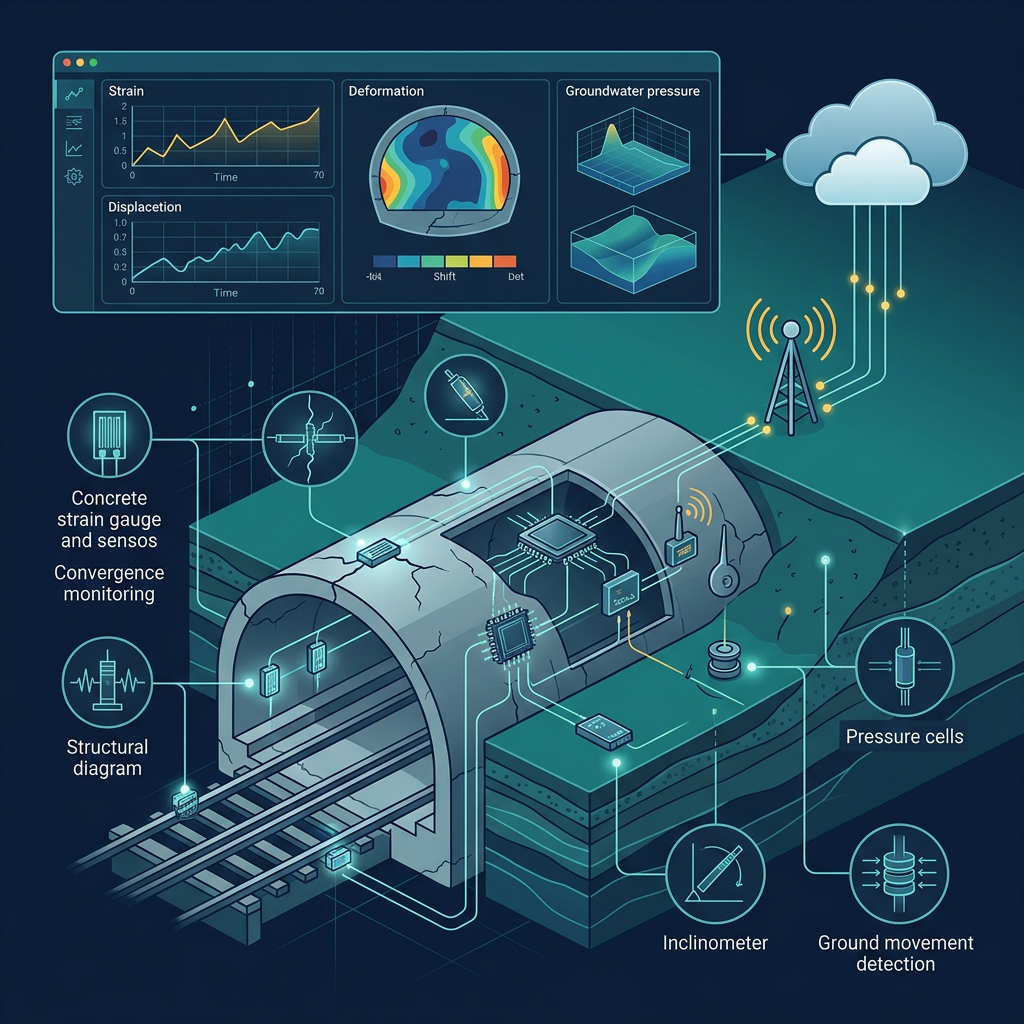
Tunnel construction and maintenance present unique challenges. Ensuring structural integrity and safety requires continuous, accurate monitoring. Traditional methods are often time-consuming and labor-intensive. This guide explores how tunnel monitoring IoT sensors are revolutionizing tunnel management, specifically addressing convergence, stress, and ground movement detection, with a focus on Indian infrastructure projects.
Who This Guide Is For
- Civil Engineers: Involved in the design, construction, and maintenance of tunnels.
- Geotechnical Consultants: Providing expertise on ground conditions and stability.
- Infrastructure Project Managers: Overseeing tunnel projects for organizations like NHAI, RVNL and CPWD.
- Procurement Leads: Responsible for sourcing and implementing monitoring solutions for smart city initiatives.
The Importance of Tunnel Monitoring
Tunnels are susceptible to various risks, including ground movement, water ingress, and structural deterioration. Early detection of these issues is crucial for preventing catastrophic failures and ensuring the safety of workers and the public. Effective tunnel monitoring helps:
- Minimize risks associated with tunnel collapse or instability.
- Optimize maintenance schedules and reduce downtime.
- Extend the lifespan of tunnel infrastructure.
- Ensure compliance with safety regulations.
Convergence Monitoring with IoT Sensors
Convergence monitoring measures the deformation or inward movement of the tunnel walls. Excessive convergence can indicate instability and potential collapse. Tunnel monitoring IoT sensors, such as extensometers and displacement transducers, provide real-time convergence data. These sensors can be strategically placed throughout the tunnel to detect even minor movements.
For example, in the Delhi Metro project, convergence monitoring IoT sensors were deployed to track the deformation of tunnel linings during construction. The data helped engineers identify areas of concern and implement timely corrective measures. Learn more about IoT in civil engineering.
Stress Monitoring in Tunnel Linings
Tunnel linings are designed to withstand significant stress from the surrounding ground. However, changes in ground conditions or external loads can lead to stress concentrations that compromise the lining's integrity. Stress monitoring IoT sensors, such as strain gauges and pressure cells, measure the stress distribution within the tunnel lining. This data helps engineers assess the structural health of the lining and identify areas that require reinforcement.
Consider the Chenab Railway Bridge tunnel, where stress monitoring is critical due to the region's seismic activity. IoT sensors provide continuous data on the stress levels in the tunnel lining, enabling engineers to respond quickly to any potential issues.
Ground Movement Detection for Tunnel Safety
Ground movement around a tunnel can significantly impact its stability. Factors such as earthquakes, landslides, and nearby construction activities can cause ground displacement. Ground movement detection IoT sensors, including inclinometers and settlement markers, measure the magnitude and direction of ground movement. This information is essential for assessing the risk of tunnel damage and implementing appropriate mitigation measures.
In the Himalayan region, highway tunnels are particularly vulnerable to landslides. Ground movement detection IoT sensors are used to monitor slope stability and provide early warning of potential landslides that could affect the tunnels. Read more on similar applications in dam monitoring systems.
Benefits of Tunnel Monitoring IoT Sensors
Compared to traditional methods, tunnel monitoring IoT sensors offer several advantages:
- Real-time Data: Continuous monitoring provides up-to-date information on tunnel conditions.
- Remote Access: Data can be accessed remotely, eliminating the need for manual inspections in hazardous environments.
- Early Warning: Sensors can detect subtle changes that may indicate potential problems before they escalate.
- Cost Savings: Automated monitoring reduces labor costs and minimizes downtime.
- Improved Safety: Early detection of problems enhances safety for workers and the public.
Data Analytics and Visualization
The data collected by tunnel monitoring IoT sensors is only valuable if it can be effectively analyzed and visualized. Geolook's platform provides advanced data analytics tools that allow engineers to identify trends, patterns, and anomalies in the data. The platform also offers customizable dashboards that visualize the data in a user-friendly format, making it easy to interpret and act upon.
Geolook vs Traditional Approach
Traditional tunnel monitoring methods often rely on manual inspections and periodic surveys, which are time-consuming and prone to errors. Geolook's IoT-based system provides continuous, real-time data, enabling faster and more accurate decision-making. For example, implementing a Geolook system can reduce inspection time by up to 40% and lower overall monitoring costs by approximately 25% compared to traditional methods. This translates to significant cost savings and improved safety for tunnel projects.
Comparison Table
| Feature | Geolook (Mavenox Prime) | Encardio-Rite |
|---|---|---|
| Data Acquisition | Real-time, continuous | Periodic, manual |
| Data Access | Remote, cloud-based | On-site, manual |
| Alerting System | Automated, customizable | Manual, less frequent |
| Data Analytics | Advanced, predictive | Basic, descriptive |
| Indian Project Suitability | Specifically designed for Indian infrastructure challenges (e.g., extreme weather, remote locations) | General solutions, may require customization |
| Cost-Effectiveness | Lower long-term costs due to reduced labor and downtime | Higher initial costs, but potentially higher long-term maintenance |
Download: Tunnel Monitoring Proposal Checklist
Ready to implement a tunnel monitoring system? Download our comprehensive Tunnel Monitoring Proposal Checklist to ensure you cover all the essential aspects.
Frequently Asked Questions
Q: What types of sensors are used in tunnel monitoring IoT systems?
A: Common sensors include extensometers, strain gauges, pressure cells, inclinometers, and settlement markers.
Q: How often is the data collected?
A: Data is typically collected continuously and transmitted in real-time.
Q: Can the system be integrated with existing monitoring infrastructure?
A: Yes, Geolook's platform is designed to be compatible with existing monitoring systems.
Q: What happens if a sensor fails?
A: The system includes redundancy measures and automated alerts to notify users of sensor failures.
Q: Is the data secure?
A: Yes, Geolook employs robust security measures to protect the data from unauthorized access.
Conclusion
Tunnel monitoring IoT sensors are transforming the way tunnels are managed and maintained. By providing real-time data on convergence, stress, and ground movement, these sensors enable engineers to make informed decisions and ensure the safety and longevity of tunnel infrastructure. Geolook offers a comprehensive solution that is specifically tailored to the challenges of Indian infrastructure projects. Explore our other resources to learn more.
Request a Tunnel Monitoring Proposal
Ready to take the next step? Contact us today to request a customized tunnel monitoring proposal for your project. Our team of experts will work with you to design a solution that meets your specific needs and budget. Ensure the safety and longevity of your tunnel infrastructure with Geolook. Check out our blog for more information.