SHM Solutions for Aging Bridges: When & Why to Retrofit
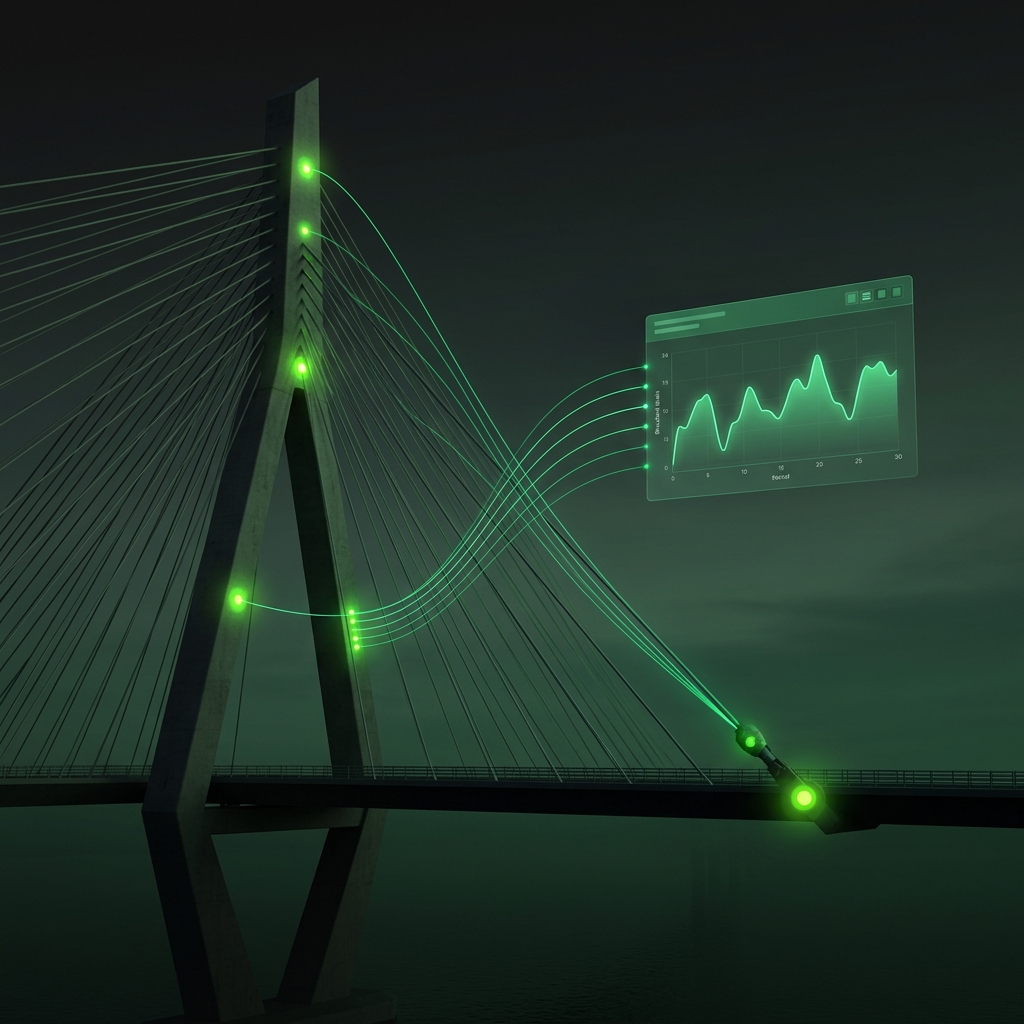
In 2022, the collapse of the Morbi suspension bridge in Gujarat underscored the critical necessity for rigorous, data-driven oversight of aging infrastructure. According to the Ministry of Road Transport and Highways (MoRTH), India possesses over 1.7 lakh bridges, a significant portion of which have exceeded their 50-year design life and require urgent structural intervention. For asset owners at NHAI and RITES, the decision to decommission, repair, or retrofit is no longer a matter of visual inspection alone but a requirement dictated by IRC SP-35:2023 guidelines for maintenance and rehabilitation.
Structural health monitoring (SHM) provides the quantitative evidence needed to justify life-extension projects. By transitioning from reactive maintenance to proactive bridge monitoring, engineers can identify sub-millimetre shifts in pier settlement or micro-strain variations in prestressing cables before they manifest as visible cracks. This technical deep-dive examines the integration of SHM within the retrofitting lifecycle of aging Indian bridges.
The Engineering Mandate for Retrofitting Aging Spans
Aging bridges face a trifecta of degradation: carbonation-induced corrosion of reinforcement, fatigue from increased axle loads beyond original IRC:6 specifications, and scour-related instability at the foundation. IRC:112 provides the framework for concrete bridge design, but for structures built 40 years ago, the material properties often deviate from modern safety factors. Retrofitting becomes mandatory when the residual load-carrying capacity falls below the required serviceability limit states (SLS).
The integration of bridge structural monitoring during the assessment phase allows for the calibration of finite element models (FEM). Instead of assuming material degradation, engineers use vibrating wire strain gauges and ultrasonic pulse velocity (UPV) testing as per IS 13311 to determine the actual stiffness of the structure. This data ensures that retrofitting measures, such as carbon fibre reinforced polymer (CFRP) wrapping or external post-tensioning, are precisely targeted to zones of maximum stress concentration.
Quantifying Structural Deficiencies via Sensor Analytics
To determine the efficacy of a retrofit, a baseline must be established using high-precision instrumentation. For cable-stayed and extra-dosed bridges, monitoring stay cable tension is paramount. Under the strategic guidance of Sandeep Gupta (IRSE), former CAO of Indian Railways and advisor to Geolook, our approach emphasizes the measurement of fundamental frequencies to detect loss of tension. A shift in the natural frequency of a cable, measured in Hz, directly correlates to a change in its axial force (kN).
Key parameters measured during the assessment of aging bridges include:
- Tilt and Inclination: Using MEMS-based biaxial tiltmeters with a resolution of 0.001 degrees to monitor pier stability.
- Dynamic Displacement: Utilizing LVDTs and laser displacement sensors to track mid-span deflection under live loads.
- Vibration Signatures: Accelerometers measuring mm/s2 to identify modal damping ratios.
- Crack Propagation: Potentiometric crack meters to monitor width changes in MPa-stressed zones.
Digital Twins and VR in Bridge Rehabilitation
Modern retrofitting projects for PSUs like RITES Ltd now leverage 3D Digital Twin and VR Visualization Platforms. By mapping real-time sensor data onto a high-fidelity digital replica, stakeholders can visualize the structural response to thermal expansion and heavy vehicle transit. This is particularly critical for complex geometries where traditional 2D drawings fail to capture the interaction between old masonry and new concrete jackets.
Geolook has supported academic and government initiatives, including the supply of bridge health monitoring accessories to IIT-Mandi, ensuring that the next generation of SHM protocols is rooted in empirical research. These digital platforms allow for 'what-if' simulations, where engineers can model the impact of a 20% increase in traffic volume on a retrofitted span, ensuring compliance with IRC:114 for seismic retrofitting of bridges.
Wireless Data Acquisition in Remote Bridge Sites
One of the primary challenges in monitoring aging bridges in India is the lack of power and connectivity at remote river crossings. The deployment of wireless DAQ systems, such as those utilized by Neeladari Buildtech for Bridge Health Monitoring, eliminates the need for extensive cabling which is prone to damage during monsoon floods. These systems utilize LoRaWAN or NB-IoT protocols to transmit data from vibrating wire sensors and thermistors to a centralized cloud dashboard.
Wireless nodes are programmed to trigger 'Alert' and 'Action' levels based on pre-defined thresholds. For instance, if a pier exhibits a tilt exceeding 0.5 degrees, the system can automatically notify the NHAI regional office, enabling immediate traffic diversion. This real-time capability is a significant advancement over the periodic bridge inspection vs SHM debate, providing continuous safety assurance.
Comparative Analysis of Bridge Assessment Methodologies
The following table outlines the technical differences between traditional visual assessments and sensor-integrated SHM for aging bridge retrofitting.
| Parameter | Visual Inspection (IRC SP-18) | Sensor-Integrated SHM |
|---|---|---|
| Data Frequency | Periodic (typically biennial) | Real-time (up to 100Hz sampling) |
| Defect Detection | Surface-level cracks/spalling | Sub-surface strain and internal fatigue |
| Load Rating | Theoretical based on age | Empirical based on proof load testing |
| Human Error | High (subjective interpretation) | Low (calibrated digital output) |
| Predictive Capability | None (reactive) | High (trend analysis and RUL estimation) |
| Cost-Efficiency | Low (hidden defects cause over-design) | High (optimized retrofit interventions) |
Seismic Retrofitting and Dynamic Response
Bridges in Seismic Zones IV and V, such as those in the Himalayan belt or the North-East, require specific dynamic monitoring. IS 1893 (Part 3) mandates the evaluation of bridges for seismic forces. For an aging bridge, the ductility of the piers may have diminished over decades. SHM solutions for aging bridges involve installing strong-motion accelerometers at the foundation and deck levels.
By comparing the ground motion to the deck response, engineers calculate the amplification factor. If the fundamental period of the bridge has lengthened significantly, it indicates a loss of structural stiffness. Retrofitting measures like base isolation or the addition of shear walls can then be validated by measuring the reduction in peak floor acceleration (PFA) during subsequent minor tremors or controlled vibration tests using specialized SHM sensor types.
Corrosion Monitoring and Concrete Longevity
Corrosion of embedded steel is the leading cause of structural failure in coastal Indian bridges. Monitoring the half-cell potential and chloride ion concentration provides an early warning of rebar degradation. When retrofitting, the application of cathodic protection systems can be monitored using reference electrodes to ensure the protective current is reaching the reinforcement. This ensures that the repair work actually halts the chemical degradation of the concrete matrix, extending the service life by decades as per CWC and IRC standards.
Frequently Asked Questions
Q: What are structural health monitoring solutions for aging bridges?
A: Structural health monitoring solutions for aging bridges are integrated systems of sensors, data acquisition hardware, and analytical software used to quantify the physical condition of a bridge. These solutions measure parameters like strain, displacement, and vibration to detect structural deficiencies that are not visible during standard manual inspections.
Q: When is bridge retrofit monitoring required under Indian Standards?
A: Bridge retrofit monitoring is required when a structure shows signs of distress as per IRC SP-35 or when its load-carrying capacity must be upgraded to meet IRC:6 standards. It is also mandated for bridges in high seismic zones (Zones IV and V) to ensure the effectiveness of seismic dampers or base isolators.
Q: How does SHM assist in aging bridge assessment?
A: SHM assists in aging bridge assessment by providing real-time data that replaces conservative assumptions in structural modeling. By measuring actual response to live loads, engineers can accurately determine the residual life of the bridge and identify specific components requiring reinforcement, thereby optimizing the retrofitting budget and schedule.
Q: What sensors are used for monitoring cable-stayed aging bridges?
A: Monitoring cable-stayed bridges involves using load cells and vibrating wire strain gauges to measure stay cable tension, along with accelerometers to track deck vibrations. Anemometers are also used to correlate structural movement with wind speed, ensuring the bridge remains within the safety limits defined during its design or rehabilitation phase.
Q: Can wireless DAQ systems be used for long-term bridge monitoring?
A: Wireless DAQ systems are highly suitable for long-term bridge monitoring due to their low power consumption and ease of installation in difficult terrain. These systems use industrial-grade batteries and solar harvesting to provide continuous data for years, transmitting information via cellular or radio networks to a centralized management platform.
Book bridge assessment
Is your aging infrastructure meeting modern safety standards? Geolook provides comprehensive structural health monitoring solutions for aging bridges, from initial sensor deployment to advanced digital twin visualization. Our team, backed by the expertise of former Indian Railways and NHAI consultants, ensures your retrofit projects are data-driven and compliant with IRC and IS codes. Contact our engineering team today to schedule a technical site assessment or to discuss your bridge monitoring requirements.
Project inquiry
Talk to a Geolook™ specialist
Share your monitoring requirement and our team will help identify the right next step.
By submitting, you agree that Geolook™ may contact you about this inquiry. Your details are not added to a marketing list.