SHM Cloud Software: Features, Benefits & Why You Need One
In September 2023, the National Disaster Management Authority reported that India loses an estimated ₹1 lakh crore annually to infrastructure failures — a figure that underscores the cost of monitoring gaps across bridges, tunnels, and high-rise structures. For project managers and IT decision-makers overseeing large civil assets, the question is no longer whether to monitor, but whether the software layer holding that monitoring data is reliable, secure, and actionable. SHM cloud software has become the operational backbone of modern structural health monitoring programmes, and choosing the wrong platform carries consequences measured in missed alerts, compliance gaps, and unplanned downtime.
This guide covers the core SHM software features that matter to engineering and IT teams, the security and uptime standards a cloud SHM platform must meet in the Indian regulatory context, and the deployment considerations that separate a functional system from one that simply generates data.
Key Takeaways
- SHM cloud software must deliver continuous, timestamped sensor data with configurable alert thresholds — not periodic snapshots — to support real-time structural decision-making.
- For Indian government and PSU projects, data residency, role-based access control, and audit trails are non-negotiable compliance requirements, not optional features.
- Platform uptime of 99.9% or above is the practical minimum for safety-critical infrastructure; anything lower introduces unacceptable monitoring gaps during high-load or seismic events.
- Integration with digital twin environments and 3D visualisation layers — as demonstrated in Geolook's RITES and MIT-WPU deployments — significantly reduces the time from data acquisition to engineering decision.
- Sensor-agnostic architecture and open API support prevent vendor lock-in and allow phased expansion across heterogeneous sensor networks.
What Is SHM Cloud Software?
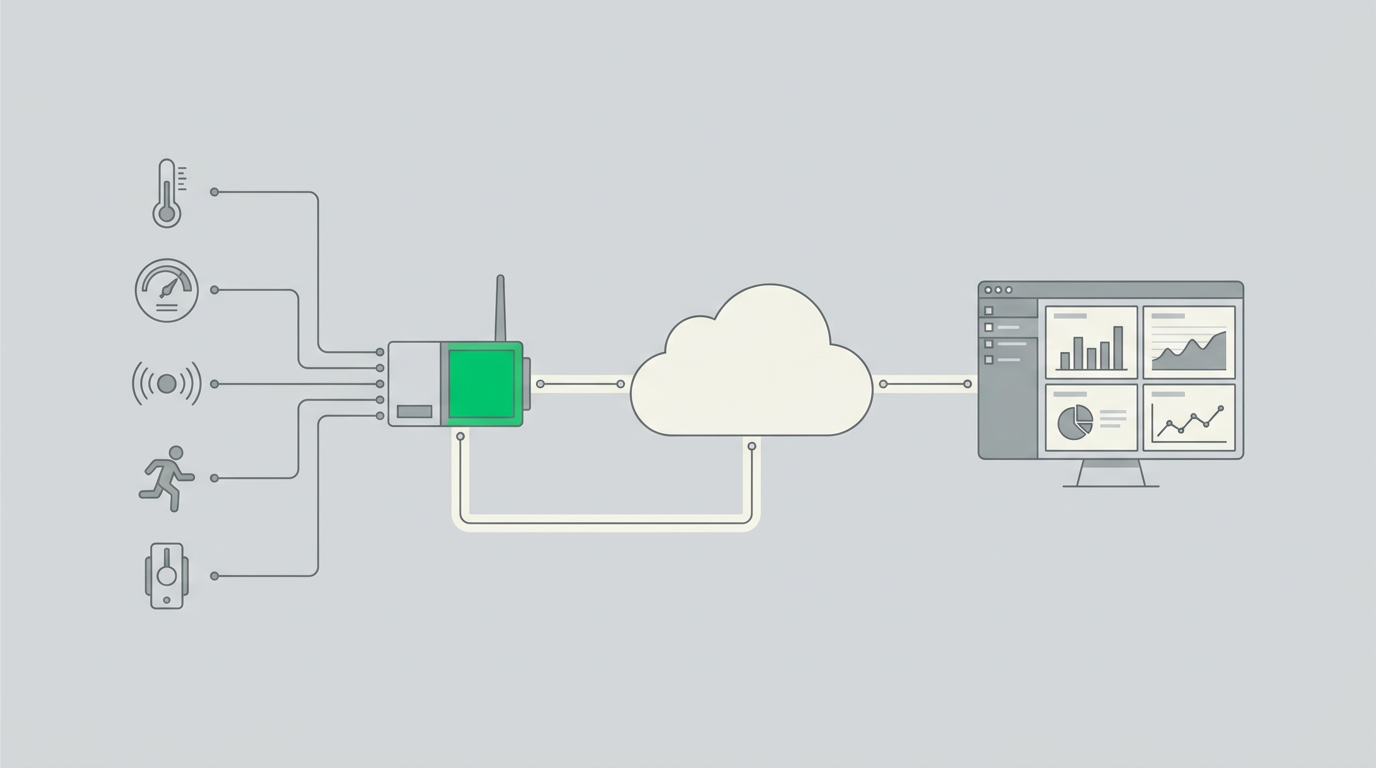
SHM cloud software is a hosted data management and analytics platform that ingests, processes, stores, and visualises sensor data from structural health monitoring networks in real time, enabling engineers and asset managers to assess structural condition without physical site access.
Unlike on-premise SCADA systems or standalone data loggers with local storage, a cloud SHM platform centralises data from geographically distributed assets — tunnels, bridges, retaining walls, high-rise foundations — into a single, browser-accessible environment. Engineers can review vibration readings in mm/s², crack-width trends in micrometres, piezometric levels in kPa, and settlement vectors in millimetres from a single dashboard, regardless of whether the sensor is in a J&K tunnel or a Gurgaon basement excavation.
The platform layer sits between the field instrumentation — vibrating wire sensors, MEMS accelerometers, tiltmeters, strain gauges — and the engineering team. Its quality determines whether raw sensor voltages become actionable structural intelligence or remain archived numbers. For a deeper grounding in the monitoring discipline itself, the guide on structural health monitoring covers sensor selection, data acquisition principles, and code-referenced thresholds in detail.
Core SHM Software Features: An Engineering Checklist
Not every cloud SHM platform offers the same depth of capability. The following checklist reflects the features that engineering teams and IT procurement leads should evaluate before committing to a platform for a long-duration infrastructure project.
Real-time data ingestion and timestamping: The platform must accept continuous data streams from field DAQ units at configurable sampling rates — from 1 Hz for quasi-static settlement monitoring to 200 Hz or above for dynamic load events. Each reading must carry a hardware-synchronised UTC timestamp to support post-event forensic analysis.
Configurable alert thresholds and escalation logic: Alert levels should map to the traffic-light system (green/amber/red) commonly referenced in IRC SP-35 and CWC dam safety guidelines. Escalation paths — SMS, email, API webhook — must be configurable per sensor, per structure, and per user role without requiring backend code changes.
Multi-structure, multi-site dashboard: A PM overseeing five bridge contracts simultaneously cannot manage five separate logins. The platform must support a unified asset hierarchy where individual sensor readings roll up to structure-level health indices and then to portfolio-level risk summaries.
Digital twin and 3D visualisation integration: Geolook's platform deployed for RITES Ltd integrates a 3D digital twin and VR visualisation layer for bridge health monitoring, allowing engineers to locate sensor anomalies spatially within the structural model rather than hunting through tabular data. This capability compresses the time between alert and engineering response.
Automated reporting and audit trails: For NHAI, RVNL, and CWC-regulated assets, the platform must generate timestamped, tamper-evident reports suitable for submission to the asset owner. Audit trails must log every threshold change, user login, and data export event.
Sensor-agnostic data ingestion: Infrastructure projects rarely use a single sensor type. The platform must accept Modbus, SDI-12, RS-485, and MQTT protocols from heterogeneous sensor networks. Explore the Geolook data logger product range for hardware that is pre-integrated with the platform's ingestion layer.
Machine learning-based anomaly detection: Static thresholds miss gradual structural degradation. An ML layer that learns baseline behaviour per sensor — accounting for seasonal temperature variation, traffic load cycles, and construction-phase disturbance — reduces false positives while catching slow-onset damage. The post on machine learning in structural health monitoring covers the algorithmic approaches in detail.
Security and Data Governance for Indian Infrastructure Projects
For government clients — NHAI, RVNL, BRO, CWC — and large EPCs handling sensitive infrastructure data, the security architecture of a cloud SHM platform is as important as its sensor integration capability. The following requirements reflect the current Indian regulatory and procurement environment.
Data residency: The Digital Personal Data Protection Act, 2023 and MeitY's cloud policy framework require that data classified as sensitive infrastructure data be stored on servers located within India. Procurement teams should request written confirmation of data centre location before contract award.
Role-based access control (RBAC): A site engineer, a structural consultant, a client PM, and a regulatory auditor each require different data access levels. RBAC must be granular to the sensor level, not just the project level.
Encryption in transit and at rest: TLS 1.2 or above for data in transit; AES-256 for data at rest. These are baseline requirements for any platform handling safety-critical structural data.
Uptime SLA: A platform monitoring a live highway tunnel or a dam instrumentation network cannot tolerate extended outages. The practical minimum for safety-critical SHM deployments is 99.9% uptime, which equates to no more than approximately 8.7 hours of unplanned downtime per year. Platforms should publish their SLA in writing and provide historical uptime logs on request.
API security and third-party integration: Open APIs must use OAuth 2.0 authentication. Any integration with third-party GIS, ERP, or BIM platforms must pass through authenticated endpoints, not open data feeds.
The MIT-WPU Tunnel Health Monitoring and Digital Twin Excellence Centre, inaugurated by Minister Sh. Nitin Gadkari, uses Geolook's platform as its data backbone — a deployment that required meeting the security and data governance standards of both an academic institution and a government-affiliated research programme.
Deployment Models: Cloud, Hybrid, and On-Premise Considerations
Not every project context suits a fully public cloud deployment. The table in the following section compares deployment models, but the underlying decision framework is straightforward: connectivity reliability at the site, data sensitivity classification, and the client's internal IT governance policy.
For remote sites — high-altitude tunnels, river-crossing bridges, or dam abutments — where cellular connectivity is intermittent, a hybrid model is more appropriate. The field DAQ unit stores data locally and synchronises to the cloud platform when connectivity is restored, with no data loss during the gap period. This is the model used in Geolook's Ramban-Banihal NH-44 tunnel deployments across five tunnels in J&K, where NHAI-reviewed monitoring data must remain continuous despite challenging terrain and variable network coverage.
For urban high-rise and deep excavation projects — such as the DLF Downtown Gurgaon deployments with Ahluwalia Constructions and B L Kashyap — full cloud connectivity is generally available, and real-time settlement data in millimetres can be pushed to the platform at sub-minute intervals without local buffering.
IT decision-makers should also evaluate the platform's disaster recovery architecture. A geographically redundant backup — with recovery point objective (RPO) of less than 1 hour and recovery time objective (RTO) of less than 4 hours — is the appropriate standard for safety-critical monitoring data. For projects involving transport infrastructure monitoring, where data continuity is tied to operational safety decisions, these parameters should be written into the service agreement.
Cloud SHM Platform Deployment Models Compared
| Parameter | Full Public Cloud | Hybrid (Edge + Cloud) | Private Cloud | On-Premise Server |
|---|---|---|---|---|
| Connectivity requirement | Continuous broadband or 4G/5G | Intermittent connectivity acceptable | Dedicated leased line preferred | LAN only; no internet required |
| Data residency control | Depends on provider; confirm India hosting | Sensitive data can remain on edge node | Full control within client data centre | Complete on-site control |
| Uptime SLA | 99.9%+ achievable with redundant cloud infra | Field data preserved locally during outage | Dependent on client IT infrastructure | Dependent on client IT infrastructure |
| Scalability | Elastic; add sensors or sites without hardware changes | Moderate; edge hardware must be sized at deployment | Limited by provisioned server capacity | Limited by on-site hardware |
| Maintenance burden | Managed by platform provider | Shared between provider and client | Primarily client IT team | Entirely client IT team |
| Suitable project type | Urban infra, high-rise, connected bridges | Remote tunnels, mountain highways, dam sites | Defence, classified government assets | Air-gapped or highly classified assets |
| Integration with digital twin | Native; low latency 3D model updates | Near-real-time with sync intervals | Possible with internal BIM server | Requires custom integration effort |
Integration with Digital Twins and Remote Monitoring Workflows
The value of SHM cloud software is not realised at the sensor level — it is realised at the decision level. A platform that delivers raw time-series data without spatial context, trend analysis, or cross-sensor correlation forces engineers to do interpretive work that the software should handle. Digital twin integration closes this gap.
In Geolook's deployment for RITES Ltd, the 3D digital twin and VR visualisation platform for bridge health monitoring allows structural engineers to navigate a georeferenced model of the bridge, select any sensor node, and view its live reading alongside its historical trend and threshold status. Anomalies are flagged spatially — a tiltmeter reading outside its ±0.5° threshold appears as a highlighted element in the 3D model, not as a row in a spreadsheet.
This integration pattern is also central to the MIT-WPU Digital Twin Excellence Centre, where the platform serves as both a live monitoring environment and a research testbed for AI-enabled condition assessment algorithms. The ability to replay historical sensor data against the structural model — simulating a seismic event per IS 1893 or a flood-induced scour scenario — makes the platform a training and validation tool as well as an operational one.
For project managers overseeing distributed asset portfolios, the remote infrastructure monitoring guide covers the workflow integration between field instrumentation, cloud platforms, and engineering review cycles in detail.
The full SHM software capability stack — from sensor firmware to dashboard configuration — is documented in the Geolook SHM software product page, including API documentation for third-party BIM and GIS integration.
Procurement Checklist for IT Decision-Makers and Project Managers
When evaluating a cloud SHM platform for a government or large EPC project, the following checklist covers the questions that procurement committees and IT security teams most commonly raise during vendor assessment.
- Data centre location: Are servers physically located in India? Can the vendor provide a written declaration of data residency compliant with MeitY cloud policy?
- Uptime SLA: Is 99.9% uptime guaranteed in writing? Are historical uptime logs available for the past 12 months?
- Encryption standards: Is TLS 1.2+ used for data in transit? Is AES-256 used for data at rest?
- RBAC granularity: Can access be restricted to individual sensors, structures, or data types — not just project-level access?
- Audit trail: Does the platform log all user actions, threshold changes, and data exports with timestamps?
- API documentation: Is a full API reference available? Does it support OAuth 2.0? Are there existing integrations with BIM, GIS, or ERP platforms used by the client?
- Disaster recovery: What are the RPO and RTO commitments? Is there geographic redundancy in the backup architecture?
- Sensor compatibility: Does the platform support the sensor protocols (Modbus, SDI-12, RS-485, MQTT) used in the project's instrumentation plan?
- Regulatory reporting: Can the platform generate reports in formats acceptable to NHAI, CWC, RVNL, or the relevant asset owner?
- Support SLA: What is the guaranteed response time for critical alerts or platform outages? Is 24/7 support available for safety-critical deployments?
Frequently Asked Questions
Q: What is SHM cloud software and how does it differ from traditional data logging?
A: SHM cloud software is a hosted platform that ingests, stores, and visualises structural sensor data in real time, accessible from any browser without on-site server infrastructure. Traditional data logging stores readings locally on a DAQ unit, requiring manual download and offline analysis. Cloud platforms enable continuous remote access, automated alerting, and multi-site portfolio management — capabilities that local loggers cannot provide.
Q: What uptime standard should a cloud SHM platform meet for safety-critical infrastructure?
A: A cloud SHM platform monitoring safety-critical assets such as highway tunnels, bridges, or dam instrumentation networks should meet a minimum uptime SLA of 99.9%, equating to no more than approximately 8.7 hours of unplanned downtime per year. For assets where a monitoring gap during a seismic or flood event could have safety consequences, the SLA should be documented in the service agreement and supported by historical uptime records.
Q: How does a cloud SHM platform handle data security for Indian government projects?
A: A compliant cloud SHM platform for Indian government projects must store data on India-hosted servers per MeitY cloud policy, use TLS 1.2 or above for data in transit and AES-256 for data at rest, implement role-based access control, and maintain tamper-evident audit trails. Procurement teams should request written confirmation of data residency and review the platform's ISO 27001 certification or equivalent security attestation before contract award.
Q: Can SHM cloud software integrate with digital twin and BIM environments?
A: Yes, modern SHM cloud software platforms support integration with digital twin and BIM environments through open APIs, typically using OAuth 2.0 authenticated endpoints. This allows live sensor readings — vibration in mm/s², settlement in millimetres, strain in micro-strain — to be mapped spatially onto a 3D structural model, enabling engineers to locate anomalies within the asset geometry rather than interpreting tabular data alone.
Q: What connectivity options are available for remote or low-connectivity SHM sites?
A: For remote sites with intermittent connectivity — such as mountain tunnels or dam abutments — a hybrid deployment model is appropriate. The field DAQ unit stores data locally and synchronises to the cloud platform when connectivity is restored, ensuring no data loss during network outages. This model supports 4G, satellite, and wired Ethernet backhaul, and is suitable for sites where continuous broadband is not available.
Try Geolook software demo
Geolook's SHM cloud software platform is deployed across tunnel, bridge, high-rise, and digital twin projects in India — from NHAI-reviewed tunnel monitoring on NH-44 to the RITES 3D digital twin bridge health monitoring system. The platform is built for the data volumes, security requirements, and reporting workflows that Indian infrastructure projects demand.
If you are evaluating a cloud SHM platform for an upcoming project or looking to migrate an existing monitoring programme to a more capable software environment, the Geolook team can walk you through a live platform demonstration tailored to your asset type and project scale.
To understand how the platform fits within a complete monitoring programme, review the guide on what is the best cloud based software platform for structural health monitoring in india for a detailed comparison of platform capabilities in the Indian market context.
Request a Geolook SHM software demo and speak with a structural monitoring engineer about your project requirements.
Project inquiry
Talk to a Geolook™ specialist
Share your monitoring requirement and our team will help identify the right next step.
By submitting, you agree that Geolook™ may contact you about this inquiry. Your details are not added to a marketing list.