Which Is Better for Long-Term Infrastructure Monitoring: VW or MEMS?
In August 2018, the Majerhat Bridge in Kolkata collapsed, killing three people and injuring dozens more. A subsequent CAG audit noted the absence of any continuous structural health monitoring system on the ageing structure. For procurement leads at NHAI, RVNL, RITES, and major EPCs, that incident crystallised a question that now sits at the centre of every SHM tender: which is better for long-term infrastructure monitoring, vibrating wire sensors or MEMS sensors? The answer is not a single product name — it is a decision framework built on service life, signal stability, environmental tolerance, and total cost of ownership over a 10-year or longer deployment horizon.
Both vibrating wire (VW) and microelectromechanical systems (MEMS) sensors are mature, field-proven technologies. Yet they behave differently under the thermal cycling, humidity, and vibration loads that Indian infrastructure routinely imposes. Getting the selection wrong at procurement stage means either over-engineering a simple tilt-monitoring task or under-specifying a critical strain-measurement point on a cable-stayed bridge — both of which carry cost and safety consequences. This guide gives you the technical basis to choose correctly.
Key Takeaways
- Vibrating wire sensors offer superior long-term signal stability — their frequency-based output is inherently immune to cable resistance drift over multi-year deployments, making them the default choice for permanent embedment in concrete and soil.
- MEMS sensors deliver higher sampling rates (up to several kHz) and lower unit cost, making them well-suited for dynamic modal analysis, seismic response, and short-to-medium-term monitoring campaigns.
- For 10-year or longer deployments in Indian conditions — high humidity, wide diurnal temperature swings, and monsoon-driven groundwater fluctuation — VW sensors have a documented field advantage in geotechnical and structural embedment applications.
- MEMS accelerometers are the correct choice wherever dynamic response data (frequency, mode shape, damping ratio) is the primary deliverable, as VW sensors cannot capture sub-second dynamic events.
- Procurement decisions should be driven by measurement parameter, required service life, data acquisition architecture, and site environment — not by unit price alone.
Defining the Core Technologies
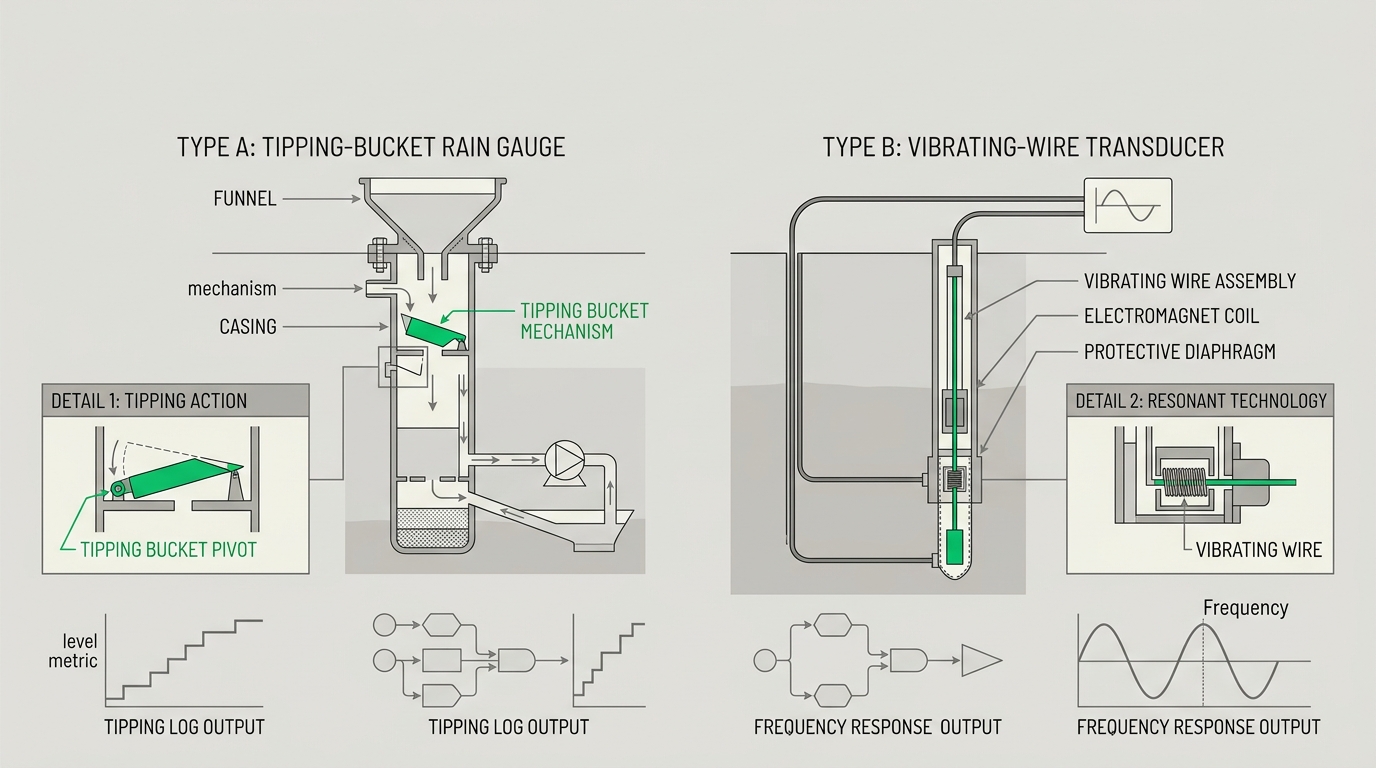
A vibrating wire sensor measures the resonant frequency of a tensioned steel wire; strain, pressure, load, or displacement is inferred from the change in that frequency, which is independent of cable resistance and supply voltage variations. A MEMS sensor uses microfabricated silicon structures — typically a proof mass suspended on flexures — to measure acceleration, tilt, or pressure through capacitive or piezoresistive transduction. Both technologies are referenced in structural health monitoring sensor selection guides as complementary rather than competing tools, each optimised for a different measurement regime.
The fundamental difference is this: VW sensors produce a quasi-static frequency output that remains stable over years without recalibration drift caused by electronic component ageing, while MEMS sensors produce a voltage or digital output that is susceptible to offset drift if the signal conditioning electronics age or if thermal gradients are not compensated. For a procurement lead evaluating a 10-year bridge or dam monitoring contract, this distinction is not academic — it directly affects the maintenance budget and data reliability clauses in the SLA.
Sensor Longevity: What 10-Year Field Data Shows
Sensor longevity is the dominant procurement criterion for permanent infrastructure monitoring. VW sensors embedded in concrete or grouted into boreholes have demonstrated service lives exceeding 20 years in documented dam and tunnel instrumentation programmes globally, including projects monitored under CWC guidelines and the Dam Safety Act 2021. The frequency-based output means that even if the readout cable degrades in resistance — a common outcome in Indian monsoon conditions where cable joints are exposed to standing water — the measurement remains valid provided the wire itself is intact.
MEMS sensors, by contrast, are more sensitive to long-term offset drift in static or quasi-static applications. A MEMS tilt sensor installed at a retaining wall toe may show a 0.05° to 0.1° zero-point drift per year under sustained thermal cycling between 5 °C and 45 °C — a range routinely encountered across North India. For a 10-year deployment, that accumulated drift can exceed the alarm threshold for the parameter being monitored, requiring periodic field recalibration or sensor replacement. This is not a disqualifying limitation for MEMS; it is a maintenance cost that must be priced into the procurement.
At the IIT-Mandi bridge health monitoring accessories supply project, sensor selection for long-span bridge instrumentation required explicit consideration of Himalayan temperature extremes and high-humidity tunnel approaches — conditions where VW strain gauges and piezometers were specified for permanent embedment precisely because of their resistance to environmental drift. For dynamic modal testing on the same structure, MEMS accelerometers were the appropriate complement, capturing mode shapes and damping ratios that VW sensors cannot resolve.
For a deeper comparison of how these two sensor families perform across geotechnical and structural applications, see our geotechnical sensor comparison guide, which covers piezometers, inclinometers, and load cells alongside VW and MEMS devices.
VW vs MEMS Long Term: Environmental and Signal Considerations
The VW vs MEMS long-term performance gap widens in three specific Indian site conditions: high relative humidity (above 85% RH sustained), aggressive soil chemistry (pH below 5 or above 9, common in black cotton soil zones), and high-vibration environments such as railway bridges or metro viaducts. In each case, the VW sensor's passive transduction mechanism — no active electronics at the sensing element — gives it a durability advantage. The readout electronics can be located in a protected enclosure tens or hundreds of metres away without signal degradation, because frequency is transmitted over the cable, not a low-level voltage.
MEMS sensors integrate the sensing element and signal conditioning on the same silicon die or in the same housing. In high-humidity environments, moisture ingress into the connector or housing can cause leakage currents that corrupt the output. IP68-rated MEMS housings mitigate this, but the protection rating applies to the housing, not to the connector terminations — a distinction that matters on a construction site where connectors are repeatedly disconnected and reconnected during formwork cycles, as was the case at the L&T Constructions Noida Realty Green, Sector-120 high-rise SHM deployment where sensor analytics were integrated across multiple floors during active construction.
Temperature coefficient of sensitivity is another long-term consideration. VW sensors have a well-characterised thermal correction factor (typically expressed in Hz²/°C) that is stable over the sensor's life. MEMS accelerometers have a temperature coefficient of bias (TCB) that can vary with ageing of the ASIC. For IS 1893-compliant seismic monitoring where the sensor must remain calibrated across a wide temperature range, this requires either active temperature compensation or periodic field verification — both of which add to the 10-year total cost of ownership.
For projects where tropical humidity is a primary concern, our detailed analysis of vibrating wire vs mems accuracy in tropical climate conditions provides site-specific performance data relevant to coastal and high-rainfall Indian deployments.
VW vs MEMS Sensor Comparison for Long-Term Infrastructure Monitoring
| Criterion | Vibrating Wire (VW) Sensors | MEMS Sensors |
|---|---|---|
| Primary output | Frequency (Hz or Hz²) — passive, drift-resistant | Voltage or digital (SPI/I²C) — active, drift-susceptible |
| Typical service life in embedded applications | 15–25 years with proper installation per IS 2720 / CWC guidelines | 5–10 years before recalibration or replacement typically required |
| Measurement parameters | Strain, pore pressure, load, displacement, temperature (quasi-static) | Acceleration, tilt, vibration, dynamic strain (static to several kHz) |
| Dynamic response capability | Limited to quasi-static; cannot resolve events faster than ~1 Hz | Suitable for modal analysis, seismic response, and impact events up to several kHz |
| Sensitivity to cable resistance drift | None — frequency output is cable-resistance-independent | Significant for analogue output types; mitigated by digital output variants |
| Performance in high humidity (>85% RH) | High — sensing element is passive steel wire, no active electronics at sensor | Moderate — requires IP68 housing and sealed connectors; ASIC ageing risk |
| Unit cost (indicative range) | Higher per sensor (₹8,000–₹40,000+ depending on type) | Lower per sensor for standard MEMS accelerometers (₹2,000–₹15,000) |
| Data acquisition compatibility | Requires VW-compatible readout (frequency counter or dedicated DAQ) | Compatible with standard ADC-based DAQ and IoT edge devices |
| Applicable Indian Standard / guideline | IS 2720, IS 7894, CWC dam instrumentation guidelines, IRC SP-35 | IS 1893 (seismic), IS 13311 (NDT), no dedicated IS for MEMS SHM |
| Recommended application | Permanent embedment: dams, tunnels, bridge foundations, retaining walls | Dynamic monitoring: bridge decks, seismic stations, modal testing campaigns |
Decision Framework: Choosing Between VW and MEMS
A structured decision tree helps procurement teams avoid the most common error: selecting a sensor technology based on unit price rather than measurement requirement and service life. Work through the following logic sequence before issuing a sensor specification:
- What is the primary measurement parameter? If it is pore water pressure, earth pressure, crack opening, or long-term strain in concrete or soil, specify VW. If it is acceleration, vibration frequency, or dynamic tilt, specify MEMS.
- What is the required service life? If the monitoring programme extends beyond 7 years without planned sensor replacement, VW sensors are the lower-risk choice for static parameters. MEMS sensors in permanent installations beyond 7 years should include a recalibration or replacement budget line.
- What is the site environment? For underground, submerged, or high-humidity environments — tunnels, dam galleries, borehole installations — VW sensors' passive transduction is a material advantage. For surface-mounted or accessible locations with controlled environments, MEMS sensors are viable for both static and dynamic parameters.
- What is the data acquisition architecture? If the project already has a VW-compatible DAQ infrastructure, adding MEMS sensors requires a separate ADC channel or edge device. Evaluate the integration cost, not just the sensor cost. Explore Geolook's data acquisition systems for SHM to understand multi-sensor DAQ compatibility.
- Is dynamic modal analysis required? If the deliverable includes natural frequency, mode shape, or damping ratio — as required for IRC SP-37 bridge condition assessment or IS 1893 seismic vulnerability studies — MEMS accelerometers are mandatory. VW sensors cannot substitute for this measurement.
In practice, most permanent infrastructure monitoring systems on Indian bridges, tunnels, and dams use a hybrid architecture: VW sensors for quasi-static parameters (strain, pressure, load, settlement) and MEMS accelerometers for dynamic response. The RITES Ltd 3D Digital Twin and VR Visualisation Platform for Bridge Health Monitoring, developed with Geolook, integrates both sensor types into a unified data model — demonstrating that the VW vs MEMS question is often answered with both, not either.
Procurement Specifications and Indian Standards Alignment
When drafting sensor specifications for a long-term SHM tender, procurement leads should reference the applicable Indian Standards and agency guidelines to ensure the selected technology meets the regulatory baseline. For bridge monitoring under IRC SP-35 and IRC:114, the specification should define the measurement range in micro-strain (με) or kPa, the resolution required, the operating temperature range in °C, and the ingress protection rating. VW strain gauges typically offer a resolution of 1 με or better and an operating range of −20 °C to +80 °C, which covers all Indian climatic zones.
For geotechnical applications governed by IS 1892 and IS 2720 — foundation investigations, retaining wall monitoring, embankment settlement — VW piezometers and earth pressure cells are the standard specified instrument. The CWC dam instrumentation manual and the Dam Safety Act 2021 implementation guidelines both reference VW-based instrumentation as the baseline for pore pressure and seepage monitoring in large dams.
MEMS sensors do not yet have a dedicated Indian Standard for SHM applications, though IS 1893 Part 1 governs the seismic design basis that MEMS accelerometers must satisfy when used in seismic monitoring arrays. Procurement specifications for MEMS devices should therefore reference the manufacturer's calibration certificate, the temperature coefficient of bias, and the long-term stability specification — parameters that are not always prominently stated in commercial datasheets but are critical for 10-year deployments.
For procurement teams evaluating the full range of sensor types available for Indian infrastructure projects, the Geolook SHM sensor product range covers VW strain gauges, piezometers, load cells, MEMS accelerometers, tiltmeters, and crack meters with specifications aligned to Indian Standards and international equivalents. For a broader view of how sensor selection fits into a complete monitoring system, see our overview of SHM sensor types and their applications.
Pros and Cons Summary
Vibrating Wire Sensors — Pros:
- Frequency-based output eliminates cable resistance drift; reliable over 15+ year deployments
- Passive sensing element has no active electronics to age or fail at the measurement point
- Well-established calibration procedures and Indian Standards references (IS 2720, IS 7894, CWC guidelines)
- Suitable for permanent embedment in concrete, grout, and soil in all Indian climatic zones
- Thermistor integrated in most VW sensors provides simultaneous temperature measurement for thermal correction
Vibrating Wire Sensors — Cons:
- Cannot capture dynamic events faster than approximately 1 Hz; unsuitable for modal analysis or seismic waveform recording
- Higher unit cost than equivalent MEMS devices for simple tilt or acceleration measurement
- Requires dedicated VW readout equipment; not directly compatible with standard ADC-based IoT platforms without a frequency-to-voltage converter
MEMS Sensors — Pros:
- High sampling rates (10 Hz to several kHz) enable dynamic structural response characterisation, modal analysis, and seismic event recording
- Lower unit cost per channel for acceleration and tilt measurement
- Digital output variants (SPI, I²C, RS-485) integrate directly with modern IoT edge devices and cloud DAQ platforms
- Small form factor enables dense sensor arrays on bridge decks, building floors, and tunnel linings
MEMS Sensors — Cons:
- Static offset drift over multi-year deployments requires periodic recalibration, adding to 10-year total cost of ownership
- Active ASIC at the sensing element is susceptible to moisture ingress and thermal ageing in harsh site environments
- No dedicated Indian Standard for SHM applications; specification relies on manufacturer data and international references
- Temperature coefficient of bias must be explicitly specified and verified for deployments spanning Indian seasonal temperature extremes
Frequently Asked Questions
Q: Which is better for long-term infrastructure monitoring, vibrating wire sensors or MEMS sensors, when the deployment exceeds 10 years?
A: For deployments exceeding 10 years in static or quasi-static parameter monitoring — strain, pore pressure, load, settlement — vibrating wire sensors are the lower-risk choice. Their frequency-based output does not degrade with cable resistance drift or electronic component ageing. MEMS sensors in the same timeframe require a recalibration or replacement budget to maintain data integrity.
Q: Can MEMS sensors replace VW piezometers in dam safety monitoring under the Dam Safety Act 2021?
A: MEMS piezometers are not the standard specified instrument for dam safety monitoring under CWC guidelines and the Dam Safety Act 2021 implementation framework, which reference VW-based instrumentation for pore pressure and seepage measurement. MEMS pressure sensors may be used as supplementary devices, but VW piezometers remain the primary specification for permanent dam gallery installations due to their proven long-term stability.
Q: What sampling rate do VW sensors support, and is it sufficient for bridge dynamic monitoring per IRC SP-37?
A: Vibrating wire sensors support quasi-static sampling rates, typically one reading per second at best, which is insufficient for dynamic bridge monitoring as required under IRC SP-37 condition assessment. Dynamic modal analysis requires MEMS accelerometers capable of sampling at 100 Hz or above to resolve the natural frequencies and mode shapes of bridge spans. A hybrid VW and MEMS architecture is the standard approach for comprehensive bridge SHM.
Q: How does sensor longevity affect the total cost of ownership in a 10-year SHM contract?
A: Sensor longevity directly affects total cost of ownership through replacement frequency, recalibration visits, and data gap risk. VW sensors embedded in concrete or grouted boreholes typically do not require replacement over a 10-year contract, whereas MEMS sensors in harsh environments may require one or two recalibration or replacement cycles. Procurement teams should model both scenarios in the lifecycle cost analysis before finalising the sensor specification.
Q: Are MEMS tiltmeters suitable for retaining wall monitoring in Indian black cotton soil zones?
A: MEMS tiltmeters can be used for retaining wall monitoring, but their suitability in Indian black cotton soil zones — characterised by high shrink-swell activity, aggressive soil chemistry, and seasonal moisture variation — depends on housing integrity and recalibration frequency. VW-based in-place inclinometers or settlement cells are generally preferred for permanent installations in these conditions, as their passive transduction is less sensitive to the electrochemical environment at the sensor location.
Talk to sensor expert
Selecting the right sensor technology for a long-term infrastructure monitoring programme is a specification decision with consequences that extend across the full contract period. Whether you are procuring instrumentation for a bridge health monitoring system under IRC SP-35, a dam safety programme under the Dam Safety Act 2021, or a high-rise settlement monitoring deployment, the VW vs MEMS decision deserves the same rigour as the structural design it supports.
Geolook's sensor engineering team has supported deployments from IIT-Mandi bridge monitoring accessories to integrated SHM analytics for L&T Constructions high-rise projects. We can review your monitoring specification, identify where VW and MEMS technologies should be combined, and recommend a data acquisition architecture that supports your 10-year data integrity requirements.
For transport infrastructure projects, explore how sensor selection integrates with full-system SHM on our transport infrastructure monitoring solutions page. To discuss your specific project requirements with a sensor specialist, contact the Geolook technical team directly.
Project inquiry
Talk to a Geolook™ specialist
Share your monitoring requirement and our team will help identify the right next step.
By submitting, you agree that Geolook™ may contact you about this inquiry. Your details are not added to a marketing list.