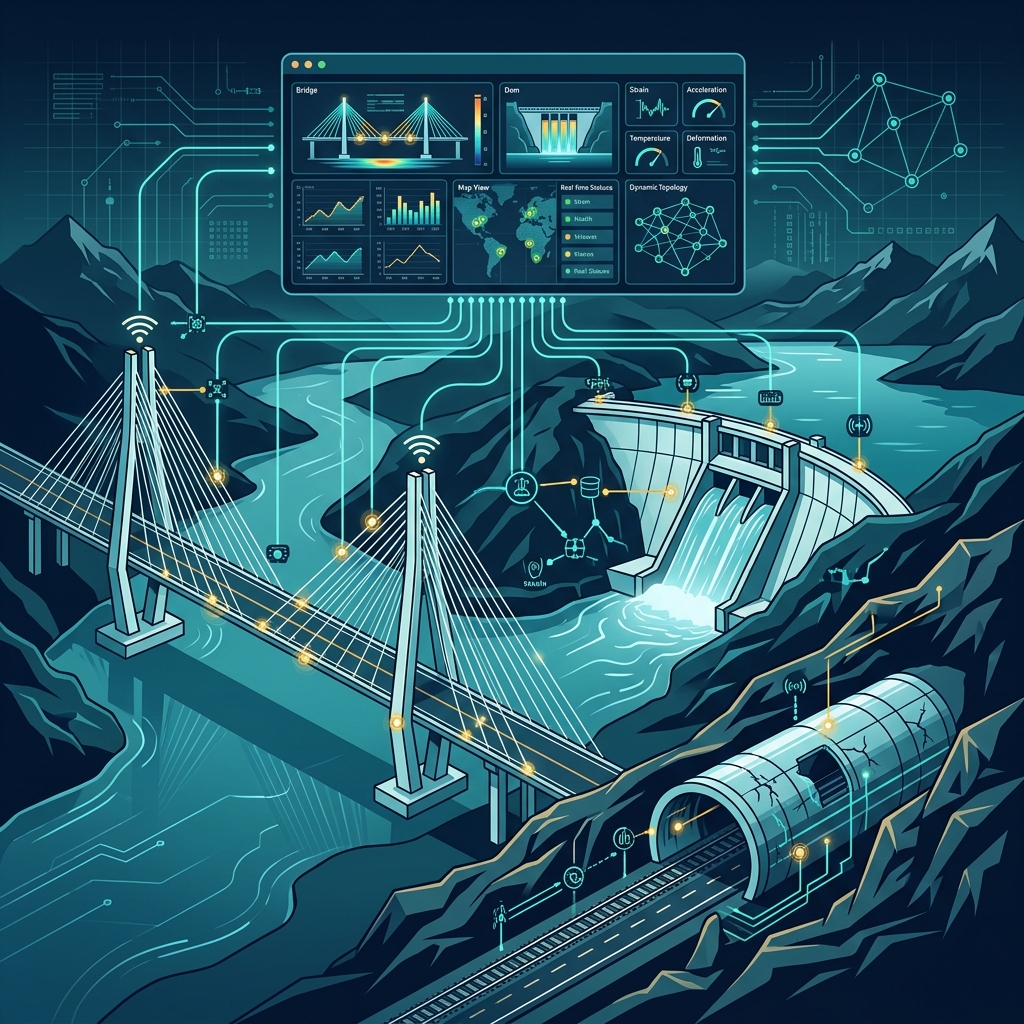
IoT in Civil Engineering: Bridge, Dam & Tunnel Monitoring Explained
Who This Guide Is For:
- Civil Engineers seeking to enhance structural monitoring with IoT.
- Geotechnical Consultants looking for advanced data-driven insights.
- Infrastructure Project Managers aiming to improve safety and efficiency.
- Procurement Leads at NHAI/RVNL/CPWD evaluating modern SHM solutions.
The integration of the Internet of Things (IoT) into civil engineering is transforming how we monitor and manage critical infrastructure. From bridges and dams to tunnels and buildings, IoT-based structural health monitoring (SHM) systems provide real-time data, enabling proactive maintenance, enhanced safety, and optimized performance. This comprehensive guide explores the applications, benefits, and key components of IoT in civil engineering, focusing on bridge, dam, and tunnel monitoring.
Traditional methods of structural monitoring often rely on manual inspections and infrequent data collection, which can be time-consuming, costly, and prone to human error. IoT offers a more efficient and reliable approach by deploying a network of sensors that continuously collect data on various parameters, such as strain, temperature, vibration, and displacement. This data is then transmitted wirelessly to a central platform for analysis and visualization, providing engineers with actionable insights into the health and performance of structures.
IoT for Bridge Health Monitoring
Bridge health monitoring is a critical application of IoT in civil engineering. Bridges are subjected to constant stress from traffic loads, environmental factors, and natural disasters. Implementing IoT-based SHM systems allows for continuous monitoring of key structural parameters, enabling early detection of potential issues and preventing catastrophic failures.
IoT sensors deployed on bridges can measure strain, stress, vibration, and displacement. These sensors provide real-time data on the structural response to various loads and environmental conditions. By analyzing this data, engineers can identify areas of concern, such as cracks, corrosion, or excessive deformation, and take timely corrective actions. Furthermore, predictive maintenance algorithms can be applied to forecast future structural performance and optimize maintenance schedules. This proactive approach minimizes downtime, reduces maintenance costs, and extends the lifespan of bridges.
IoT for Dam Safety and Stability
Dams are vital infrastructure assets that require continuous monitoring to ensure their safety and stability. The consequences of dam failures can be devastating, leading to loss of life, property damage, and environmental disasters. IoT in civil engineering offers a powerful solution for dam monitoring, providing real-time data on water levels, pore pressure, seepage, and structural deformation.
IoT sensors embedded within dams can measure various parameters that indicate the dam's health. Piezometers monitor pore water pressure, which is a critical factor in assessing dam stability. Strain gauges measure stress and deformation within the dam structure. Accelerometers detect vibrations caused by seismic activity or internal erosion. This data is transmitted wirelessly to a central monitoring system, where it is analyzed to detect anomalies and potential risks. Early detection of issues such as seepage, cracking, or excessive deformation allows for timely intervention and prevents catastrophic failures. Moreover, IoT-based dam monitoring systems can provide valuable data for optimizing reservoir management and water resource allocation.
IoT for Tunnel Structural Integrity
Tunnels are complex underground structures that require careful monitoring to ensure their structural integrity. Factors such as ground movement, water infiltration, and traffic loads can compromise the stability of tunnels, leading to potential collapses or other failures. The use of IoT in civil engineering for tunnel monitoring provides real-time data on ground pressure, deformation, and environmental conditions, enabling proactive maintenance and enhanced safety.
IoT sensors installed within tunnels can measure ground pressure, strain, displacement, and temperature. These sensors provide valuable data on the tunnel's response to various loads and environmental factors. By analyzing this data, engineers can identify areas of concern, such as ground movement, water infiltration, or excessive deformation, and take timely corrective actions. Furthermore, IoT-based tunnel monitoring systems can provide early warnings of potential collapses or other failures, allowing for evacuation and emergency response. This proactive approach minimizes downtime, reduces maintenance costs, and ensures the safety of tunnel users.
Data Analytics and Visualization in SHM
The vast amount of data generated by IoT-based SHM systems requires sophisticated data analytics and visualization tools to extract meaningful insights. Data analytics involves processing and analyzing the raw data collected by sensors to identify patterns, trends, and anomalies. Visualization tools present the analyzed data in a user-friendly format, allowing engineers to easily understand the health and performance of structures.
Advanced algorithms, such as machine learning and artificial intelligence, can be applied to the data to predict future structural performance and optimize maintenance schedules. For example, machine learning models can be trained to identify early signs of deterioration based on historical data and sensor readings. This allows for proactive maintenance and prevents costly repairs. Visualization tools, such as dashboards and 3D models, provide engineers with a comprehensive view of the structural health, enabling them to make informed decisions and take timely actions. The combination of data analytics and visualization empowers engineers to effectively manage and maintain critical infrastructure assets.
Key Sensor Technologies in IoT for Civil Engineering
The effectiveness of IoT in civil engineering for SHM depends on the selection and deployment of appropriate sensor technologies. Various types of sensors are used to measure different parameters, such as strain, temperature, vibration, displacement, and environmental conditions. Each sensor technology has its own advantages and limitations, and the selection of the right sensor depends on the specific application and requirements.
Some of the key sensor technologies used in IoT-based SHM systems include strain gauges, accelerometers, fiber optic sensors, and wireless sensor networks. Strain gauges measure the strain or deformation of a structure, providing valuable data on stress levels. Accelerometers measure vibrations, which can indicate structural damage or instability. Fiber optic sensors offer high accuracy and sensitivity for measuring strain, temperature, and displacement. Wireless sensor networks enable the deployment of a large number of sensors without the need for extensive wiring, reducing installation costs and complexity. The choice of sensor technology depends on factors such as accuracy, sensitivity, durability, and cost. For a detailed overview, see our SHM Sensor Types Comparison Guide.
Geolook vs. Traditional Monitoring Methods
Traditional structural health monitoring methods often involve manual inspections, visual assessments, and periodic data collection using conventional instruments. While these methods can provide valuable information, they are often time-consuming, labor-intensive, and prone to human error. Geolook offers a more efficient, accurate, and cost-effective solution by leveraging the power of IoT and advanced data analytics.
Unlike traditional methods, Geolook provides continuous, real-time monitoring of structural parameters, enabling early detection of potential issues and preventing catastrophic failures. Geolook's wireless sensors and cloud-based platform eliminate the need for manual data collection and reduce the risk of human error. Furthermore, Geolook's advanced data analytics algorithms provide actionable insights into the health and performance of structures, enabling proactive maintenance and optimized resource allocation. For instance, Geolook can reduce the cost of bridge inspections by up to 40%, saving infrastructure owners thousands of INR per year.
Comparative Analysis of SHM Solutions
| Feature | Geolook | Traditional Methods | Encardio-Rite |
|---|---|---|---|
| Data Collection | Continuous, Real-time | Periodic, Manual | Continuous, Real-time |
| Data Analysis | Automated, AI-powered | Manual, Visual Inspection | Automated |
| Alerting System | Real-time Alerts | Delayed, Manual Reporting | Real-time Alerts |
| Cost-Effectiveness | Lower Long-Term Costs | Higher Labor Costs | Comparable |
| Ease of Deployment | Easy, Wireless Sensors | Complex, Wired Systems | Complex, Wired Systems |
| Indian project suitability | Specifically designed for Indian infrastructure conditions, including extreme weather and varied construction practices. | May not be optimized for all Indian conditions. | Suitable for Indian conditions. |
Download Our Comprehensive Guide
Want to dive deeper into the world of IoT in civil engineering? Download our free comprehensive guide, covering everything from sensor selection to data analysis and real-world case studies. Get your copy now at /resources/downloads/iot-civil-engineering-guide.
What are the main benefits of using IoT in civil engineering?
IoT in civil engineering offers several benefits, including real-time monitoring, early detection of structural issues, reduced maintenance costs, enhanced safety, and optimized resource allocation.
How does IoT improve bridge health monitoring?
IoT sensors provide continuous data on strain, stress, vibration, and displacement, enabling early detection of cracks, corrosion, and other structural issues. This allows for timely corrective actions and prevents catastrophic failures.
What types of sensors are used in IoT-based dam monitoring?
Common sensors used in dam monitoring include piezometers, strain gauges, and accelerometers. These sensors measure pore water pressure, stress, deformation, and vibrations, providing valuable data on dam stability.
How can data analytics and visualization improve SHM?
Data analytics and visualization tools process and analyze sensor data to identify patterns, trends, and anomalies. This allows engineers to easily understand the health and performance of structures and make informed decisions.
Is Geolook suitable for Indian infrastructure projects?
Yes, Geolook is specifically designed for Indian infrastructure conditions, including extreme weather and varied construction practices. Our solutions are optimized to meet the unique challenges of Indian projects.
The integration of IoT in civil engineering is revolutionizing how we monitor and manage critical infrastructure. By providing real-time data, advanced analytics, and proactive maintenance capabilities, IoT-based SHM systems offer significant benefits in terms of safety, efficiency, and cost-effectiveness. As technology continues to evolve, the adoption of IoT in civil engineering will only increase, leading to safer, more resilient, and sustainable infrastructure.
Ready to explore how Geolook can transform your structural health monitoring? See Geolook IoT Solutions and discover the future of infrastructure management.
