Slope Instrumentation: Sensor Types, Installation & Data
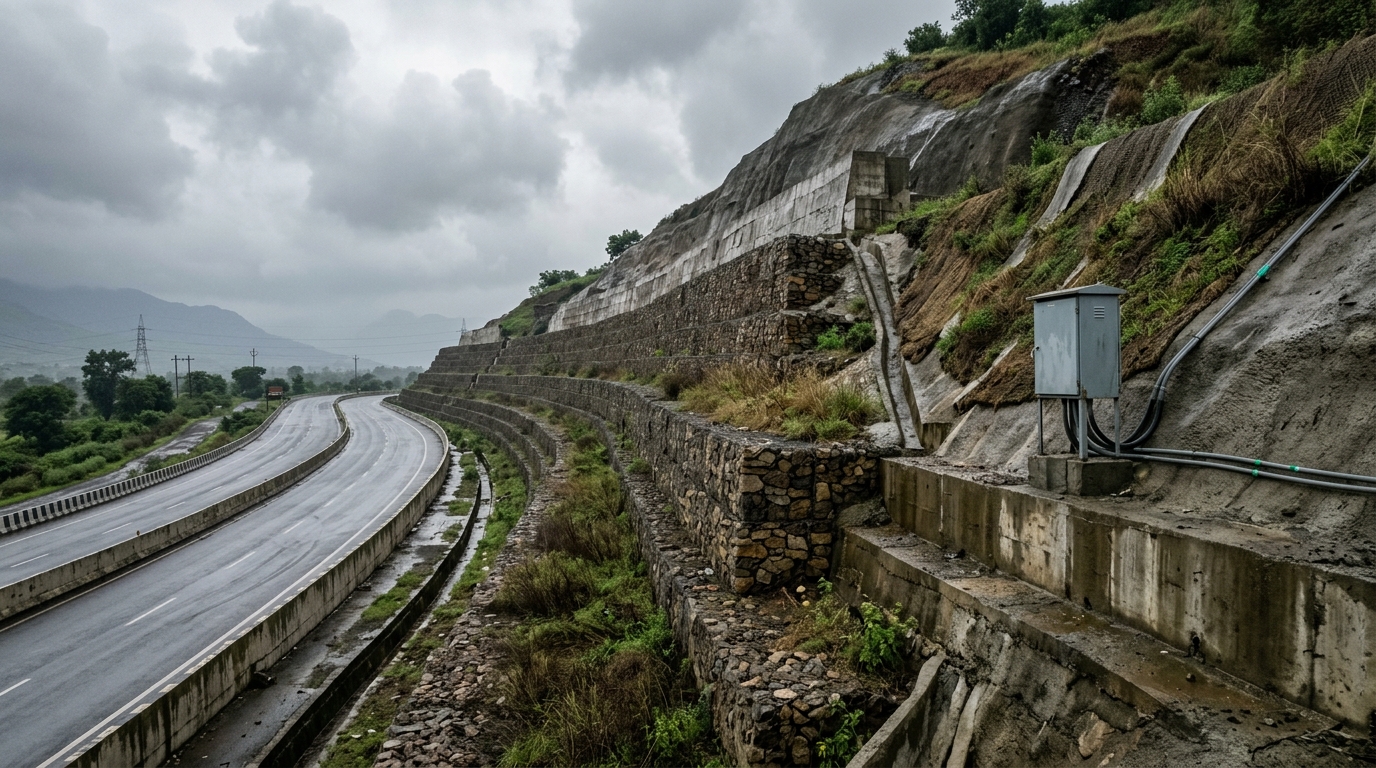
In August 2010, cloudbursts triggered catastrophic landslides in Leh, Ladakh, killing over 250 people and destroying critical road and communication infrastructure — a disaster that the National Disaster Management Authority (NDMA) later cited as evidence that real-time slope instrumentation networks were absent at every affected site. For geotechnical engineers working on highway cuttings, embankments, dam abutments, and hill-road corridors, this is not a historical footnote; it is a design mandate. Slope instrumentation — the systematic deployment of subsurface and surface sensors to measure deformation, pore pressure, and displacement within a slope mass — is the primary technical defence against undetected progressive failure. This guide covers sensor selection, installation protocols aligned with IS 14458 and NDMA guidelines, and the data interpretation workflows that convert raw readings into actionable stability assessments.
Key Takeaways
- Slope instrumentation integrates inclinometers, piezometers, extensometers, and tilt meters into a layered monitoring system that detects deformation at depths unreachable by visual inspection.
- IS 14458 (Guidelines for Retaining Walls) and NDMA's landslide risk management guidelines together define the minimum monitoring obligations for engineered slopes in India.
- Sensor selection must be driven by failure mode: rotational slides demand inclinometers; tension crack opening requires extensometers; pore pressure build-up requires vibrating-wire piezometers.
- Installation quality — borehole verticality, grout mix, and casing joint integrity — determines data reliability more than sensor specification alone.
- Threshold-based alert logic (green/amber/red) tied to displacement rate in mm/day, rather than absolute displacement in mm, is the operationally correct interpretation framework for active slopes.
What Is Slope Instrumentation
Slope instrumentation is the engineering practice of embedding or surface-mounting geotechnical sensors within a slope mass to continuously or periodically measure parameters — including lateral displacement, pore water pressure, surface crack width, and tilt — that indicate the onset or progression of instability. The discipline draws from IS 1892 (site investigation), IS 2720 (soil testing), and IS 14458, and is increasingly mandated by NDMA's National Landslide Risk Management Strategy for slopes along national highways, railway cuttings, and reservoir rims.
A complete slope instrumentation system typically comprises four sensor families working in concert. Borehole inclinometers track subsurface lateral movement profiles. Vibrating-wire piezometers measure pore water pressure at discrete depths. Wire or rod extensometers quantify surface crack opening and relative displacement between slope blocks. Tilt meters mounted on retaining structures or slope markers capture angular rotation that precedes visible cracking. Each sensor type addresses a specific failure mechanism, and their combined output allows the geotechnical engineer to distinguish between superficial creep and deep-seated translational or rotational failure.
For engineers managing slopes along transport corridors, our geotechnical monitoring solutions for transport infrastructure detail how these sensor networks integrate with highway and railway project requirements.
Inclinometer Slope Monitoring: Principles and Sensor Types
The inclinometer slope measurement system remains the most diagnostic tool in the geotechnical engineer's instrumentation kit because it resolves the depth and magnitude of a shear zone — information that surface observations cannot provide. A borehole inclinometer casing (typically 70 mm or 85 mm OD ABS or aluminium) is grouted into a borehole that terminates at least 3–5 m below the anticipated failure surface. A probe containing a biaxial MEMS accelerometer or servo-accelerometer is lowered in 0.5 m increments, and the inclination angle θ at each depth is recorded. Cumulative displacement is calculated as Σ(L × sin θ), where L is the gauge length between readings.
MEMS-based digital inclinometer probes have largely displaced older analogue servo-accelerometer probes in Indian practice because they offer resolution down to 0.01 mm per 0.5 m gauge length, operate across the −20 °C to +70 °C range relevant to Himalayan and peninsular sites, and output RS-485 digital signals that eliminate cable-induced noise. For projects requiring continuous automated readings rather than periodic manual surveys, in-place inclinometer (IPI) arrays — a string of fixed MEMS sensors installed at pre-selected depths — provide data at configurable intervals from 1 minute to 24 hours. Explore Geolook's MEMS digital inclinometer for slope and embankment monitoring for full technical specifications.
Interpretation of inclinometer data requires plotting cumulative displacement versus depth for successive survey dates. A distinct inflection in the displacement profile — where the curve bends sharply — identifies the shear zone depth. Displacement rates exceeding 1–2 mm/day at the shear zone are widely treated as a threshold for escalated monitoring frequency, though site-specific geology and rainfall correlation must govern final alert levels.
Tilt Meter Slope Applications and Piezometer Integration
A tilt meter slope sensor measures angular rotation (in arc-seconds or milliradians) of a surface or embedded element relative to a reference plane. In slope monitoring, tilt meters are mounted on retaining wall stems, slope marker posts, or rock outcrops to detect the early rotational precursors of failure that precede measurable crack opening. MEMS-based biaxial tilt meters with resolution of 0.001° are standard for continuous monitoring; electrolytic tilt sensors are used where lower cost and lower resolution (0.01°) are acceptable for periodic checks.
Pore water pressure is the dominant destabilising force in most Indian slope failures, particularly in the monsoon-sensitive Himalayan, Western Ghats, and North-East hill regions. Vibrating-wire piezometers installed at multiple depths within the same borehole as the inclinometer casing — or in dedicated piezometer boreholes — measure pore pressure in kPa with resolution of ±0.025% FS. The critical parameter is the piezometric head relative to the slip surface: when the phreatic surface rises above the failure plane, the effective normal stress σ′ = σ − u drops, reducing the available shear resistance τ = c′ + σ′ tan φ′ (Mohr-Coulomb). Correlating piezometer readings with rainfall intensity (mm/hr) and inclinometer displacement rate creates a predictive model that can trigger alerts before displacement becomes irreversible.
Extensometer Selection and Surface Displacement Monitoring
An extensometer measures the change in distance between two anchor points — either across a tension crack at the surface (crack extensometer) or between a fixed deep anchor and a surface reference (rod or wire extensometer). In slope instrumentation, extensometers serve two functions: they quantify the rate of crack opening in mm/day, which is a direct proxy for slope acceleration, and they provide a redundant surface displacement check against inclinometer subsurface data.
Wire extensometers use an invar or stainless-steel wire tensioned between a deep grouted anchor and a surface reference block; displacement is measured by a linear potentiometer or vibrating-wire transducer with resolution of 0.01 mm over ranges of 50–500 mm. Rod extensometers (single-point or multi-point) use a rigid steel rod grouted at a fixed depth; relative movement between the rod head and the surface collar is read by a dial gauge or electronic transducer. Multi-point borehole extensometers (MPBX) with 3–6 anchors at different depths provide a displacement profile comparable to an inclinometer but along the borehole axis rather than laterally.
For slopes where surface crack geometry is complex or access is restricted, total-station prism arrays and GNSS displacement sensors supplement contact extensometers. The combination of extensometer data (local crack kinematics) with inclinometer data (subsurface shear zone depth) and piezometer data (pore pressure) constitutes a complete slope instrumentation dataset adequate for back-analysis using limit equilibrium methods per IS 14458.
See our detailed discussion of slope stability monitoring methods and threshold setting for guidance on integrating multi-sensor datasets into a unified stability assessment.
Sensor Selection Matrix for Slope Instrumentation
Selecting the correct sensor for a given slope failure mode is the most consequential engineering decision in any slope instrumentation programme. The matrix below maps failure mechanism to recommended sensor type, measurand, typical range, and resolution for Indian geotechnical practice.
| Failure Mechanism | Primary Sensor | Measurand | Typical Range | Resolution | Indian Standard / Guideline |
|---|---|---|---|---|---|
| Deep rotational / translational slide | Borehole inclinometer (MEMS or IPI) | Lateral displacement profile (mm) | ±75 mm per 0.5 m gauge | 0.01 mm / 0.5 m | IS 14458, NDMA Landslide Guidelines |
| Pore pressure build-up (monsoon) | Vibrating-wire piezometer | Pore water pressure (kPa) | 0–700 kPa | ±0.025% FS | IS 2720 Part 36, CWC guidelines |
| Tension crack opening | Wire / rod extensometer | Crack width change (mm) | 0–500 mm | 0.01 mm | IS 14458 |
| Retaining wall rotation | Biaxial MEMS tilt meter | Angular tilt (°, mrad) | ±15° | 0.001° | IS 14458, IRC SP-48 |
| Shallow debris / surficial creep | GNSS displacement sensor / total station prism | 3D surface displacement (mm) | Unlimited range | 1–3 mm (GNSS); 0.1 mm (total station) | NDMA Landslide Guidelines |
| Rockfall / block sliding | Geophone / seismic sensor array | Ground vibration (mm/s²) | 0–2000 mm/s² | 0.001 mm/s² | IS 1893 Part 1 |
| Embankment settlement (fill slopes) | Settlement plate / liquid level sensor | Vertical settlement (mm) | 0–300 mm | 0.1 mm | IS 1892, MORTH Specifications |
This matrix is a starting point. Final sensor selection must be validated against site-specific geology (GSI rock mass classification or IS 1892 soil classification), groundwater regime, and the consequence class of the slope as defined by NDMA risk zoning.
Installation Best Practices for Slope Instrumentation in India
Installation quality is the single largest source of data error in slope instrumentation programmes. A correctly specified MEMS inclinometer installed in a poorly grouted, misaligned casing will produce systematically biased displacement readings that can mask or exaggerate movement. The following practices reflect IS 14458 requirements and field experience across Himalayan, Western Ghats, and Deccan Plateau terrain.
Borehole preparation: Drill to at least 3 m below the deepest anticipated failure surface, or to competent rock if shallower. Borehole diameter should be 100–150 mm for standard 70–85 mm OD casing. Flush with clean water, not drilling mud, to avoid bentonite contamination of the annular grout.
Casing installation: Lower casing with keyways oriented to the principal direction of anticipated movement (typically slope-dip azimuth ±5°). Misalignment beyond 10° from the movement direction reduces sensitivity by cos²θ — a 15° error reduces measured displacement by approximately 7%, which is significant when monitoring slow creep at 0.1–0.5 mm/month. Couple joints with manufacturer-specified connectors; improvised threading introduces spiral error.
Grouting: Use a cement-bentonite grout with water:cement ratio of 0.6:1 and 3–5% bentonite by weight of cement. This mix achieves a stiffness close to the surrounding soil (shear modulus 5–15 MPa), ensuring the casing deforms with the slope mass rather than bridging across the shear zone. Tremie-pipe grout from the bottom up to eliminate voids.
Baseline surveys: Take a minimum of three baseline surveys over 2–4 weeks before construction or monsoon loading begins. Baseline scatter greater than ±0.5 mm indicates casing or installation problems that must be resolved before monitoring data can be trusted.
Data logging and telemetry: For remote Himalayan or BRO-managed road slopes where manual access is seasonal, solar-powered dataloggers with GSM/4G telemetry and local SD-card backup are standard. Configure alert thresholds at the datalogger level so SMS or email alerts are triggered autonomously if displacement rate exceeds the site-specific amber threshold — typically 0.5–1.0 mm/day for highway slopes per NDMA guidance.
For a comprehensive overview of automated monitoring architectures for landslide-prone corridors, see our guide on real time slope monitoring system for landslide prevention india.
Data Interpretation: From Raw Readings to Stability Decisions
Raw sensor output — displacement in mm, pressure in kPa, tilt in milliradians — becomes actionable only when interpreted within a geomechanical framework. The following workflow is applicable to most slope instrumentation programmes governed by IS 14458 and NDMA guidelines.
Step 1 — Establish displacement rate, not absolute displacement. Plot cumulative displacement versus time for each sensor depth. Calculate the displacement rate (mm/day or mm/month) over rolling 7-day and 30-day windows. Absolute displacement thresholds are site-specific and often misleading; a slope that has moved 50 mm over five years may be stable, while one that moves 5 mm in 24 hours is accelerating toward failure.
Step 2 — Correlate with piezometric head and rainfall. Overlay piezometer readings (kPa converted to metres of head) and daily rainfall (mm) on the displacement-time plot. A consistent lag of 12–72 hours between rainfall peak and piezometric head peak, followed by a displacement rate increase, confirms a pore-pressure-driven failure mechanism. This correlation is essential for calibrating early warning thresholds.
Step 3 — Apply a three-level alert framework. Green (normal): displacement rate below 0.1 mm/day, piezometric head below design phreatic surface. Amber (watch): rate 0.1–1.0 mm/day or piezometric head approaching design level; increase monitoring frequency to hourly. Red (emergency): rate exceeding 1.0 mm/day or accelerating trend; notify NDMA/state disaster management authority and initiate evacuation protocol if applicable.
Step 4 — Back-analyse with limit equilibrium. When displacement data indicates a developing shear zone, use the inclinometer depth profile to fix the failure surface geometry and back-calculate mobilised shear strength parameters (c′, φ′) using software implementing Bishop's simplified method or Morgenstern-Price method. Compare back-calculated parameters with laboratory values from IS 2720 Part 13 (direct shear) to assess residual strength mobilisation.
Engineers seeking a broader framework for instrument selection and early warning integration should also review our resource on best instruments for early landslide warning systems.
Wireless and IoT-Enabled Slope Instrumentation Networks
Traditional slope instrumentation relied on periodic manual surveys — a geotechnical engineer visiting a site every 2–4 weeks to lower an inclinometer probe and read piezometer standpipes. This approach is inadequate for slopes that can transition from creep to rapid failure within hours during intense monsoon events, as documented in multiple GSI post-failure investigations of NH-44 and NH-58 corridor landslides.
Modern slope instrumentation networks integrate in-place inclinometer arrays, vibrating-wire piezometers, tilt meters, and rain gauges into a single IoT datalogger that samples at 1–15 minute intervals and transmits via 4G LTE or LoRaWAN to a cloud-based SCADA dashboard. Alert logic runs at the edge (on the datalogger) so that SMS and email notifications are sent even if cloud connectivity is interrupted. Data is stored locally on SD card as a backup, ensuring no data loss during network outages common in remote hill terrain.
Power autonomy is a critical design parameter. A 40 Wp solar panel with a 50 Ah lithium-iron-phosphate battery provides sufficient energy for a datalogger sampling 8 sensors at 5-minute intervals through 5 consecutive cloudy days — a realistic worst-case for monsoon-season monitoring in the North-East or Western Ghats.
For project-specific requirements on landslide monitoring sensor networks, visit Geolook's landslide monitoring instrumentation and IoT systems page.
Frequently Asked Questions
Q: What is slope instrumentation and why is it required under Indian standards?
A: Slope instrumentation is the systematic deployment of geotechnical sensors — inclinometers, piezometers, extensometers, and tilt meters — to measure deformation and pore pressure within a slope mass. IS 14458 and NDMA's National Landslide Risk Management Strategy require instrumented monitoring for engineered slopes along national highways, railway cuttings, and reservoir abutments classified as high or very-high hazard zones.
Q: How deep should an inclinometer casing be installed for slope monitoring?
A: An inclinometer casing for slope monitoring must extend at least 3–5 metres below the deepest anticipated failure surface, or to competent rock if shallower. This ensures the bottom of the casing remains in stable ground and provides a fixed reference point from which cumulative lateral displacement is calculated upward through the slope mass.
Q: What is the difference between a tilt meter and an inclinometer in slope monitoring?
A: A tilt meter measures angular rotation (in degrees or milliradians) of a surface-mounted or embedded element and is best suited for monitoring retaining walls, slope marker posts, and rock outcrops. An inclinometer measures the lateral displacement profile with depth inside a borehole casing, identifying the precise depth of a subsurface shear zone. Both sensors are complementary in a complete slope instrumentation system.
Q: What displacement rate threshold should trigger a red alert on a monitored slope?
A: A displacement rate exceeding 1.0 mm/day at the identified shear zone depth, or any accelerating trend in the displacement-time curve, is widely used as a red-alert threshold for highway and railway slopes in India, consistent with NDMA early warning guidance. Site-specific geology, slope consequence class, and piezometric conditions must be used to calibrate final thresholds for each project.
Q: How does an extensometer differ from an inclinometer in slope instrumentation?
A: An extensometer measures the change in distance between two fixed anchor points — typically across a tension crack or between a deep anchor and the surface — providing crack opening rate in mm/day. An inclinometer measures lateral displacement versus depth inside a borehole. Extensometers are surface or near-surface instruments best suited to quantifying crack kinematics, while inclinometers diagnose subsurface failure geometry.
Download slope guide
Geolook's Slope Instrumentation Field Guide consolidates the sensor selection matrix, IS 14458-aligned installation checklists, grout mix specifications, baseline survey protocols, and three-level alert threshold templates into a single reference document for geotechnical engineers and project managers.
The guide is structured for direct use on site: each checklist is formatted as a sign-off sheet compatible with NHAI, BRO, and RVNL quality assurance documentation requirements. Threshold tables are pre-populated with NDMA-referenced values and include blank columns for site-specific calibration entries.
To receive the guide or discuss slope instrumentation requirements for your project, contact Geolook's geotechnical instrumentation team. For engineers evaluating sensor options, the MEMS digital inclinometer product page includes downloadable datasheets, probe compatibility charts, and casing specification tables.
Project inquiry
Talk to a Geolook™ specialist
Share your monitoring requirement and our team will help identify the right next step.
By submitting, you agree that Geolook™ may contact you about this inquiry. Your details are not added to a marketing list.