techonology
Vibrating Wire Sensors: Complete Guide to SHM Technology (2026)
Farhan AkhtarMarch 13, 2026 9 min read
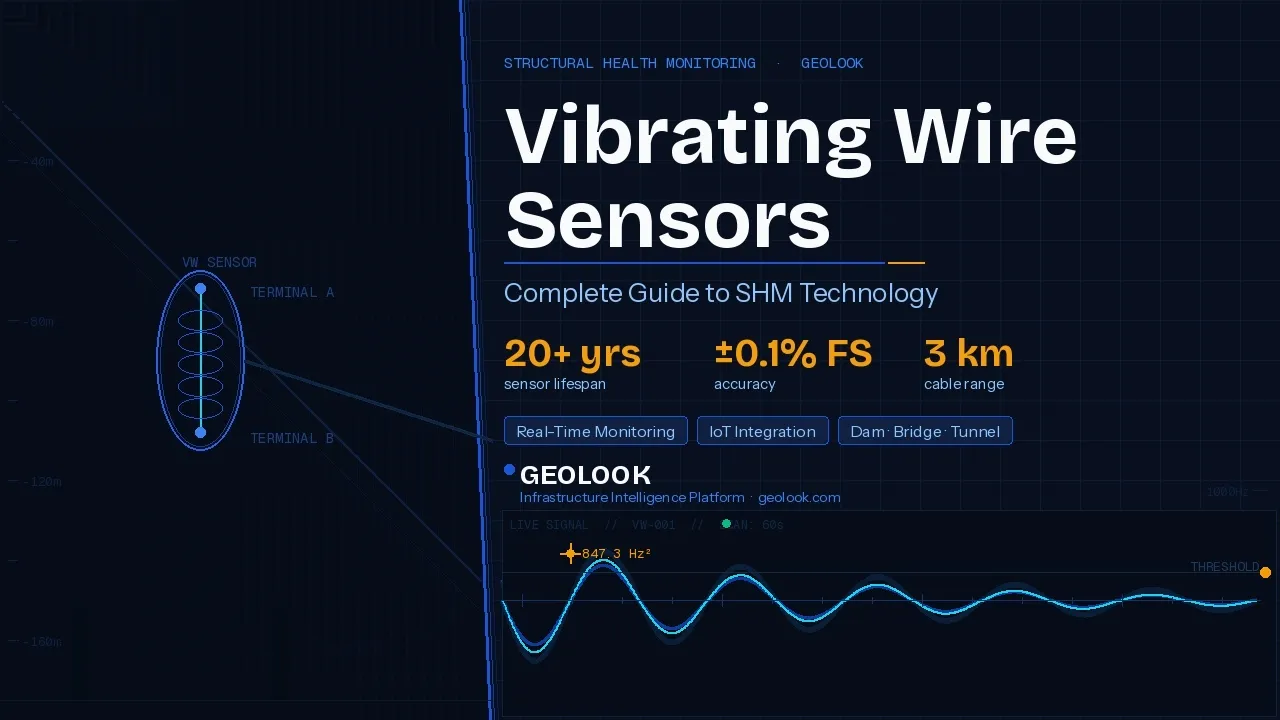
Discover how vibrating wire technology powers
structural health monitoring in bridges, dams & tunnels. Real-time IoT
integration explained. Read Geolook's expert guide.
Overview
Every year, aging infrastructure costs the global economy over $2.5 trillion in reactive maintenance, emergency repairs, and lost productivity. Yet the failure of most structures doesn't happen suddenly, it builds gradually, through years of undetected stress, strain, and movement.
That's
precisely why vibrating wire sensors have become the gold standard for
structural health monitoring (SHM). Trusted by engineers across tunnels, dams,
bridges, slopes, and high-rise buildings, vibrating wire technology delivers
the measurement accuracy, long-term stability, and environmental resilience
that modern infrastructure demands.
This guide covers everything you need to know, how VW sensors work, their key advantages over competing technologies, real-world applications, and how Geolook integrates them into a unified, IoT-enabled monitoring platform.
"A vibrating wire (VW) sensor measures structural parameters — strain, pressure, load, displacement, pore water pressure — by detecting changes in the resonant frequency of a tensioned steel wire. Unlike voltage-based sensors, VW technology is immune to signal drift and electromagnetic interference, making it ideal for long-term infrastructure monitoring in harsh environments."
"Stable over 20+ years | Accurate to ±0.1% FS | Operates from –20°C to +80°C | Cable runs up to 3 km without signal loss"
What Is Vibrating Wire Technology?
Vibrating
wire technology is a measurement principle based on the relationship between
mechanical tension and resonant frequency. Inside every VW sensor, a
high-tensile steel wire is clamped under tension between two anchor points
embedded within the structure being monitored.
As
the structure experiences stress, strain, settlement, or pressure changes, the
anchor points shift - altering the tension on the wire. A built-in
electromagnetic coil excites the wire into vibration, and the sensor precisely
measures the resulting resonant frequency. Because frequency is a physical
property that remains stable regardless of cable length, temperature variation,
or electrical noise, the output is inherently reliable.
This
frequency signal is then converted into engineering units - strain, load, pore water pressure, or displacement - using manufacturer-calibrated coefficients stored in
the datalogger. The entire process happens automatically, delivering real-time
readings to a cloud dashboard without manual intervention.
"Most conventional electrical resistance sensors output a voltage signal that degrades over long cable runs and is vulnerable to moisture ingress and EMI. Vibrating wire sensors output a frequency - a property that doesn't degrade with distance, making them uniquely suited to the long cable runs (100m–3km) typical in dam galleries, tunnel bores, and deep excavations."
How Vibrating Wire Sensors Work: Step-by-Step
Understanding the operating principle helps
engineers specify the right sensor and interpret readings correctly. Here is
the measurement cycle, step by step:
1.
Tensioned wire at rest -
The steel wire inside the sensor is
pre-tensioned to a known baseline frequency - typically 400–6,000 Hz depending
on sensor type and measurement range.
2.
Structural change occurs
- External forces (load, pressure,
settlement, thermal expansion) cause the sensor body to deform, changing the
wire tension.
3.
Electromagnetic
excitation - A readout unit or
datalogger sends a brief electrical pulse to the coil, which magnetically
plucks the wire into vibration.
4.
Frequency measurement - The same coil reads the wire's resonant frequency as it
decays. The datalogger records this frequency with microsecond precision.
5.
Engineering unit
conversion - Using the calibration
factor (supplied per sensor), the datalogger converts frequency shift (ΔF²)
into the target parameter: strain (με), pressure (kPa), load (kN), or
displacement (mm).
6.
Data transmission - The reading is timestamped and transmitted - via cable,
wireless LoRa, or cellular - to Geolook's cloud monitoring platform for
storage, visualization, and alert processing.
5 Key Advantages of Vibrating Wire Sensors Over Competing Technologies
When procurement teams and project engineers
evaluate SHM sensor technologies, vibrating wire consistently outperforms
alternatives across the metrics that matter most for long-term infrastructure
projects.
1. Long-Term Measurement Stability
3. Reliable Data Over Long Cable Distances
4. Environmental Durability
5. Low Total Cost of Ownership
|
Performance Factor |
Electrical Resistance Sensors |
Vibrating Wire Sensors |
|
Long-term stability |
Drift over months/years |
✅ Stable over 20+ years |
|
EMI immunity |
❌ Susceptible |
✅ Fully immune |
|
Long cable runs |
❌ Signal degrades >100m |
✅ Stable up to 3 km |
|
Moisture resistance |
❌ Moisture causes errors |
✅ Hermetically sealed |
|
Temperature compensation |
Manual correction required |
✅ Built-in thermistor |
|
Calibration life |
Frequent recalibration needed |
✅ Factory-set, stable lifetime |
|
Cost over 10-year project |
Higher (maintenance + replacement) |
✅ Lower (install-and-forget) |
1. Long-Term Measurement Stability
For
infrastructure projects spanning 5–30 years - dams, metro tunnels, highway
bridges - sensor drift is a critical failure mode. Vibrating wire sensors
maintain measurement accuracy for the life of the structure without
recalibration. Field deployments in dam monitoring programs have recorded
continuous, drift-free data for over 25 years.
2. Full Immunity to Electromagnetic Interference (EMI)
Construction
sites, railway lines, and industrial facilities generate intense
electromagnetic fields that corrupt voltage-based sensor readings. Because VW
sensors output frequency rather than voltage, EMI has zero effect on
measurement accuracy. This is particularly important for bridge monitoring near
electrified rail lines and mine monitoring near heavy machinery.
3. Reliable Data Over Long Cable Distances
Deep
dam galleries, long tunnel bores, and large earth embankments require cable
runs of hundreds of metres to kilometres. Vibrating wire technology maintains
signal integrity across distances up to 3 km - a capability no conventional
electrical sensor can match without expensive signal conditioning equipment.
4. Environmental Durability
Geolook's
VW sensors are hermetically sealed with stainless steel housings, rated for
continuous submersion in water and operation across a temperature range of
–20°C to +80°C. This makes them the go-to choice for underwater foundation
monitoring, alpine slope monitoring, and tropical dam instrumentation.
5. Low Total Cost of Ownership
While the upfront cost of VW sensors is slightly higher than basic electrical resistance gauges, the total cost over a 10-year monitoring program is significantly lower. Zero recalibration requirements, negligible maintenance, and near-zero sensor replacement rates make VW technology the most cost-efficient option for critical infrastructure projects.
Vibrating Wire Sensor Applications in Infrastructure Monitoring
Vibrating
wire technology is deployed across virtually every major infrastructure
category. Below are the primary applications where VW sensors are the specified
standard - and the specific parameters they measure in each context.
|
🌉 Bridge Monitoring • Strain in girders, decks & cables • Load distribution under traffic • Thermal expansion & contraction • Long-term structural fatigue detection |
🏔️Dam Monitoring • Uplift pressure in foundations • Pore water pressure in embankments • Seepage monitoring in galleries • Structural strain in concrete sections |
|
🚇 Tunnel Monitoring • Convergence & deformation • Ground movement during TBM boring • Lining stress & contact pressure • Settlement of overlying structures |
🏗️ Deep Excavation &
High-Rise • Retaining wall deflection & strain • Pile load & bearing capacity • Building settlement monitoring • Tilt & differential movement |
|
🌿 Slope & Landslide
Monitoring • Pore pressure changes pre-failure • Subsurface movement via in-place inclinometers • Rainfall-triggered displacement alerts • Retaining structure performance |
⚒️ Mine & Industrial Monitoring • Pillar and roof stress monitoring • Tailings dam stability • Ground subsidence tracking • Rock bolt load measurement |
Types of Vibrating Wire Sensors: Choosing the Right Instrument
Not
all VW sensors are the same. Selecting the correct instrument type is critical
for measurement accuracy and long-term reliability. Here are the main vibrating
wire instrument types and their primary use cases:
•
VW Strain Gauge: Measures micro-strain (με) in concrete, steel, and timber
structural elements. Embedded during construction or surface-mounted on
existing structures.
•
VW Piezometer: Measures pore water pressure and groundwater levels.
Available in standpipe, vibrating wire, and pneumatic configurations. Essential
for dam safety and slope stability programs.
•
VW Load Cell: Measures compressive or tensile loads in piles, anchors,
struts, and rock bolts. Capacities from 50 kN to 20,000 kN.
•
VW Crack Meter / Joint
Meter: Monitors opening, closing, or
shear movement at structural joints, cracks, and construction joints. Critical
for concrete dam and tunnel lining monitoring.
•
VW Settlement Cell: Measures differential settlement across large
embankments, earth dams, and reclamation areas using a fluid-filled hydraulic
system.
• VW In-Place Inclinometer: Measures lateral movement profiles in slopes and retaining structures. Strings of sensors provide continuous deformation profiles without manual readout.
• VW Pressure Cell: Measures total earth pressure and contact pressure between soil and structural interfaces - critical for retaining wall and foundation design verification.
IoT Integration: From Standalone Sensors to Real-Time Monitoring
A
vibrating wire sensor alone is an instrument. Connected to Geolook's
IoT-enabled monitoring ecosystem, it becomes a real-time intelligence system.
🔗 The Geolook VW Monitoring Stack
① VW Sensors → measure strain, pressure, load, displacement at the structure
② Smart Dataloggers → auto-read sensors at configurable intervals (1 min to 24 hrs), apply calibration factors
③ Wireless Transmission → LoRa (long-range), 4G/LTE, or satellite relay to cloud
④ Geolook Cloud Platform → unified dashboard with real-time charts, threshold alerts, and trend analysis
⑤ Automated Alerts → SMS, email, and webhook notifications when readings cross engineer-defined thresholds
This end-to-end architecture eliminates the need for manual site visits, reduces human error, and gives engineers remote access to live structural data from any device - desktop, tablet, or mobile.
Key IoT Integration Features
•
Multi-sensor fusion: A single datalogger reads VW sensors, thermistors,
tiltmeters, and rainfall gauges simultaneously - delivering a complete picture
of structural and environmental conditions.
•
Configurable scan rates:
From 1-minute intervals for active
construction monitoring to daily reads for long-term operational monitoring -
all configurable remotely without site visits.
•
Edge processing &
local storage: Geolook dataloggers store
data locally on SD card or internal memory, ensuring no data loss during
cellular outages.
• Threshold-based automated alerts: Set primary, secondary, and tertiary alert thresholds (green / amber / red) per sensor. Automated notifications reach the right team members the moment a threshold is breached.
• API integration: Geolook's REST API enables seamless integration with third-party project management platforms, SCADA systems, and BIM environments.
Geolook's Vibrating Wire Monitoring Solutions
At Geolook, we design and deploy end-to-end
vibrating wire monitoring systems for infrastructure projects across India and
internationally. Our solutions cover the complete project lifecycle - from
sensor specification and installation support to real-time data management and
reporting.
✅ What Sets Geolook Apart
Sensor-agnostic platform - integrates VW sensors from all major manufacturers (Geokon, Soil Instruments, Sisgeo, Durham Geo, and others)
Rapid deployment - standard monitoring arrays installed and live on the Geolook dashboard within 48–72 hours
Multi-parameter dashboards - combine VW data with piezometers, inclinometers, settlement cells, and weather stations in one unified view
Engineering-grade alerting - tiered alert thresholds (green/amber/red) with automated escalation and audit trail
Regulatory reporting - auto-generated PDF reports formatted for NDMA, CWC, MoRTH, and other Indian regulatory bodies
India-focused support - local engineering team, Tamil/Hindi/English support, on-site commissioning across major infrastructure hubs
Project inquiry
Talk to a Geolook™ specialist
Share your monitoring requirement and our team will help identify the right next step.
By submitting, you agree that Geolook™ may contact you about this inquiry. Your details are not added to a marketing list.