SHM Solutions for Aging Bridges: When & Why to Retrofit with Monitoring
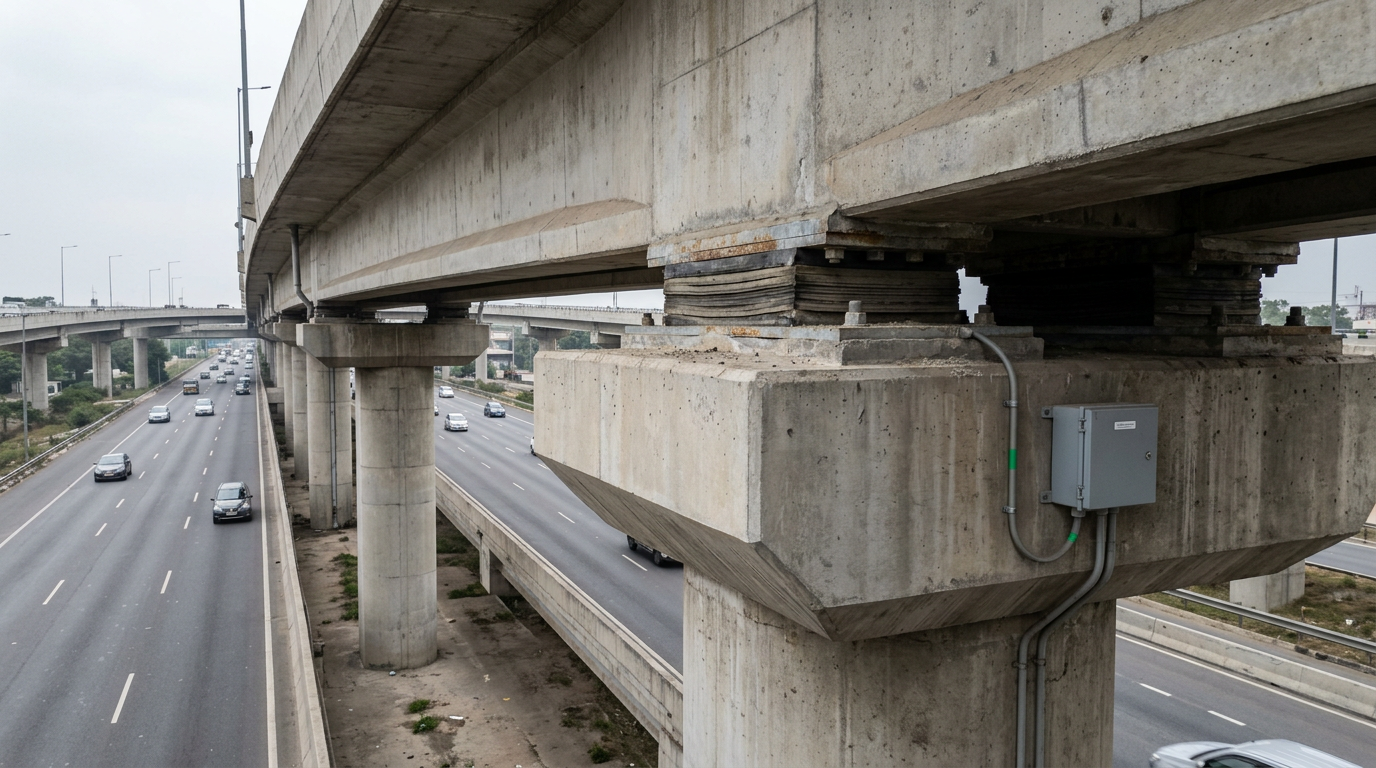
```json { "title": "Structural Health Monitoring Solutions for Aging Bridges: When & Why to Retrofit", "metaDescription": "Discover when and why structural health monitoring solutions for aging bridges are essential. Bridge retrofit monitoring strategies for Indian asset owners and engineers.", "slug": "shm-solutions-for-aging-bridges-retrofit", "sections": [ { "header": "", "content": "<p>In August 2016, the Majerhat Bridge in Kolkata — a 50-year-old structure on a busy arterial corridor — collapsed without warning, killing three people and severing a critical urban link for months. The bridge had been classified as distressed years earlier, yet no continuous monitoring system was in place to track the rate of deterioration or trigger an evacuation threshold. That gap between periodic inspection and real-time awareness is precisely where structural health monitoring solutions for aging bridges become not a luxury but an operational necessity.</p><p>India's bridge stock is ageing faster than it is being replaced. According to the Ministry of Road Transport and Highways, a significant proportion of national highway bridges were constructed before 1980, predating IRC:6 load revisions that now mandate heavier axle loads. Many of these structures were designed for traffic intensities that today's freight corridors exceed routinely. For asset owners and consulting engineers, the question is no longer whether to instrument an aging bridge — it is when, with what, and to what performance threshold.</p><p>This post sets out the engineering rationale for bridge retrofit monitoring, the decision criteria that should trigger instrumentation, and the monitoring architecture that delivers actionable data rather than raw sensor streams. For a foundational comparison of periodic inspection versus continuous monitoring, see our detailed analysis of <a href='/resources/blogs/bridge-inspection-vs-shm'>bridge inspection versus structural health monitoring</a>.</p>" }, { "header": "Key Takeaways", "content": "<ul><li>Bridges designed before IRC:6 (2017 revision) may be structurally under-rated for current axle loads; retrofit monitoring quantifies the actual demand-to-capacity ratio in service.</li><li>Aging bridge assessment should combine visual inspection per IRC SP-35 with sensor-based monitoring of strain, deflection, vibration, and crack width to produce a defensible condition index.</li><li>Wireless DAQ systems and 3D digital twin platforms now make continuous bridge retrofit monitoring viable on structures where cable routing is impractical.</li><li>Trigger thresholds — expressed in micro-strain, mm deflection, or mm/s² acceleration — must be defined before deployment, not after an anomaly appears.</li><li>Regulatory pressure is increasing: the Dam Safety Act 2021 model and NDMA's multi-hazard guidelines are informing a parallel push for mandatory SHM on critical road and rail bridges.</li></ul>" }, { "header": "What Structural Health Monitoring Solutions for Aging Bridges Actually Measure", "content": "<p>Structural health monitoring solutions for aging bridges are integrated systems of sensors, data acquisition hardware, communication networks, and analytical software that continuously or periodically measure the physical response of a bridge to load, environment, and time-dependent degradation.</p><p>The core measurands on a typical aging bridge instrumentation scheme include: static and dynamic strain (reported in micro-strain, µε) at critical sections such as mid-span, pier caps, and bearing zones; vertical deflection (mm) under live load; natural frequency and modal damping ratios derived from accelerometer data (mm/s²); crack width and propagation rate (mm); bearing displacement and rotation; and corrosion potential (mV) on reinforcement in chloride-exposed environments.</p><p>Each measurand maps to a specific failure mode. Loss of natural frequency, for instance, indicates stiffness reduction — a direct proxy for section loss or bearing degradation. Strain asymmetry between symmetric girders flags load redistribution that may indicate a failing element. These are not abstract data points; they are the early indicators that periodic visual inspection, conducted at intervals of three to five years per IRC SP-35, structurally cannot capture.</p><p>For a detailed breakdown of sensor technologies used in these systems, the guide on <a href='/resources/blogs/shm-sensor-types-comparison'>SHM sensor types and their engineering comparison</a> covers vibrating wire, MEMS, fibre Bragg grating, and piezoelectric options with their respective accuracy ranges and installation constraints.</p>" }, { "header": "Decision Criteria: When Does an Aging Bridge Warrant Retrofit Monitoring?", "content": "<p>Not every aging bridge requires a full instrumentation programme. The decision to deploy structural health monitoring solutions for aging bridges should be driven by a structured risk matrix that considers structural age and design vintage, traffic volume and axle load spectrum, seismic zone classification per IS 1893, proximity to water (scour risk), and the consequence of failure — measured in terms of lives, economic disruption, and network redundancy.</p><p>Bridges that warrant priority instrumentation typically meet one or more of the following conditions: the structure is more than 40 years old and carries more than 5,000 commercial vehicles per day; the bridge spans a river in a zone of active scour and has no real-time pier settlement monitoring; the structure is in seismic zone III, IV, or V and was designed before IS 1893 (2002) provisions; visual inspection has recorded a condition rating of 3 or below on the IRC SP-35 six-point scale; or the bridge is a cable-stayed, extra-dosed, or long-span structure where modal behaviour is the primary structural integrity indicator.</p><p>Sandeep Gupta, IRSE, former Chief Administrative Officer of Indian Railways and Strategic Advisor at Geolook, notes that cable-stayed and extra-dosed bridges present a particular monitoring challenge: <em>"The stay cable force distribution in these structures changes continuously with temperature, traffic, and creep. A static inspection tells you the condition at one moment. Only continuous monitoring of cable tension and deck acceleration gives you the structural story over time."</em> This is especially relevant as Indian Railways and NHAI expand their portfolios of long-span crossings on seismically active corridors.</p><p>Aging bridge assessment should also be triggered by any change in the bridge's operating environment: a new heavy-haul freight route opening nearby, a flood event that may have caused scour, or a seismic event above M 4.0 within 50 km of the structure.</p>" }, { "header": "Monitoring Architecture for Retrofit Deployments", "content": "<p>Retrofitting a monitoring system onto an operational bridge — one that cannot be taken out of service — imposes constraints that greenfield installations do not face. Sensor placement must avoid disrupting traffic, cable routing must be protected from vehicle impact and vandalism, and power supply must be reliable without requiring a dedicated substation connection.</p><p>A practical retrofit architecture for a medium-span PSC box girder bridge on a national highway typically comprises: vibrating wire strain gauges bonded or embedded at mid-span and quarter-span sections; MEMS accelerometers at deck level and pier tops, sampling at 200 Hz or above to capture dynamic response; linear variable differential transformers (LVDTs) or draw-wire sensors measuring bearing displacement to ±0.1 mm resolution; tiltmeters at pier caps to detect differential settlement; and a weather station recording temperature, humidity, and wind speed to allow thermal correction of strain readings.</p><p>Data acquisition in retrofit scenarios increasingly uses wireless DAQ nodes to eliminate the cable routing problem. Neeladari Buildtech deployed a wireless DAQ system for a bridge health monitoring programme where conventional cabling was impractical, demonstrating that wireless mesh architectures can achieve data latency below 500 ms while operating on solar-charged battery packs — a critical consideration for bridges in remote or flood-prone locations.</p><p>At the data management layer, RITES Ltd has implemented a 3D digital twin and VR visualisation platform for bridge health monitoring that maps live sensor data onto a parametric structural model. This approach allows engineers to interrogate the structural response spatially — identifying, for example, that strain concentrations are localised to a specific girder web rather than distributed across the section — which accelerates root-cause diagnosis significantly.</p><p>IIT-Mandi's bridge health monitoring accessories supply programme further demonstrates that academic institutions are now active participants in building India's bridge monitoring ecosystem, providing calibrated reference instrumentation that supports both research and operational deployments.</p>" }, { "header": "Sensor Performance Comparison for Aging Bridge Retrofit Monitoring", "content": "<p>Selecting the right sensor technology for a bridge retrofit monitoring programme depends on the measurand, the required accuracy, the installation environment, and the expected service life of the monitoring system. The table below compares the principal sensor types used in aging bridge assessment against the parameters most relevant to a retrofit decision.</p><table><thead><tr><th>Sensor Type</th><th>Primary Measurand</th><th>Typical Resolution</th><th>Operating Temperature Range</th><th>Retrofit Suitability</th><th>Relevant Indian Standard / Code</th></tr></thead><tbody><tr><td>Vibrating Wire Strain Gauge</td><td>Static strain (µε)</td><td>±0.1 µε</td><td>-20°C to +80°C</td><td>High — surface-mountable, long cable runs tolerated</td><td>IS 13311 (Part 1 & 2)</td></tr><tr><td>MEMS Accelerometer</td><td>Dynamic acceleration (mm/s²), modal frequency</td><td>0.001 mm/s²</td><td>-40°C to +85°C</td><td>High — compact, wireless options available</td><td>IS 1893 (seismic response context)</td></tr><tr><td>Fibre Bragg Grating (FBG)</td><td>Strain and temperature simultaneously</td><td>±1 µε, ±0.1°C</td><td>-40°C to +120°C</td><td>Medium — requires protected cable routing</td><td>IRC:112 (concrete bridge context)</td></tr><tr><td>LVDT / Draw-Wire Sensor</td><td>Displacement (mm)</td><td>±0.01 mm</td><td>-10°C to +70°C</td><td>Medium — requires fixed reference point</td><td>IRC SP-37</td></tr><tr><td>Tiltmeter (MEMS-based)</td><td>Angular rotation (arc-seconds)</td><td>0.001°</td><td>-30°C to +70°C</td><td>High — bolt-on installation, no embedment needed</td><td>IRC:78 (foundation monitoring context)</td></tr><tr><td>Corrosion Potential Probe</td><td>Half-cell potential (mV vs Cu/CuSO₄)</td><td>±1 mV</td><td>0°C to +50°C</td><td>Low — requires access to reinforcement</td><td>IS 516 (Part 5)</td></tr></tbody></table><p>For a deeper technical review of how these sensor types perform across bridge typologies, the post on <a href='/resources/blogs/what-sensors-are-used-for-real-time-structural-monitoring-of-bridges-in-india-guide'>what sensors are used for real time structural monitoring of bridges in india</a> provides application-specific guidance aligned with Indian site conditions.</p>" }, { "header": "Defining Alert Thresholds and Alarm Protocols", "content": "<p>A monitoring system without pre-defined alert thresholds is a data archive, not a safety tool. Before any sensor goes live on an aging bridge, the project team must establish three threshold levels: a watch level (data trending toward a limit), an alert level (immediate engineering review required), and an action level (traffic restriction or closure).</p><p>Threshold values must be derived from structural analysis, not from generic tables. For a PSC girder bridge, the watch-level mid-span strain might be set at 80% of the design allowable tensile strain under IRC:6 load combinations. For a cable-stayed bridge, the alert-level cable tension deviation might be ±5% from the baseline tension established at commissioning. For a pier in a scour-prone river, the action-level settlement might be 10 mm differential between adjacent piers — a value that must be cross-referenced against the foundation design per IRC:78.</p><p>Alarm protocols must specify who receives the alert, within what time window, and what the mandatory response is. A vibration alarm triggered by a seismic event above the IS 1893 design spectrum should automatically log the peak ground acceleration and initiate a post-event inspection protocol, not simply reset after the shaking stops. This procedural rigour is what separates a monitoring programme that protects lives from one that generates reports.</p><p>Understanding why these thresholds matter at a systemic level is covered in the post on <a href='/resources/blogs/why-is-structural-health-monitoring-important-for-bridges-guide'>why is structural health monitoring important for bridges</a>, which addresses the regulatory and liability dimensions alongside the engineering rationale.</p>" }, { "header": "Integrating Monitoring Data into Bridge Asset Management", "content": "<p>Sensor data has no value unless it feeds a decision. For asset owners managing portfolios of aging bridges — NHAI, RVNL, state PWDs, or urban local bodies — the output of a monitoring programme must integrate with the bridge management system (BMS) to update condition ratings, prioritise maintenance budgets, and schedule interventions before distress becomes failure.</p><p>The IRC SP-35 condition rating framework provides a six-point scale from 0 (new) to 5 (critical). A monitoring programme should be capable of updating the relevant sub-indices — structural adequacy, durability, and functionality — on a continuous basis rather than at the three-to-five-year inspection cycle. When a strain gauge records a sustained exceedance of the watch-level threshold, the BMS condition rating for that element should be automatically flagged for engineering review.</p><p>Digital twin platforms, such as the 3D visualisation system developed by RITES Ltd for bridge health monitoring, make this integration tractable. By linking the sensor data stream to a parametric model of the bridge, asset managers can run scenario analyses — what happens to the stress distribution if one bearing seizes, or if the traffic loading increases by 15% following a route diversion — without waiting for the next physical inspection.</p><p>For asset owners managing bridges alongside other infrastructure assets such as dams and embankments, the post on <a href='/resources/blogs/real-time-remote-monitoring-platform-for-bridges-and-dams-guide'>real time remote monitoring platform for bridges and dams</a> explains how unified monitoring platforms reduce the operational overhead of managing multiple sensor networks.</p>" }, { "header": "Regulatory Context and the Path Toward Mandatory SHM", "content": "<p>India does not yet have a single mandatory standard requiring continuous SHM on road bridges, but the regulatory trajectory is clear. The Dam Safety Act 2021 mandates instrumentation and monitoring for all large dams — a legislative precedent that infrastructure ministries are watching closely. NDMA's guidelines on seismic vulnerability of bridges, and MORTH's bridge maintenance manual, both reference condition monitoring as a component of asset management best practice.</p><p>IRC:114, which covers the seismic design of bridges, implicitly requires that structures in zones IV and V be assessed for their actual dynamic response — an assessment that periodic inspection alone cannot provide. As IRC codes are revised to align with international practice, the expectation of continuous monitoring on critical structures is likely to become explicit rather than implied.</p><p>For consulting engineers advising asset owners, the practical implication is this: deploying structural health monitoring solutions for aging bridges now, under a voluntary programme, positions the owner ahead of a regulatory requirement that is approaching. It also creates a defensible record of structural performance that is increasingly relevant in the context of infrastructure liability and insurance.</p><p>Explore the full range of <a href='/products/bridge-monitoring'>bridge monitoring instrumentation and systems</a> that Geolook deploys across road, rail, and urban bridge assets in India.</p>" }, { "header": "Frequently Asked Questions", "content": "<p><strong>Q: What is bridge retrofit monitoring and how does it differ from new-build SHM?</strong></p><p>A: Bridge retrofit monitoring is the installation of structural health monitoring instrumentation on an existing, operational bridge without taking it out of service. Unlike new-build SHM where sensors can be embedded during construction, retrofit deployments use surface-mounted gauges, wireless DAQ nodes, and bolt-on tiltmeters to minimise disruption. The engineering challenge is achieving equivalent data quality with constrained access and no embedment opportunity.</p><p><strong>Q: Which Indian Standard codes govern aging bridge assessment and monitoring?</strong></p><p>A: Aging bridge assessment in India is primarily governed by IRC SP-35 (guidelines for inspection and maintenance of bridges), IRC:6 (loads and load combinations), IRC:78 (foundations), and IRC:112 (concrete bridges). Seismic vulnerability assessment references IS 1893. Sensor calibration and concrete testing reference IS 13311 and IS 516. No single code mandates continuous SHM, but IRC SP-35 sets the inspection frequency and condition rating framework that monitoring data should update.</p><p><strong>Q: How many sensors does a typical aging bridge monitoring system require?</strong></p><p>A: The sensor count depends on bridge typology, span length, and the failure modes being monitored. A medium-span PSC girder bridge on a national highway typically requires 8–16 vibrating wire strain gauges, 4–8 MEMS accelerometers, 4 LVDTs at bearings, 2–4 tiltmeters at pier caps, and a weather station. Cable-stayed and extra-dosed bridges require additional cable tension load cells and a denser accelerometer array to capture modal behaviour accurately.</p><p><strong>Q: What alert thresholds should be set for structural health monitoring on an aging bridge?</strong></p><p>A: Alert thresholds for structural health monitoring on an aging bridge must be derived from the bridge's structural analysis, not from generic tables. A three-tier system — watch, alert, and action — is standard practice. Typical watch-level strain thresholds are set at 80% of the design allowable under IRC:6 load combinations. Pier settlement action levels are typically 10 mm differential. All thresholds must be documented in the monitoring plan before sensor commissioning.</p><p><strong>Q: Can wireless DAQ systems provide reliable data on bridges in remote or flood-prone locations?</strong></p><p>A: Wireless DAQ systems are well-suited to remote and flood-prone bridge locations where cable routing is impractical or vulnerable to damage. Modern wireless mesh nodes operating on licensed or unlicensed spectrum can achieve data latency below 500 ms and operate on solar-charged battery packs with autonomy of 7–14 days. Data integrity protocols including local edge storage ensure no readings are lost during communication outages, making wireless architectures viable for continuous bridge retrofit monitoring.</p>" }, { "header": "Book bridge assessment", "content": "<p>Geolook's bridge engineering team works with asset owners, consulting engineers, and EPCs to design and deploy structural health monitoring solutions for aging bridges — from initial aging bridge assessment and sensor selection through to digital twin integration and alarm protocol definition.</p><p>Whether you are managing a portfolio of national highway bridges for NHAI, a rail bridge corridor for RVNL, or a critical urban crossing, our team can scope a monitoring programme that is calibrated to your structure's specific failure modes, traffic loading, and regulatory obligations under IRC SP-35 and IRC:6.</p><p><a href='/contact'>Request a bridge assessment consultation with Geolook's structural monitoring team</a> to discuss your specific asset, site conditions, and monitoring objectives. You can also explore our full <a href='/solutions/transport'>transport infrastructure monitoring solutions</a> covering road, rail, and urban bridge assets across India.</p>" } ] } ```