Dam Safety Monitoring: Guide to Instruments & Compliance
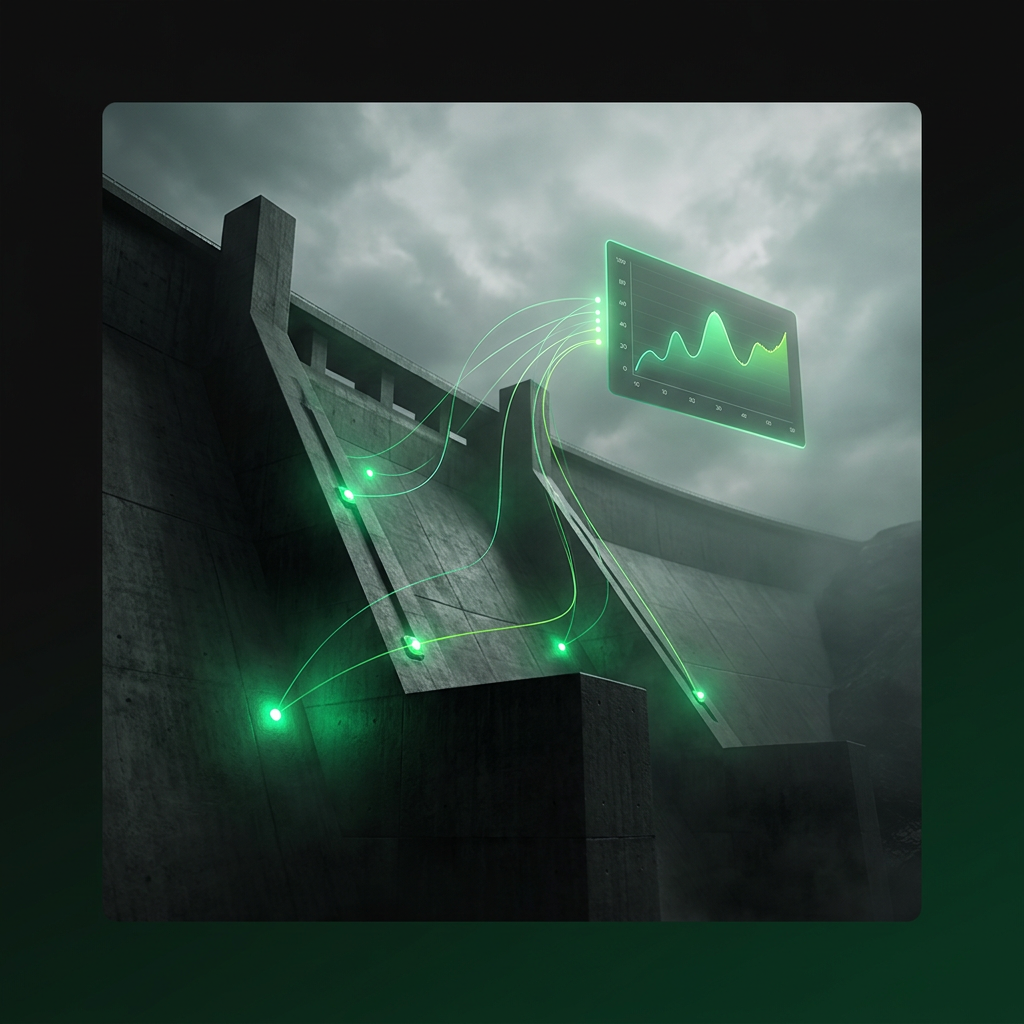
The failure of the Machhu II dam in 1979 remains one of the most significant hydrological disasters in Indian history, underscoring the catastrophic potential of inadequate seepage control and structural oversight. According to the Central Water Commission (CWC), India operates over 5,745 large dams, with hundreds more under construction, many of which are surpassing their 50-year design life. The enactment of the Dam Safety Act 2021 has transitioned dam safety monitoring from a recommended practice to a statutory mandate, requiring every dam owner to establish a dedicated dam safety unit and implement comprehensive instrumentation programs.
Structural health monitoring for hydraulic structures involves the precise measurement of pore water pressure, seepage discharge, internal deformation, and seismic response. Adhering to IS 7495 and CWC guidelines ensures that the data collected is sufficient for evaluating the Factor of Safety (FoS) against piping, slope instability, and structural cracking. This guide examines the technical requirements for a dam monitoring system that meets the rigorous standards of the National Committee on Dam Safety (NCDS).
Regulatory Framework: Dam Safety Act 2021 and CWC Mandates
The Dam Safety Act 2021 provides the legal framework for the surveillance, inspection, operation, and maintenance of specified dams to prevent dam failure-related disasters. Under this Act, the National Dam Safety Authority (NDSA) and State Dam Safety Organizations (SDSO) oversee compliance. For engineers, the primary technical directive is the mandatory installation of hydro-meteorological and seismological stations at every large dam site. The Act stipulates that any vulnerability identified during pre-monsoon or post-monsoon inspections must be addressed through data-backed remedial measures.
CWC guidelines emphasize the importance of 'instrumentation-based health profiles.' This involves the integration of manual observations with automated data acquisition systems (ADAS). The objective is to monitor parameters that indicate the structural integrity of the dam, such as uplift pressure in gravity dams and pore pressure in earthen embankments. Failure to maintain a functional dam safety monitoring program can lead to significant legal liabilities for the implementing agency or EPC contractor.
Piezometric Monitoring and Seepage Analysis
Pore water pressure is the most critical variable in assessing the stability of embankment dams. High pore pressure reduces the effective stress within the soil matrix, potentially leading to shear failure. The vibrating wire piezometer is the industry standard for this application due to its long-term stability and resistance to moisture ingress. These sensors operate on the principle of frequency change in a tensioned wire, which is unaffected by cable resistance or signal attenuation over long distances.
In concrete gravity dams, uplift pressure at the base must be monitored to ensure it does not exceed the design assumptions specified in IS 6512. Uplift pressure cells are typically installed at the contact interface between the dam base and the foundation rock. Excessive uplift can lead to the instability of the dam monolith against sliding or overturning. Seepage monitoring, often conducted using V-notch weirs equipped with ultrasonic level sensors, provides a secondary verification of the dam's internal health. A sudden increase in seepage volume or turbidity is a primary indicator of internal erosion or piping.
Deformation and Settlement Instrumentation
Internal and external deformations provide physical evidence of structural distress. For earthen dams, vertical settlement and lateral movement are monitored using magnetic settlement systems and inclinometers. Inclinometer casings are installed through the dam body into the foundation to measure the horizontal displacement profile. This is vital for detecting deep-seated circular slips in the downstream or upstream slopes.
For concrete dams, joint meters and strain gauges are deployed to monitor the behavior of construction joints and the response of the concrete mass to thermal loading and reservoir levels. Multi-point borehole extensometers (MPBX) are utilized in the foundation and abutments to monitor rock mass deformation. These instruments provide data in millimeters (mm) with high resolution, allowing engineers to distinguish between seasonal elastic movements and permanent plastic deformations that may signal impending failure.
Seismic and Dynamic Response Monitoring
India is divided into four seismic zones as per IS 1893, and many large dams are located in high-risk Zone IV and V regions. The CWC mandates the installation of strong-motion accelerographs and peak-recording accelerometers at the base, gallery, and crest of dams exceeding specific height thresholds. These instruments record ground acceleration in m/s2 during seismic events.
Post-earthquake analysis involves comparing the recorded peak ground acceleration (PGA) with the Design Basis Earthquake (DBE) and Maximum Credible Earthquake (MCE) parameters. Real-time dynamic monitoring allows for the immediate assessment of structural integrity following a tremor, enabling authorities to make informed decisions regarding reservoir drawdown or emergency evacuations. The integration of these sensors into a centralized dam monitoring system ensures that data is available to decision-makers within seconds of an event.
Automated Data Acquisition and Digital Integration
Manual data collection is increasingly being replaced by Automated Data Acquisition Systems (ADAS) to eliminate human error and provide high-frequency sampling. Modern DAQ units utilize SDI-12 or RS-485 interfaces to communicate with a variety of geotechnical sensors. The data is then transmitted via cellular, satellite, or LoRaWAN networks to a centralized cloud platform. This transition is aligned with the CWC's push for the Digital Twin approach in infrastructure management.
Digital Twin technology, as explored in research centers like the MIT-WPU Excellence Centre, allows for the creation of a virtual replica of the dam. By feeding real-time sensor data into finite element models (FEM), engineers can predict how the structure will behave under extreme flood conditions or seismic loads. This proactive approach to dam safety monitoring moves beyond reactive maintenance to predictive intelligence, significantly reducing the risk of catastrophic failure.
Comparison of Dam Monitoring Technologies
| Parameter | Manual Instrumentation | Automated (Vibrating Wire) | Fiber Optic (FOS) |
|---|---|---|---|
| Data Frequency | Weekly/Monthly | Real-time (Minutes) | Continuous (Distributed) |
| Accuracy | Subject to human error | High (0.1% FS) | Very High |
| Longevity | High (Simple mechanical) | Excellent (Hermetically sealed) | Moderate (Fragile cables) |
| Signal Transmission | N/A | Up to 2km without loss | Up to 20km |
| Cost Efficiency | Low initial, high O&M | Balanced for large dams | High initial investment |
| Compliance Level | Basic (Pre-2021) | Standard (DSA 2021) | Advanced/Research |
Compliance Checklist for Dam Authorities
To ensure compliance with the Dam Safety Act 2021 and CWC guidelines, dam authorities should verify the following technical requirements:
- Establishment of a dedicated Dam Safety Unit (DSU) with qualified geotechnical and structural engineers.
- Installation of vibrating wire piezometers in the core, chimney drain, and downstream casing of embankment dams.
- Deployment of uplift pressure cells and V-notch weirs for concrete gravity dams.
- Implementation of a seismological station for dams located in Seismic Zone III, IV, or V.
- Annual calibration of all electronic sensors and DAQ units to maintain data integrity.
- Development of an Emergency Action Plan (EAP) based on dam break analysis and real-time sensor thresholds.
Download compliance guide
Ensure your infrastructure meets the latest regulatory standards. Our technical team provides end-to-end support for dam instrumentation, from sensor selection to real-time dashboard integration. For detailed specifications on VW sensors or to discuss a compliance audit for your project, contact our engineering team today.
Frequently Asked Questions
Q: What is the primary objective of dam safety monitoring?
A: Dam safety monitoring is the systematic collection and analysis of data regarding the structural and hydraulic behavior of a dam to ensure its continued integrity. It aims to detect early signs of distress, such as excessive seepage or deformation, allowing for timely intervention to prevent catastrophic failure and ensure compliance with the Dam Safety Act 2021.
Q: How does the Dam Safety Act 2021 impact existing dam operations?
A: The Dam Safety Act 2021 mandates that all specified dams undergo regular inspections, establish instrumentation programs, and develop Emergency Action Plans (EAPs). It shifts the responsibility of safety to the dam owners, requiring them to maintain a functional dam safety unit and report data to the National Dam Safety Authority to mitigate risks to life and property.
Q: Why are vibrating wire sensors preferred for dam instrumentation?
A: Vibrating wire sensors are preferred because they provide high long-term stability and are relatively immune to electrical noise and signal degradation over long cable lengths. In the harsh, high-moisture environments of dams, their hermetically sealed design ensures reliability for decades, which is essential for monitoring slow-evolving structural changes in large-scale hydraulic infrastructure.
Q: What role does pore water pressure play in dam stability?
A: Pore water pressure is the pressure of water held within the soil or rock pores of a dam's structure or foundation. Excessive pore pressure reduces the effective stress and shear strength of the material, which can lead to slope instability or piping. Monitoring this parameter using piezometers is critical for evaluating the factor of safety against failure.
Q: What is an Automated Data Acquisition System (ADAS) in dam monitoring?
A: An Automated Data Acquisition System (ADAS) is a centralized electronic system that automatically collects, processes, and transmits data from various geotechnical sensors installed in a dam. By providing real-time data and automated alerts, an ADAS eliminates manual reading errors and allows for immediate response to structural anomalies or extreme weather events.