Learn what structural health monitoring of bridges means, what to check in an inspection, and which sensors capture real data. Expert guide by Geolook.
techonology
Bridge Inspection vs Structural Health Monitoring: What Every Asset Owner Must Know
Team GeolookApril 3, 2026 12 min read
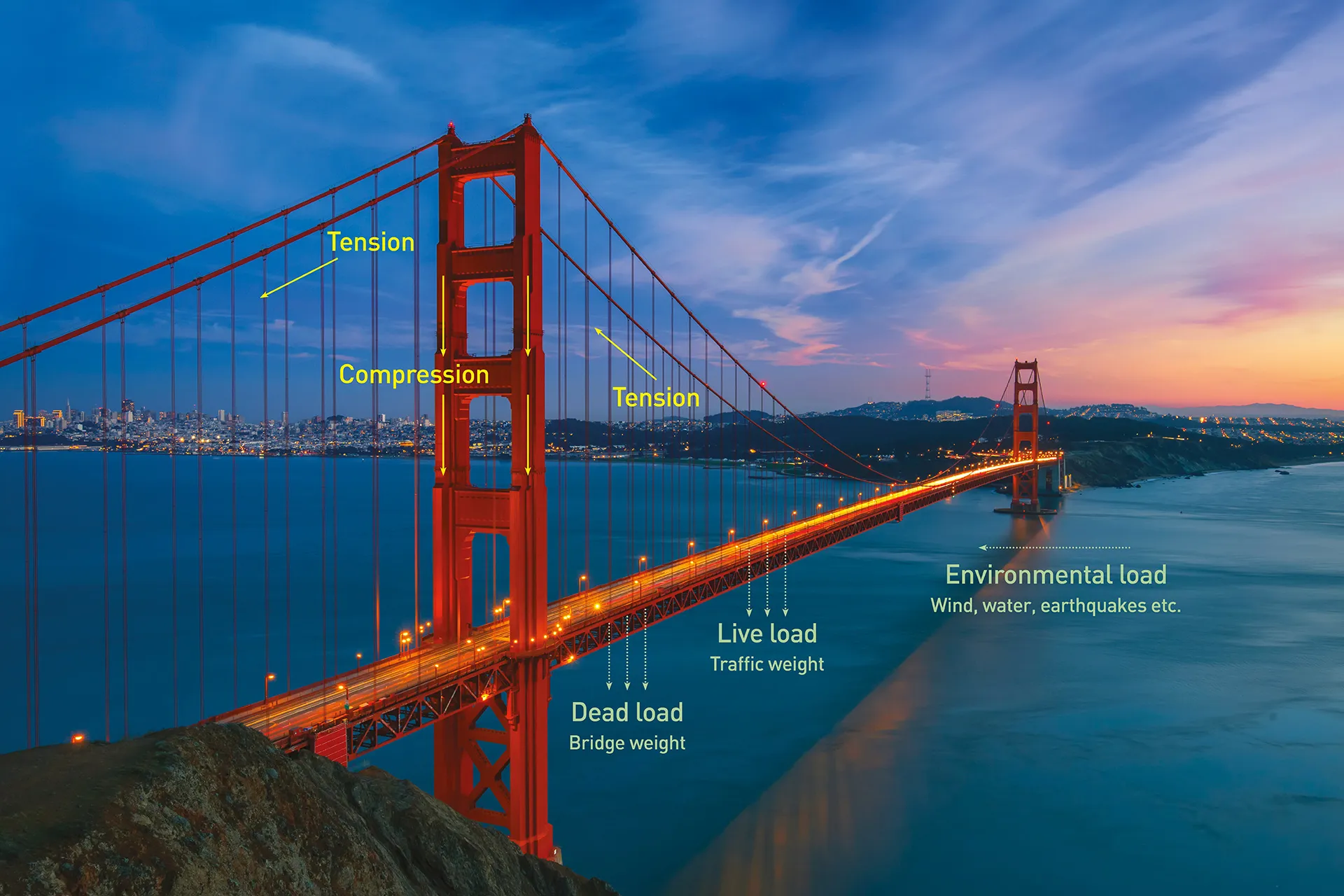
Why Every Bridge Needs More Than a Visual Check
A bridge doesn't fail because no one looked at it. It fails because no one detected what the eye couldn't see — the micro-crack propagating inside a concrete pier, the cable tension drifting by three percent after a monsoon, the bearing plate corroding below the deck surface.
Traditional inspection tells you what a bridge looks like at a single point in time. Structural health monitoring tells you how a bridge is behaving — continuously, under load, in real weather conditions, against its own historical baseline. For any critical infrastructure asset, the difference between those two approaches is the difference between reactive maintenance and intelligent asset management.
This guide answers the most searched questions on bridge inspection and structural health monitoring, with enough depth to be useful for engineers and decision-makers alike.
What Is Structural Health Monitoring of Bridges?
Structural health monitoring (SHM) of bridges is the continuous or scheduled acquisition, processing, and interpretation of sensor data to assess a structure's condition, detect damage, and support maintenance decisions — in real time or near real time.
Unlike a visual inspection carried out every one or two years, an SHM system operates around the clock. Sensors embedded in or attached to critical structural members measure physical parameters — strain, vibration, displacement, tilt, temperature, and more — and transmit that data to a central platform for analysis.
The output is not just a data log. A well-configured SHM system provides anomaly detection, trend analysis, and condition ratings that inform maintenance schedules, load management decisions, and long-term asset strategy.
How SHM Differs From Traditional Bridge Inspection
|
Parameter |
Visual / Manual Inspection |
Structural Health Monitoring |
|
Frequency |
Every 1–2 years |
Continuous / real-time |
|
Coverage |
Surface-visible defects |
Internal & subsurface behavior |
|
Detection capability |
Cracks >0.2mm visible to inspector |
Micro-deformation, fatigue onset |
|
Data output |
Condition rating report |
Live sensor feed + analytics |
|
Response time |
Weeks (post-inspection report) |
Immediate alerts via thresholds |
|
Load data captured |
No |
Yes — under actual traffic loads |
|
Integration with AI/ML |
No |
Yes — pattern recognition, anomaly flags |
|
Cost basis |
Periodic capex per inspection |
System capex + low opex over lifecycle |
What to Check in a Bridge Inspection
A bridge inspection checks structural elements, deck condition, bearings and expansion joints, drainage systems, sub-structure integrity, scour around foundations, and signs of corrosion, cracking, deformation, or material deterioration across all primary and secondary load-bearing components.
Structural Superstructure Elements
This includes girders, beams, trusses, arches, and cables. Inspectors look for fatigue cracks at welded connections, section loss from corrosion, deformation, and any deviation in camber or alignment.
Deck and Wearing Surface
The deck is the most directly load-exposed component. Checks include cracking patterns, spalling, rebar exposure, delamination, potholing, and the condition of waterproofing membranes.
Bearings, Joints, and Drainage
Bearings that are seized, corroded, or laterally displaced transfer unintended loads into the structure. Expansion joints, if clogged or cracked, trap water. Drainage systems that fail concentrate moisture at vulnerable points.
Sub-Structure and Foundations
Piers and abutments are checked for cracking, settlement, and scour — the erosion of soil around foundation elements, which is one of the leading causes of bridge collapse worldwide. Where underwater elements are present, specialist underwater inspection or sonar monitoring is required.
What Are the 4 Types of Bridge Inspections?
The four primary bridge inspection types are: (1) Routine Inspection, (2) In-Depth Inspection, (3) Special or Damage Inspection, and (4) Fracture Critical Member Inspection. Each serves a different purpose and involves different levels of access, equipment, and expertise.
1. Routine Inspection
Conducted every 12–24 months, a routine inspection is a systematic, hands-on examination of all visible components. It uses the naked eye, binoculars, and simple tools. It produces an overall condition rating and flags items for follow-up. Most national inspection programs are anchored around this type.
2. In-Depth Inspection
An in-depth inspection goes where routine inspection cannot. Inspectors use access equipment — under-bridge vehicles, scaffolding, rope access — to examine specific components up close. It is typically triggered when a routine inspection identifies a concern or when a bridge reaches a certain age or load threshold. Non-destructive testing (NDT) methods such as ground-penetrating radar, ultrasonic pulse velocity, and half-cell potential testing are often deployed.
3. Special / Damage Inspection
A special inspection is unscheduled and event-driven. After a flood, earthquake, vehicle collision, fire, or any other event that may have stressed the structure, a special inspection confirms the extent of damage and determines whether the bridge is safe for continued use.
4. Fracture Critical Member (FCM) Inspection
A fracture critical member is a steel element in tension whose failure would result in partial or total collapse with no redundant load path. FCM inspections are highly targeted, typically annual, and require close-up physical contact with the member. Bridges with FCMs carry a significantly higher inspection obligation and are the clearest candidates for SHM supplementation.
Why Periodic Inspection Alone Is No Longer Sufficient
Bridge inspection standards were designed in an era when traffic volumes were lower, spans were shorter, and the cost of instrumentation was prohibitive. Three things have changed.
First, load intensity has increased dramatically. Many bridges carry traffic loads well above their original design parameters — especially on national highways and railway corridors. The damage from cyclic overloading accumulates between inspections and is invisible until it manifests as a detectable defect.
Second, climate events are intensifying. A bridge that was designed for a 1-in-100-year flood now faces those conditions far more frequently. Real-time monitoring of scour, abutment movement, and structural response during flood events provides data that no inspection cycle can replicate.
Third, the consequences of failure have grown. Urban density, rail corridor criticality, and interdependency of infrastructure networks mean a single bridge failure has cascading effects on logistics, emergency response, and economic continuity. The cost of one missed failure event dwarfs decades of monitoring investment.
What Are the Steps of Structural Health Monitoring?
The steps of structural health monitoring are: (1) sensor placement and network design, (2) data acquisition and edge processing, (3) data transmission and cloud or local storage, (4) analysis and AI-assisted pattern recognition, and (5) alert generation and decision support output.
- Step 1: Sensor Placement and Network Design
Effective SHM begins before a single sensor is installed. A structural engineer reviews drawings, identifies critical sections (high-stress zones, fracture-critical members, areas of known concern), and determines what parameters need measurement. Sensor type, quantity, placement, and cabling or wireless topology are then designed around those requirements.
A poorly designed sensor network generates high data volume with low diagnostic value. Sensor placement strategy is arguably the most important step in the entire SHM process.
- Step 2: Data Acquisition and Edge Processing
Raw sensor signals — analog or digital — are captured by data acquisition units (DAQs). Modern edge DAQs do more than log data: they apply signal conditioning, apply sampling strategies (continuous, triggered, or scheduled), and perform local computation to reduce data volume before transmission. This is especially important for remote sites with limited connectivity.
- Step 3: Data Transmission and Storage
Data travels from the edge to a central repository via wired connections, cellular (4G/5G), fiber, or satellite links depending on site conditions. Data is stored in time-series databases structured for rapid querying and long-term trend analysis. Redundancy and cybersecurity protocols apply here.
- Step 4: Analysis, Pattern Recognition, and AI Processing
This is where raw numbers become structural intelligence. Analysis engines compare current readings against baseline profiles, identify anomalies, calculate structural health indices, and apply ML models trained on historical data to forecast deterioration. Modal analysis, for instance, detects changes in natural frequencies that indicate stiffness loss — often a leading indicator of structural degradation.
- Step 5: Alert Generation and Decision Support
Threshold-based alerts notify maintenance teams when a reading exceeds predefined limits. TARP (Traffic and Alert Response Protocol) logic can escalate alerts to speed restrictions, closures, or immediate inspection orders depending on severity. Decision support dashboards give engineers a visual, queryable view of structural health across a bridge fleet.
Real-World Example of Structural Health Monitoring
A widely cited SHM example is instrumentation of a cable-stayed bridge with accelerometers and strain gauges to monitor dynamic response under wind and traffic loading, with modal analysis identifying a 4% frequency shift after a seismic event — triggering an in-depth inspection that confirmed cable anchor degradation before any visible damage appeared.
SHM on a Cable-Stayed Bridge: A Practical Scenario
Consider a major cable-stayed bridge carrying highway traffic across a river in a seismically active region. After commissioning, the owner installs the following:
- Accelerometers at deck midspan and towers to track natural frequencies and wind-induced motion
- Strain gauges on stay cables and main girder sections to monitor tension and load distribution
- Displacement transducers at expansion joints and bearings to detect settlement or drift
- Tiltmeters on pylon foundations to detect sub-structure movement
- Corrosion sensors on cable anchorage zones vulnerable to moisture infiltration
- Temperature sensors to correct
After a moderate seismic event (Mw 4.8), the SHM platform flags a 4.2% reduction in the first natural frequency of the north tower — a known indicator of stiffness reduction. An in-depth inspection is triggered within 48 hours rather than waiting 18 months for the next scheduled inspection. Engineers find early-stage fatigue cracking at a cable anchor socket and complete targeted repairs before any load restriction is needed.
This is the SHM value proposition in practice: not replacing the inspection, but deciding exactly when and where to inspect — and doing so before failure becomes visible.
What Are the Five Major Types of Sensors Used in Structural Health Monitoring?
The five major sensor types used in SHM are: (1) strain gauges, (2) accelerometers, (3) displacement sensors, (4) tiltmeters / inclinometers, and (5) environmental sensors — including crack meters, corrosion sensors, and temperature sensors. Each measures a different physical parameter relevant to structural behaviour.
Strain Gauges
Strain gauges measure the deformation of a structural member under load — expressed as micro-strain. Vibrating wire strain gauges are widely used in civil applications because of their long-term stability, immunity to signal degradation over cable runs, and ability to operate in harsh environments. They are placed on girders, stay cables, piles, and tunnel linings to track load history and fatigue accumulation.
Accelerometers
Accelerometers measure the vibration response of a structure — typically expressed in g or mm/s². In bridge monitoring, accelerometers placed at strategic deck and tower locations capture dynamic response data. Modal analysis of this data reveals natural frequencies, damping ratios, and mode shapes. A shift in these parameters over time indicates a change in stiffness — often the earliest detectable signature of structural damage.
Displacement Sensors / LVDTs
Linear Variable Differential Transformers (LVDTs) and draw-wire displacement sensors measure relative or absolute movement — deflection under load, settlement, joint opening, or bearing displacement. In bridges, mid-span deflection under traffic loading is a critical performance indicator. Cumulative displacement trends reveal long-term deterioration of support conditions.
Tiltmeters / Inclinometers
Tiltmeters measure angular displacement — the rotation of a structural element from its original position. In bridge monitoring, tiltmeters on pier caps, abutments, and pylons detect sub-structure movement that may indicate foundation settlement or scour-induced instability. They are especially important for monitoring approach embankments on soft ground.
Environmental and Condition Sensors
This group covers the parameters that affect structural behaviour without being structural themselves. Temperature sensors correct for thermal expansion in strain and displacement data. Crack meters (vibrating wire or optical) quantify crack width and track progression. Corrosion sensors measure corrosion potential and rate in reinforced concrete or steel structures exposed to chlorides. Piezometers monitor pore water pressure in embankments and foundation soils.
Which Sensors Are Specifically Used in Bridge Monitoring?
Bridge monitoring systems typically use strain gauges, accelerometers, displacement sensors, tiltmeters, crack meters, corrosion sensors, temperature sensors, piezometers, GNSS units, and load cells — selected according to the bridge type, span, material, and monitoring objective.
|
Sensor |
What It Measures |
Bridge Application |
|
Vibrating Wire Strain Gauge |
Micro-strain in steel or concrete |
Girders, stay cables, piles, decks |
|
Accelerometer (MEMS / Piezo) |
Vibration, dynamic response, seismic |
Deck, tower, cable anchorage zones |
|
LVDT / Draw-Wire Sensor |
Linear displacement / deflection |
Mid-span, joints, bearings |
|
Tiltmeter / Inclinometer |
Angular rotation |
Piers, abutments, pylons, foundations |
|
Crack Meter (VW / Optical) |
Crack width and rate of change |
Deck cracks, pier cracks, joints |
|
Corrosion Sensor |
Corrosion rate / potential |
Rebar zones, cable anchorage, piers |
|
Temperature Sensor (RTD / TC) |
Ambient and structural temperature |
Deck, girder, cable for correction |
|
Piezometer |
Pore water / hydraulic pressure |
River piers, foundation soils |
|
GNSS / Total Station |
3D absolute position drift |
Long-span bridges, approach embankments |
|
Load Cell / Weigh-in-Motion |
Live load intensity |
Approach span, support points |
What Is the Purpose of System Monitoring in Infrastructure?
The purpose of structural health monitoring as a system is to provide continuous, evidence-based visibility into infrastructure condition — enabling risk-informed maintenance decisions, extending asset life, optimising inspection resources, and preventing failures before they become emergencies.
Beyond individual sensors or alerts, SHM as a system delivers five distinct functions:
- Safety assurance: Confirms that live structural behaviour stays within design parameters under actual operating conditions
- Early warning: Detects deterioration trends before they reach critical thresholds, enabling planned rather than emergency intervention
- Load management: Quantifies the actual load history of a bridge, informing decisions about load restrictions for ageing structures
- Maintenance optimisation: Replaces calendar-driven inspection with condition-driven maintenance — directing resources where the data shows they are needed
- Lifecycle intelligence: Builds an evidence base for asset renewal decisions, insurance assessments, and regulatory compliance
For railways, highways authorities, and urban infrastructure managers maintaining large bridge fleets, a centralised monitoring platform that aggregates data from multiple structures is the foundation of modern asset management strategy.
Project inquiry
Talk to a Geolook™ specialist
Share your monitoring requirement and our team will help identify the right next step.
By submitting, you agree that Geolook™ may contact you about this inquiry. Your details are not added to a marketing list.