VW Load Cell
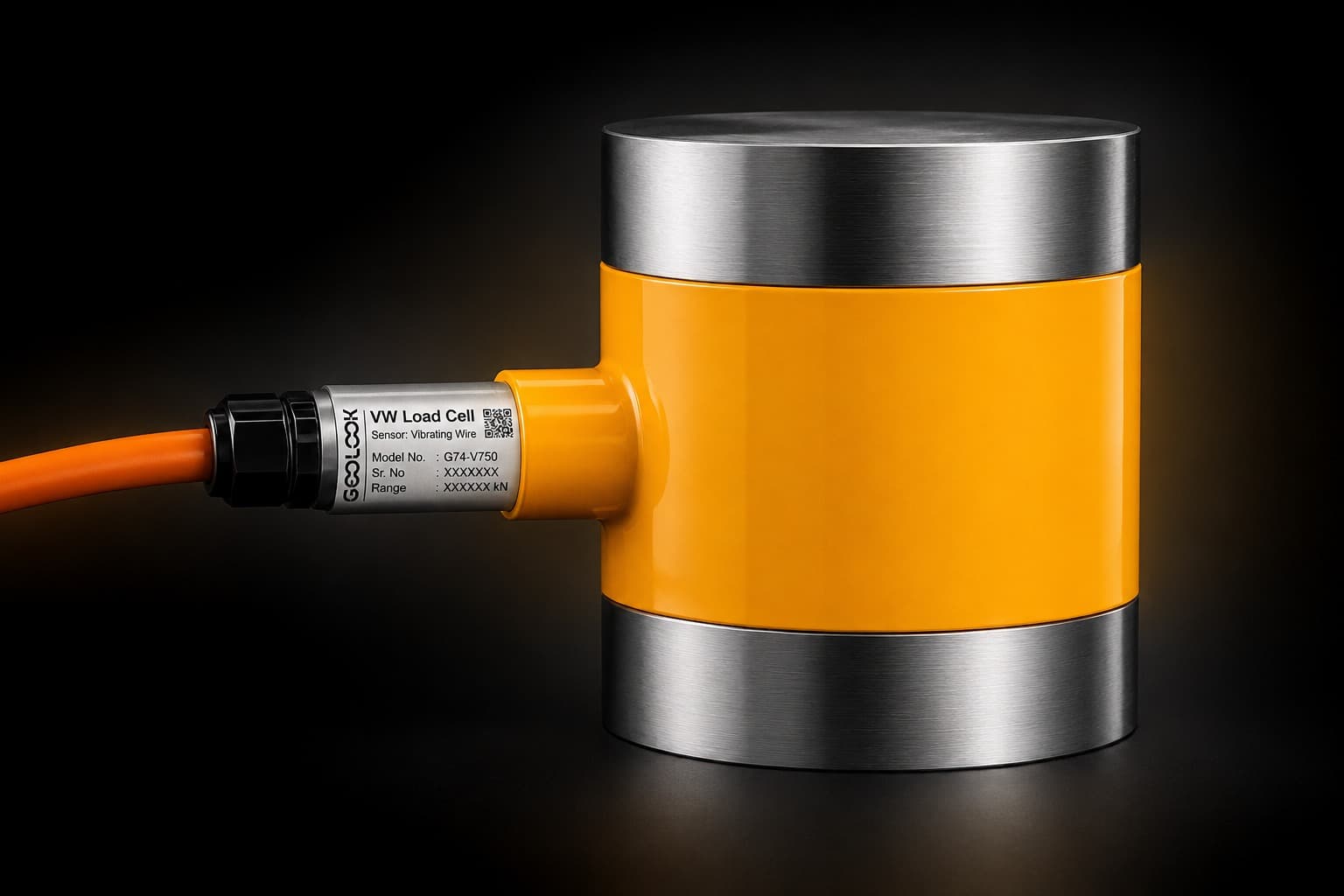
High-capacity center-hole load cell for monitoring forces in ground anchors, rock bolts, and tiebacks.
Overview
High-capacity center-hole load cell for monitoring forces in ground anchors, rock bolts, and tiebacks.
The Geolook Vibrating Wire Load Cell is designed to measure tensile or compressive loads in rock bolts, tiebacks, foundation anchors, and tunnel arch supports. It is an essential safety device for verifying that retaining structures are holding the loads they were designed for. The cell features a high-strength alloy steel cylinder with a central hole, allowing it to pass over a tie-rod or tendon. Inside the cell, 3 to 6 vibrating wire strain gauges are equally spaced around the circumference. This multi-sensor configuration allows the instrument to average the readings, effectively canceling out errors caused by eccentric (uneven) loading or bending moments.
★ Benefits & Features
- 3 to 6 internal VW sensors for high accuracy
- Compensates for eccentric / uneven loading
- High-strength alloy steel body
- Center-hole design for rock bolts & anchors
- Long-term stability (Zero drift)
- Frequency signal immune to long cable runs
- Rugged, waterproof construction (IP68)
Product Gallery
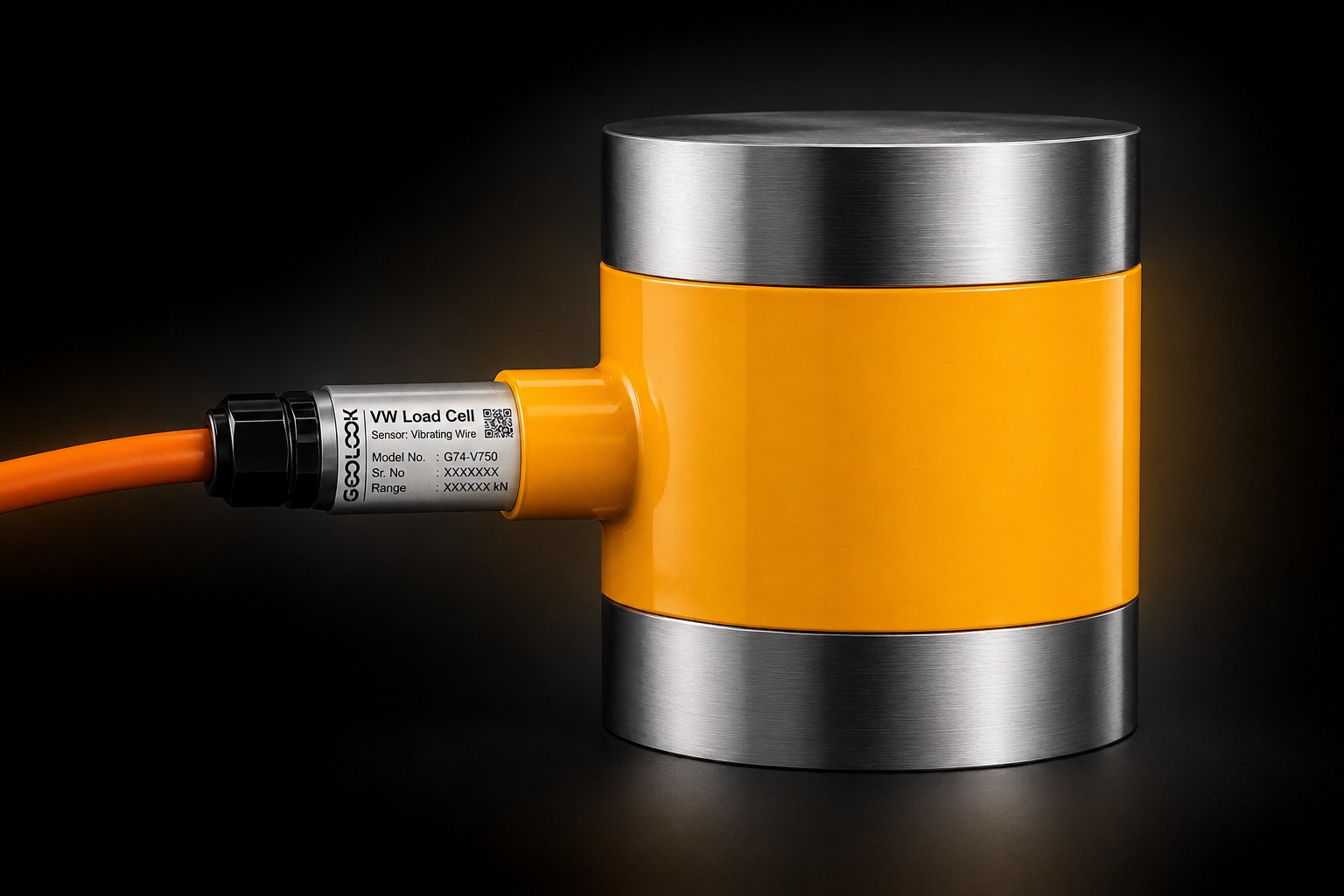
Explore the device from every angle
Detailed Description
How it Works
As load is applied to the cell (e.g., by tightening a rock bolt nut), the steel cylinder compresses slightly. This microscopic compression is transferred to the internal vibrating wire elements.
The tension in the wires decreases, changing their resonant frequency. The readout unit measures these frequencies and converts them into load units (kN or Tons). Because the relationship between strain and load is linear for steel, the measurement is highly accurate.
Solid vs. Annular Cells
While the G74-V750 is typically an 'Annular' (center-hole) cell for passing rods through, we also offer 'Solid' center cells.
- Annular (Center-Hole): For tiebacks, rock bolts, and ground anchors.
- Solid Center: For placing under compressive struts, columns, or tunnel arch footings where the load is applied directly to the top face.
Handling Eccentric Loads
In the real world, load is rarely applied perfectly straight. A slight misalignment of the anchor plate can cause one side of the load cell to compress more than the other.
A single-sensor cell would give a completely wrong reading in this scenario. The G74-V750 uses 3 to 6 sensors spaced around the ring. By averaging their readings, the system mathematically cancels out the bending effects, providing the true total load acting on the anchor.
How it Works
As load is applied to the cell (e.g., by tightening a rock bolt nut), the steel cylinder compresses slightly. This microscopic compression is transferred to the internal vibrating wire elements.
The tension in the wires decreases, changing their resonant frequency. The readout unit measures these frequencies and converts them into load units (kN or Tons). Because the relationship between strain and load is linear for steel, the measurement is highly accurate.
Handling Eccentric Loads
In the real world, load is rarely applied perfectly straight. A slight misalignment of the anchor plate can cause one side of the load cell to compress more than the other.
A single-sensor cell would give a completely wrong reading in this scenario. The G74-V750 uses 3 to 6 sensors spaced around the ring. By averaging their readings, the system mathematically cancels out the bending effects, providing the true total load acting on the anchor.
Solid vs. Annular Cells
While the G74-V750 is typically an 'Annular' (center-hole) cell for passing rods through, we also offer 'Solid' center cells.
- Annular (Center-Hole): For tiebacks, rock bolts, and ground anchors.
- Solid Center: For placing under compressive struts, columns, or tunnel arch footings where the load is applied directly to the top face.
Available Models
Models Uploading Soon
We are currently updating the specific model configurations and technical datasheets for this product category.